Whatever Needs Defending Was Never Truly Strong!
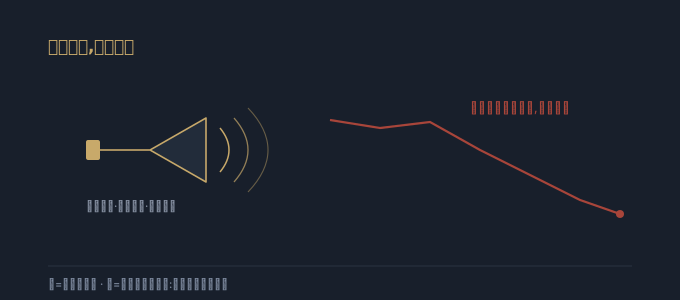
Whatever needs defending was never truly strong.
The moment the market fell today, the screen filled with defense. The Shenzhen and ChiNext indices had dropped over 3% the day before and spiked-and-faded again today, and out came the voices in a dense wave: the top ten brokerages chorused “no need to overworry about the index drop,” experts said “the long-term uptrend is intact,” institutions said “the current pullback has already priced in excessive pessimism” and “the correction is entering its final stage,” notes called it “a chance for balanced positioning.” Different titles, one single motion — using language to frantically underwrite a price that is falling.
But the harder a thing must lean on talk to stand, the more that talk is the proof it cannot stand. When did you last see the sunrise need someone to defend it? Does water running downhill require a research note to maintain its trend? A truly strong thing delivers in silence; it stands on its own and needs no mouth to speak for it. It is precisely the things that cannot stand — the suspended, the teetering, the ready-to-collapse — that must be named, defended, talked up, and propped over and over. Where language is densest, unease runs deepest. The louder the shouting, the emptier the ground beneath.
Behind this lies the most merciless feature of the market as a spontaneous order: it is a self-organizing thing computed by everyone together, and it obeys no one’s words. You can talk, you can prop, you can defend with every handsome phrase — but every sentence you utter gets voted on, ballot by ballot, by countless hands with real money. When price is already running with the trend, the talk looks miraculous — but that is the fox borrowing the tiger’s menace: the tiger is roaring, so the fox dares strut in front. Once the trend turns and the tiger walks off, the fox can shriek its orders and the beasts scatter all the same. Voice never creates force; it is only when force is present that voice sounds forceful. Mistaking the efficacy of talk-with-the-trend for a magic in the talk itself is the commonest, and costliest, illusion.
In this sense, talk is a mirror that unmasks. What it reflects is never how strong the defended thing is, but how frightened the defender is. The real thing stands on its own; it does not argue, and it needs no one to argue for it. What must be maintained, defended, propped up again and again is, more often than not, already hollow at heart. False strength must be held up by a voice, one utterance after another, and the moment the voice stops it is exposed; real strength rests quietly where it is — whether you speak of it or not, it is there. The line between true and false often hides right here: the true is silent, the false is loud.
In the end, people carry an ancient impulse to command the world with language, believing that a thing, said loudly and often enough, will come true. This is a deep pride — mistaking one’s own voice for the order of the world. But the world’s order is not written by voices; it runs coldly, silently, of itself, accepting no defense and heeding no shouting. What we can truly do is never to wave a flag for a price; it is to grow quiet, step back, and look at whether it can stand at all. Whether a thing is truly strong is decided not by how many are shouting for it, but by this: when all the shouting stops, is it still there.
Whatever needs to be said loudly to hold — the very moment it is said loudly, it has already ceased to hold.
SECURE PAYMENT VIA STRIPE
Subscribe: $50 annual pass unlocks every paid article on this site for one year
Go deeper: Ko-fi members get a weekly members-only deep dive, from $3/month Become a member →