On Friday, September 11, the Implied Odds of a Rate Hike at the September 16 Fed Meeting Got Pushed to Near 90 Percent — and the Same Morning, US Stocks Closed Up Nearly 1 Percent, Which Financial Headlines Called 'Odd.' Do the Arithmetic and It Wasn't Odd at All: What Cooled That Day Was Never Inflation, It Was Oil — and What Rose Wasn't One Shared Conviction, It Was Two Machines That Never Compare Notes, Each Filing Its Own Verdict!
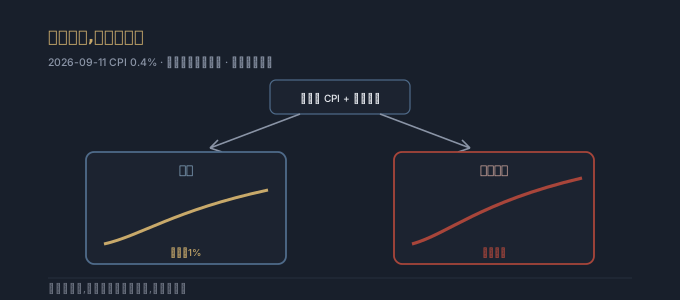
The strangest thing that day wasn’t that stocks rose — it’s that they rose on the very morning hike odds got pushed past 90%. The real question isn’t “which one went up and which went down” — it’s that the reason stocks rose and the reason hike odds rose were never the same reason to begin with. And at bottom, the problem that day wasn’t that somebody did the math wrong — it’s that there was never a single machine called “the market” doing the math in the first place. Two opposite verdicts got filed the same morning because two machines that were never asked to solve the same problem each turned in their own answer.
Friday, September 11, New York time: the moment August CPI hit the wire, financial coverage ran almost the same template — inflation wasn’t that bad, the overhang is lifted, stocks should breathe easy. By the close, all three major indexes really did close up, roughly 1% across the board, clawing back most of the week’s earlier losses. One outlet’s headline that day put it almost too neatly: a hike basically locked in, and stocks rose anyway — framed as the day’s genuine surprise. A tidier explanation followed close behind: a hike is actually good news, because it makes the central bank look credible and pulls long-run uncertainty forward and off the table, so the rally made perfect sense either way. What makes that story so appealing is exactly its flaw — an explanation flexible enough to rationalize a move in either direction was never explaining what actually happened that day. It’s explaining why the person telling it doesn’t want to admit they didn’t see it coming.
Lay the inflation ledger out flat, and the conclusion comes first: there’s nothing here worth a headline. Headline CPI rose 0.4% month over month, with the year-over-year figure still just north of 3% — almost exactly matching what forecasters had penciled in. Core CPI, stripping out food and energy, rose 0.3% — a hair above forecast, not wildly off, but nothing that reads as “cooling” either.
What actually swung hard that day sat in a different ledger. The odds rate futures assign to a hike at the September 16 meeting had climbed from under 40% three weeks earlier to just past 60% by earlier this week, then got pushed to near 90% the moment CPI hit the tape. Three weeks ago, most bets still leaned toward a hold or a cut. That morning, almost nobody was betting against a hike anymore.
Oil, meanwhile, was having its own busy morning: Brent crude spiked toward $110 a barrel intraday, then reversed hard in the hours before the close, sliding back to around $104 — the kind of swing where the morning’s worry about a pricier fill-up quietly took itself back before the trading day was out. Three separate ledgers churned through the same morning, which is exactly why it was so easy to narrate them as three faces of one cause.
Here’s the part that gets skipped: “the market” was never a single entity. Price is never dictated by any one person or any one data point — it’s the output of every participant’s pooled computing power, run through the network. But that pooled total was never one machine. It’s many ledgers that never compare notes, each closing its own books. The equities ledger weighs oil costs, earnings expectations, and risk appetite heavily in its inputs. The rate-futures ledger runs mostly on inflation prints, central-bank rhetoric, and jobs data. That same morning, oil happened to complete a sharp intraday round trip of more than 3% — an input that landed almost entirely on the equities ledger. What the rate-futures ledger actually digested was a CPI print that came in roughly as expected, with core running a shade hot. Two not-quite-identical events happened the same morning, two ledgers closed their books separately, and — unsurprisingly — produced two not-quite-identical answers. That’s not a contradiction. It’s distributed computation working exactly as spontaneous order is supposed to: no one sits at the center calling the shot, and each ledger only answers for the slice of input it was fed.
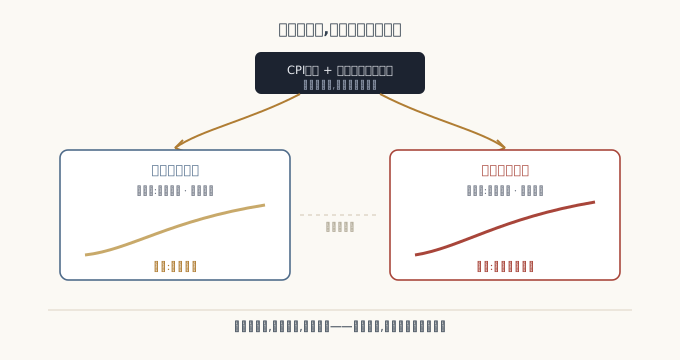
Run it backwards and it gets clearer. If “inflation cooled, the overhang lifted” were really the whole story that day, both ledgers should have exhaled at the same time — stocks rising, and the rate-futures ledger’s hike odds easing back down with them, since “how bad is inflation” and “should the Fed hike” are, underneath, the same question. Instead, the rate-futures ledger didn’t ease at all — it climbed steeper that day than it had all week. That’s the tell. What let the equities ledger exhale, start to finish, was never the substance of the inflation print — it was oil catching its breath. What kept the rate-futures ledger wound tight was the inflation print’s actual texture. The two ledgers didn’t reconcile that day not by accident — they were never solving the same problem to begin with.
That bill comes due eventually. If the September 16 meeting really delivers a hike, the price of borrowed money genuinely rises — and whatever relief the equities ledger banked that Friday on the back of one barrel of oil gets pulled back into the rate ledger’s master account and re-checked against reality. At bottom, the relief priced in that morning was resting on oil’s pullback, not on any actual handshake with the question of whether money is about to get more expensive. That handshake didn’t happen — it just got postponed to September 16.
People default to treating everything that happens on the same day as two sides of one coin — as if gains and losses both need a single unified explanation, as if “the market” were one referee nodding yes or shaking its head no. That’s a shortcut, and a lazy one: mistaking a coincidence in timing for a unity in cause, then reaching backward for a tidy-sounding line that stuffs two differently directed outcomes into one narrative. In that light, the “actually, a hike is bullish” rejoinder isn’t explaining the market at all — it’s comforting the people two separate ledgers just contradicted, who’d still like to keep believing in one coherent story.
A complex system never discounts its own arithmetic just because someone found a tidier explanation or a more satisfying story. It doesn’t care whether anyone can narrate two opposite outcomes as a single event — it only answers to its own inputs, ledger by ledger. Human pride keeps reaching for one grand narrative elegant enough to cover every case, collapsing a sprawling tangle of pooled computation into one comforting line: gains and losses both make sense. Order was never obligated to make itself convenient for that story. All it asks is that people be honest enough to tell which ledger answered which question.
"The market" was never a person who nods or shakes its head. It's many separately running machines that happened, on the same morning, to hand down two verdicts that look nothing alike.
SECURE PAYMENT VIA STRIPE
Subscribe: $50 annual pass unlocks every paid article on this site for one year
Go deeper: Ko-fi members get a weekly members-only deep dive, from $3/month Become a member →