The Dow Just Closed Its Fifth Straight Winning Month, and Everyone's Calling It Proof the Bull Market Is Bulletproof — the S&P and Nasdaq Only Just Crawled Out of Two Losing Months!
A streak is not a promise. It’s a scoreboard. A promise underwrites tomorrow. A scoreboard only records the games already played — the two look alike, but they do opposite jobs.
A claim is making the rounds: U.S. stocks just closed out a “five-month win streak,” proof the bull market’s foundation is solid and the rally has further to run. This is a classic case of cherry-picking — taking one lane’s result off a shared scoreboard and reading it as the verdict handed down by the entire field.
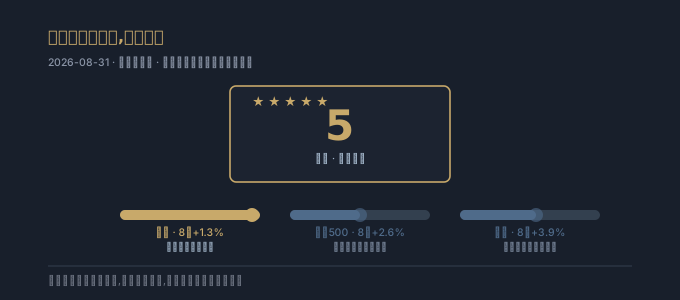
Beijing time’s early-morning close today tracks Wall Street’s Monday session, August 31 — which also happened to be the last trading day of the month. All three major indexes fell that day: the S&P 500 down 0.33%, the Nasdaq down 0.12%, the Dow down 0.70%. Whether the month’s final session closed green or red should be the least ambiguous fact available. And yet nearly every recap ran the same headline: a “winning August.”
What actually earns that headline is the full-month tally — and that tally splits cleanly in two. The Dow gained 1.3% in August, its fifth consecutive winning month. The S&P rose 2.6% and the Nasdaq 3.9% — numbers that look even better than the Dow’s on paper. But their own scorecards tell a different story: first positive month in three. Count back two more months, and both indexes had actually been in the red.
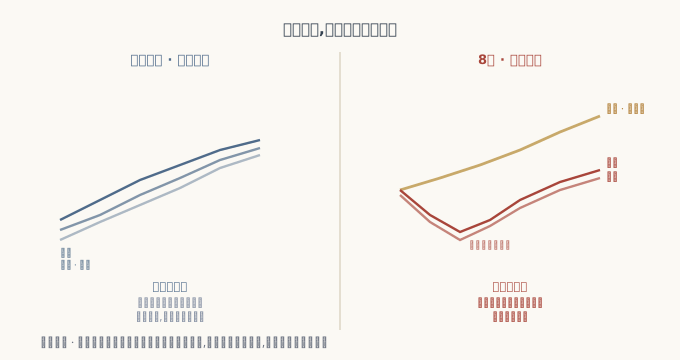
The three indexes splitting apart isn’t coincidence. It’s what their math is built to do. The Dow is price-weighted — whichever stock has the biggest sticker price carries the most weight. The S&P and Nasdaq are cap-weighted — whichever company is worth the most carries the most weight. In the same month, a batch of high-priced legacy blue chips can grind steadily higher and single-handedly deliver the Dow its fifth straight winning month, while the handful of giant tech and compute names that dominate the S&P and Nasdaq only need to wobble slightly to drag both indexes underwater. This was never one pool of capital reaching one verdict about one reality. It’s two different vote-counting methods, each arriving at its own separate answer. A spontaneous order never ships in bulk — it computes strictly according to its own weighting rules, one index at a time. The Dow’s five-month streak proves only that the companies sitting in the Dow’s own weight table have had five steady months. It proves nothing about whether every runner on the track is moving to the same beat.
What actually makes a streak dangerous isn’t the streak itself — it’s the moment someone starts using it as a reason to buy. Early in a trend, capital buys into an index’s components because it sees real earnings, real orders, real cash flow — distributed computing, each dollar run through its own math before it commits. But once the phrase “five-month streak” lands in a headline, it starts pulling in a different kind of money — capital that isn’t chasing earnings, it’s chasing “something that’s currently on a streak.” What draws this new money in isn’t that reality got better. It’s that the streak itself became credible enough to bet on. That money buys in, the price ticks up another notch, the streak extends into month six, and the loop starts feeding itself. At bottom, this is reflexivity in its plainest form: the streak attracts capital, and the capital extends the streak. The moment a streak starts recruiting its own new believers, what it’s computing is no longer what the companies are worth — it’s whether the scoreboard itself gets to stay bolted to the wall for one more month.
The same week, as it happens, spot bitcoin ETFs lost a streak of their own. Nine straight trading days of inflows had brought in more than $3 billion. Then on August 28, a single session saw $201.8 million walk out the door — and the nine-day run ended, cold, with no fresh piece of bad news required. All it took was one day where slightly more money wanted out than wanted in. What makes this genuinely interesting: zoom out to the full month, and bitcoin spot ETF inflows for August still stand as 2026’s strongest month to date. One day’s break in the chain and one month’s outsized strength are both true at once, and neither contradicts the other. Which is exactly the point — a streak’s length was never a tool for forecasting the next day. It’s just a running total that independent daily verdicts happen to stack up into. A good-looking total doesn’t mean tomorrow’s math has already been done for you.
An early-stage streak is coincidence — a pile of independent judgments happening to point the same direction. A late-stage streak is that coincidence turning into its own justification for buying, right up until the day the coincidence simply doesn’t need to continue, and the system erases the record without so much as a warning. There’s no single verdict handed down in between. Only day after day of separate, independent reconciliation — today’s math run fresh, tomorrow’s math run fresh again, with nobody owed a promise that momentum simply carries forward.
People are constitutionally unwilling to accept that every single day has to be recomputed from scratch, that no one gets to borrow tomorrow’s answer in advance. A streak sells well precisely because it repackages that chore — recomputing, every day, from nothing — into one reassuring sentence: the trend has already been confirmed. It lets people feel justified skipping the problem set that was due today. But a complex system never grants that exemption. It doesn’t care how many games you already won. It only asks one question: is anyone still willing to place a bet on today’s game.
A five-game streak sits on the scoreboard. It doesn’t walk itself into next month’s verdict.
The scoreboard only ever records the games already finished. The verdict still has to be earned in the one that hasn't started yet.
SECURE PAYMENT VIA STRIPE
Subscribe: $50 annual pass unlocks every paid article on this site for one year
Go deeper: Ko-fi members get a weekly members-only deep dive, from $3/month Become a member →