A K-Shaped Market Isn't Sorting Strength — It's Counting Cash!
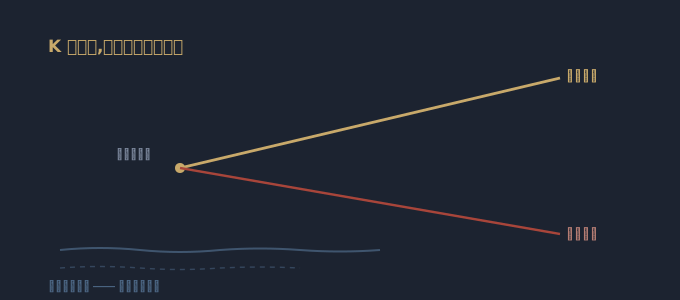
This half, the market’s favorite word is “K-shaped divergence”: AI-related names climb, traditional sectors stand still, the two lines splaying apart like the letter K. The mainstream reading is upbeat — this is the deepening of a great rotation from old to new, a triumph of structure, smart money rewarding the future and abandoning the past.
But divergence is never value stratifying. It is money getting scarcer.
When the tide comes in, good boats and bad rise together, and no one can tell which rides the swell better. Only when the tide goes out do you see who is beached and who still floats. Divergence is not the face of prosperity; it is the face of an ebbing tide. When everything in a market rises together, we call it ample liquidity; when only a few things still rise and the rest sit still, it is not because those few suddenly got better — it is because the water is no longer enough to irrigate everyone, and can only run to the few plots that best reinforce themselves.
So the fork of the K measures not “how much stronger the new economy is than the old.” It measures how much money is left in this market, and how choosy that money has become. When money is plentiful, everyone will pay for imagination — the rain falls on all. When money tightens, capital instinctively retreats into the narrowest opening that “still has a buyer, still moves up,” and huddles there for warmth. The fiercer the divergence, the stronger the winners — no. The fiercer the divergence, the less water there is to distribute — so little it can feed only a tiny handful. The steeper the upper arm of the K, the lower the water level, not the greater the boom.
Set the incoming and outgoing tide side by side and it is clear. When capital is abundant: increments everywhere → the lows get filled → a broad rally → divergence converges, and the K closes into a wide upward band. When capital contracts: increments only reach the strongest → the rest bleed out → only a few rise → divergence opens, the K splaying wider. In the same market, whether divergence converges or opens measures, fundamentally, not who is strong and who is weak, but whether the water in the invisible hand is rising or falling. In this sense, divergence is a reading of liquidity, not a ranking of value.
There is a reflexive trap hidden here too. The more a few names rise, the more they look like “validated winners,” the more they draw the remaining capital into the huddle; the huddle bids the price higher, and the higher price turns back to “prove” their strength — left foot on right foot, until the reason for rising becomes “it is rising” itself. The “strength” at this point is no longer strength computed from fundamentals; it is strength forced into concentration by shrinking liquidity. It looks like winner-take-all; in substance it is a huddle for survival after the water ran low. And the peak of the huddle is precisely the moment the last low patch has been filled and no new water can enter — at which point the upper arm of the K is not about to climb steeper, but about to go looking for its own true water level.
So do not read divergence as faith. It is closer to a thermometer — measuring not which track is greater, but whether this market’s water is still enough to go around. When everyone is praising the rising line inside the K-shaped split, the real question to ask is the other one: is that line too strong, or have the other lines simply run dry?
Divergence is not the market choosing the future. It is the market counting how much money is left in its hand.
A broad rally is the face of abundant money; divergence is the face of scarce money. The fork of the K measures not who is stronger, but whether there is still enough water to go around.
SECURE PAYMENT VIA STRIPE
Subscribe: $50 annual pass unlocks every paid article on this site for one year
Go deeper: Ko-fi members get a weekly members-only deep dive, from $3/month Become a member →