30-Year Treasury Yields Hit a 19-Year High: It Wasn't Government Crowding Out Business — It Was AI Crowding Out Government!
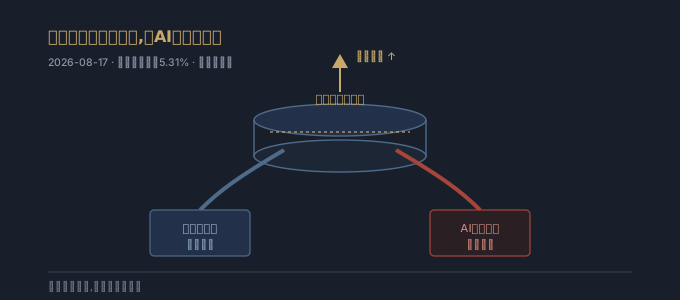
What’s strange about the 30-year Treasury hitting a 19-year high isn’t how far it climbed — it’s whose hand was on the lever that day. What should make you pause about “crowding out” getting dusted off again isn’t whether it’s real — it’s who’s actually getting crowded out this time. And what’s worth sitting with isn’t how much AI is going to cost this year — it’s that the money was never coming from a pool that belonged to AI alone.
Interest rates were never a price the central bank hands down. They’re a price every borrower in the room computes together — and the moment AI quietly pulled up a chair, who’s pricing the long end changed.
Start with what actually happened. U.S. markets that closed here in the small hours this morning were pricing in Monday, August 17, in New York. Equities were calm that day — the S&P 500 slipped just over half a percent, nothing that moved anyone. The real upheaval was in the bond market: the 30-year Treasury yield touched 5.31% intraday, a level not seen since 2007 — call it close to nineteen years. The same day, the lever the Fed actually controls didn’t move an inch — the federal funds target range held at 3.5% to 3.75%, unchanged from where it was set in late July. One end frozen, the other sprinting — that gap is the signal. The short end and the long end were never two points on the same string.
At bottom, what the Fed holds is just the tap on overnight money. The price of a 30-year bond is a number computed jointly by every lender and every borrower on earth, each working off their own ledger. That number carries inflation expectations, it carries how much new debt the Treasury plans to sell, and now it carries something it didn’t used to price in at all: how much a small cluster of AI infrastructure builders needs to borrow. The old story was the fox borrowing the tiger’s roar to scare the forest. This time the roar has two tigers behind it — the Treasury, the old regular, and AI, the quiet new one. Borrow the roar all you like; the debt still comes due.
The popular explanation is still stuck on the textbook page: heavy deficit issuance pushes long rates up — the old “government crowds out business” recipe, repeated for decades. But the sequence flipped this time. Bank of America economists estimate that this year’s surge in corporate bond issuance — AI-related sales especially — combined with a jump in mortgage-backed securities supply, has together pushed 10-year Treasury yields up by roughly 0.3 percentage point. That’s not inflation’s doing; it’s the new borrowing, forced onto the tape. The five biggest hyperscalers averaged under $30 billion a year in bond sales from 2020 through 2024 — the picture of restraint. In 2025 alone, that number cleared $120 billion. It isn’t the government crowding out AI. It’s AI crowding out the government — they were never dipping into two unrelated pools. It’s one pool, one pipe, and whoever draws harder sends the price everyone pays higher still.
There’s a reflexive loop buried in here that matters more than the word “crowding.” ① AI firms borrow to build compute. ② The more they borrow, the higher long rates get pushed. ③ Higher rates mean a harsher discount on every future cash flow across the economy — including the AI firms’ own unbooked revenue, now discounted at a pricier rate. ④ Once the math gets more expensive, nobody in this race can afford to blink first — so they borrow more to spread the cost thinner and keep the story running, drinking the poison to quench the thirst, right back to ①. Interest rates were never a price the central bank hands down; they’re a price every borrower computes together — this time with one more borrower at the table, a borrower that’s simultaneously being priced by this system and rewriting the system doing the pricing.
The early/late mirror is worth sitting with. Early on, data centers were built the slow way — hyperscalers’ own cash flow and equity raises, funding arriving from many directions at once, distributed and restrained. This stage is different: debt has become the main engine, and the scale of it is now large enough to move the benchmark rate the whole economy uses to price stocks, houses, and bitcoin alike. Early stage: many inputs working together. Late stage: one variable left standing — the sheer size of new debt issuance, now doing most of the work of deciding which way rates go.
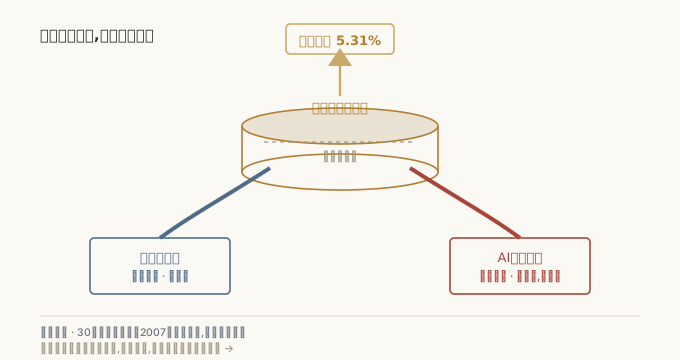
At bottom, the calm in equities that day is the thing most worth doubting. The S&P 500 slipping just over half a percent left most people reading this off the old map — AI is a tech-stock story, rates are a separate macro story, two lines running in parallel. But the bond market said otherwise at 5.31%: those two lines have already merged into one. AI’s tab is now baked into every asset priced off future cash flow, whether what you’re holding is Nvidia or the 30-year bond itself.
Everyone wants their own private tap, convinced that what they borrow and what they pay has nothing to do with anyone else. But credit has only ever had one pool. Whoever reaches in and draws the most lowers the waterline for everybody, and sends the price up for everybody. Governments and corporations, old money and new stories — different paths, same destination — all bidding against the same pool in the end. Nobody gets a private tap. Nobody escapes sharing the same well.
Interest rates were never a price anyone hands down. They're a price every borrower computes together — and this time, AI pulled up a chair too.
SECURE PAYMENT VIA STRIPE
Subscribe: $50 annual pass unlocks every paid article on this site for one year
Go deeper: Ko-fi members get a weekly members-only deep dive, from $3/month Become a member →