Gold Hit a Ten-Week High, AI Stocks Ripped Higher — Bitcoin Didn't Miss the Rally, It's Still Settling a Tab!
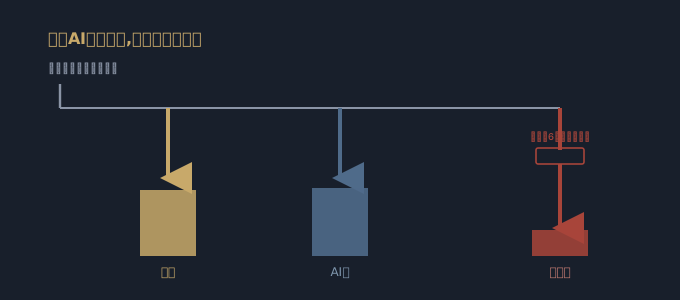
What’s hard about gold’s push to a ten-week high isn’t how far it went — it’s who else was climbing with it that same day. What should make you pause about the double-digit run in AI-server stocks isn’t the size of the move — it’s why these names got first in line for this round of easing. And what’s actually worth working through isn’t why Bitcoin only picked up a rounding error that day — it’s why the same wave of liquidity took care of the assets with no debt first.
Easing was never rain that falls evenly on every field. It waters whichever ledger is already clean.
Lay out what happened. U.S. markets that closed in the small hours here today were Wednesday, August 12, in New York. The signal that day was unusually consistent — the odds that policy tightens further got marked down: July CPI came in at 3.4% year over year, core at 2.5%, landing right on forecast, on top of Friday’s soft jobs print. Gold pushed above $4,400 an ounce intraday, closing in on a ten-week high. A blowout earnings beat from Supermicro sent a run of AI-server names up double digits on the day, with AMD, Intel and Nvidia following it higher. The popular read was everywhere: the easing trade is back on, risk assets get watered evenly, and Bitcoin — often called “digital gold,” supposedly the highest-beta play on any easing cycle — should have been leading the charge.
Instead, that same day, Bitcoin ticked up only a bit more than one percent, trading around $64,000, still down roughly 27% since the start of the year. “It missed the move” is the explanation you hear most. That explanation treats easing as one shared pipe running to every asset — turn the valve, everyone fills their cup. It’s the linear read: collapse a genuinely complex credit network down to a single shared water level.
Here’s the hinge: price was never a water level poured on by outside policy. It’s each asset’s own ledger, settling itself in real time.
Gold barely goes through a clearing process at all — no leveraged positions to unwind, no borrower who owes anyone money. Currency debasement and rate-cut expectations show up, and price answers immediately, because the ledger is already clean. Those AI-server stocks are the same: real orders and real cash flow underneath, so new easing expectations just get added on top of a loop that was already spinning smoothly — revenue lands, capex expands, more orders follow, revenue lands again, each link amplifying the next. Bitcoin is different. It went through its own credit contraction just this past June: within 48 hours, more than $3 billion in leveraged positions got force-closed, one layer of longs tripping the liquidation line for the next layer down. That’s the same reflexive loop running in reverse. This round of easing hasn’t reached it yet — it has to finish paying off June’s bill before it gets a seat.
Run the same loop in both directions and it’s the identical mechanism, only the sign flips.
On the way up: ① price rises → ② unrealized gains become fresh collateral → ③ more leverage gets added → ④ more buying flows in → back to ①. Every link makes the next one richer. On the way down: ①′ price falls → ②′ collateral shrinks → ③′ forced liquidation hits → ④′ that selling pressure drives price down further → back to ①′. Every link drags the next one under, and what’s spilled can’t be scooped back. Neither gold nor these AI stocks fell into that ④′-to-①′ stretch this year — new expectations landed on a ledger with nothing owed. Bitcoin, for a good stretch of this cycle, has still been running out the tail end of that loop — fresh money coming in gets applied to the old balance first, not to a new high.
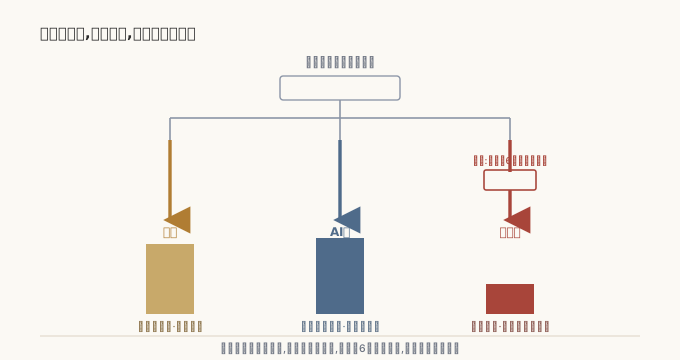
At bottom, people would rather trade a genuinely complicated situation for a score they can read off in one glance: rate-cut odds rise, so risk assets should rally together. But liquidity was never a single ticket handed out to every asset alike — it’s a ledger with an order of operations. Whoever’s book is clean gets watered first. Whoever’s still carrying debt from the last leverage cycle has to plug that hole before any new water touches price — mistaking the order for the outcome gets it backward every time. Bitcoin didn’t do anything wrong here; chasing a rally on leverage is a stage this kind of asset goes through as a matter of course. The mistake was never taking on that leverage. It was assuming this round of easing could skip the step of paying it back and carry the asset aboard anyway.
What split apart on the same day says less about Bitcoin “falling behind” than it does about a confession the whole system just made: liquidity was never indifferent to risk appetite. It asks every asset, first, whether last cycle’s bill is paid. Miss that, and on the way up you think everyone’s drinking from the same cup; on the way down you find out your cup was already half-drained by last cycle’s debt before the pour even started.
You thought Bitcoin missed this easing rally. It's still finishing the honest work of paying back the leverage from the last one.
SECURE PAYMENT VIA STRIPE
Subscribe: $50 annual pass unlocks every paid article on this site for one year
Go deeper: Ko-fi members get a weekly members-only deep dive, from $3/month Become a member →