Cheering a Shrinking Economy Isn't Madness — the Market Never Priced the Economy!
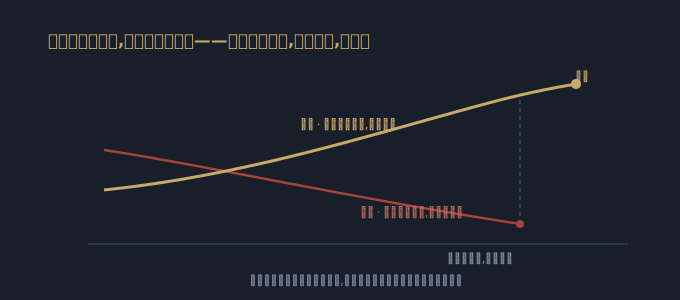
Bad news is bad news, good news is good news — that is common sense. On Friday the market turned it upside down. The July jobs numbers came in cleanly, unambiguously bad, and stocks charged together to fresh record highs. Some called it the bad news being out; some called it bad news turning into good news; some reached for the old line — the worse the economy, the sooner the Fed opens the taps. Every one of those readings dodges the one thing that matters most —
The market is cheering a shrinking economy not because it has gone mad, but because it was never pricing the economy at all. What it prices is something else entirely: whether the hand that has been tightening will finally open.
Lay the report out. Across the month the economy did not add jobs — it lost them, twenty-three thousand of them, when the market was waiting on a gain of about eighty thousand. Call it a hundred thousand jobs of hope that never arrived. Wages rose just 3.2 percent over the year, the slowest pace in five years. Even the one line that looked decent — unemployment ticking down to 4.1 percent — falls apart on a second look: it dropped not because more people found work, but because more people stopped looking and walked off the field. By any ordinary reading, a report like this should turn the stomach cold.
Instead, from the open, all three indexes charged higher, nudged the record up another notch, and booked the strongest week since April. A page that reads “the economy is weakening” bought a celebration. A contradiction? Not in the slightest.
Here is the hinge: this cycle, the Fed’s hand has been clenched toward a hike, not a cut. Prices are not fully tamed; officials have spent these days saying out loud that now is the time to raise. So what the market fears is not a weak economy — it is a strong one, strong enough to force the Fed to tighten another notch. A soft jobs report lands, and it presses that raised hand back down: no hike needed. The colder the labor market, the looser the bet on a hike, the harder stocks can run. What the market cheers is never those twenty-three thousand vanished jobs. It is the notch of easier money those jobs bought it.
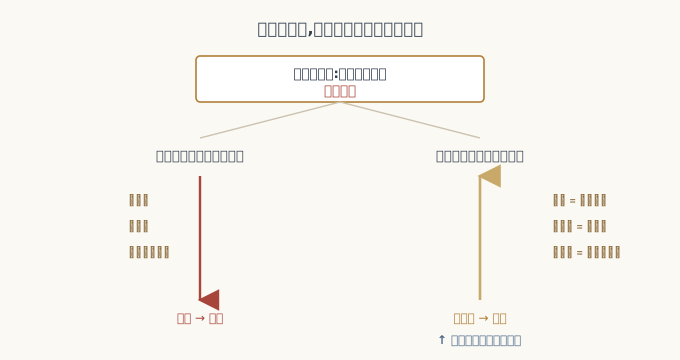
That is the whole secret of how one report reads two ways. In the market’s eyes there are no people who lost their jobs, only a hand that eased half an inch. It is not pricing the economy — it is pricing the Fed’s next move. The economy is merely a sheet of paper it borrows to read that hand. The paper says “cold,” and it reads “loose.” Let the paper say “hot,” and it reads “tight” and turns to sell in the same breath. The same report — it sells the good and sells the bad; what it sells is never the report, but the direction of the hand.
This is bad-news-is-good-news in its plainest dress: not the market working out some deep truth, but the market showing its hand. From first to last it is not computing the count of jobs or the pace of wages — it is computing which way those readings push the Fed, toward a hike or toward standing pat. To bet a single jobs report onto a single hand is reflexivity at its laziest: rather than reckon the livelihoods of millions, just wager on the loosening or clenching of one hand.
But burn the economy’s chill as fuel for easy money long enough, and the machine runs up a debt it will have to pay. The market can cheer bad jobs today only because it is betting that hand must open as the economy weakens — it has folded the Fed’s mercy forward into the price. Let the economy turn genuinely cold to the bone one day, and a notch of easing will not begin to catch it; only then will the market remember, with a jolt, that all the bad news it was cheering was real bad news. To pick up the economy’s harm and call it the Fed’s kindness is a drink of poison against thirst — you swallow what looks like the cure, and it is the poison, only slow to take.
At bottom the market never prices the economy in front of you. It prices the next move of the hand that economy forces. People always want to swap something complex for a simple wager: the livelihoods of millions are too hard to compute, the tightness of one hand is easy to bet. But the livelihoods are real, and the tightness is borrowed. What is borrowed always has a day it must be returned.
You think the market breathed a sigh of relief for the economy. It only wagered that the hand would not fall today.
SECURE PAYMENT VIA STRIPE
Subscribe: $50 annual pass unlocks every paid article on this site for one year
Go deeper: Ko-fi members get a weekly members-only deep dive, from $3/month Become a member →