Inflation Didn't Cool — It Just Moved Into Compute!
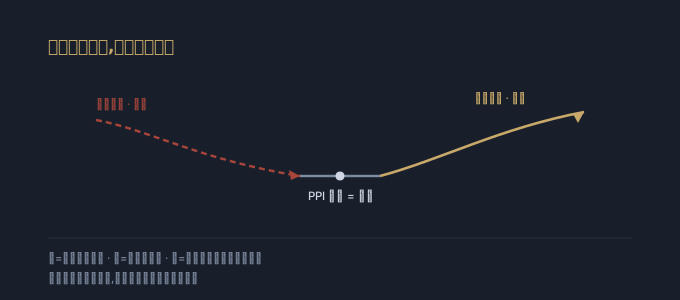
Inflation didn’t cool. It just changed addresses.
Today every financial wrap led with the same story: U.S. final-demand PPI unexpectedly fell 0.3% month-over-month, far below the flat print economists expected, the largest drop in 14 months. Stacked on a similarly soft reading the day before, it dragged the market’s odds of a 25-basis-point hike this month from 31% a week ago down to 10%. The indexes closed higher; the Nasdaq printed another record. And every reading, in every language, converged on one conclusion: inflation has peaked, tightening is ending, risk assets can be repriced. The line gets repeated with a kind of exhale — as if the beast that had been pressing down for two years had finally, on its own, lain down.
But there’s a misreading buried in that exhale, one almost everyone shares. PPI is not a price. It is a weighted average. And the one thing an average is exceptionally good at is smoothing violent internal divergence into a single, presentable curve. When everyone watches that curve bend downward and thinks they’ve seen the direction of inflation, what they’ve actually seen is only the residual left after the divergence got averaged out. Inflation didn’t disappear. It moved from one end of the average to the other.
To see this, you have to pull the average apart. In the very same data, one line gets said very quietly: prices tied to AI infrastructure kept rising. On one side, traditional goods, services, and energy demand is softening, tugging PPI down. On the other, the entire chain of compute, power, data centers, memory, and optics is pushing prices up. Two forces hedge each other inside one basket, and averaged out, you get a gentle “cooling.” But this isn’t inflation ebbing. This is inflation switching tracks. Old demand recedes, new compute surges, and the moment the average line goes flat is precisely the moment inflation finishes moving house. You think it’s gone cold — it has only walked out of the room you were watching and into the room next door, where the fire is lit.
In that light, reading a single month’s PPI drop as “inflation has peaked” is a textbook act of dimensional collapse. The market needs a direction, so it picks the convenient half out of an average and names it a trend. This isn’t the market objectively reflecting inflation; it’s the market using a data point to collateralize the road it already wanted to take. The plunge in hike odds from 31% to 10% looks like a data-driven rational repricing, but underneath it is an urge to rally that came first, then went hunting through the data for a reason to endorse it. Price is not a reaction to information; price is the information that got selected. The same PPI, its rising half proving “inflation is sticky,” its falling half proving “inflation has peaked” — the market chose the latter, not because it’s truer, but because it’s smoother.
And the truly dangerous part is the half the average line hides. The rise in compute-related prices is not a one-off restock; it is the price-shadow of a capital-expenditure surge still accelerating. Industry-wide AI capex is running toward the hundreds of billions a year, and those dollars land as real demand for power, chips, memory, electricals, and construction — as real price increases in each of those links. This slice of inflation hasn’t cooled; it’s self-reinforcing: the pricier compute gets, the more it proves demand is hot; the more demand looks hot, the more players add spend; the bigger the spend, the harder it pushes upstream prices higher. It’s a positive feedback loop, one foot stepping on the other. Today it’s hedged out inside the average by softening traditional demand — but hedged out is not gone. Let the drag from that other half ease, and the suppressed side comes back into the total, with interest. The economists put it carefully: a hike later this year remains possible. Translated: the inflation that moved out has kept its route back.
At bottom, inflation was never a whole you could sum up in a single average. It’s a network woven from countless price nodes. One region ebbs while another floods, and to describe it with one average is to stand between two opposing currents and declare the wind has stopped. But the wind hasn’t stopped — it’s just that where you’re standing, the two sides happen to cancel. What the market wants most is a simple, linear, immediately tradable conclusion: “inflation peaked, you can buy.” Complex systems refuse to supply that. They supply only divergence, migration, and the next round the average hid. Mistaking a move for a disappearance, mistaking a flattening average for inflation’s surrender, is this market’s laziest and most expensive act of self-comfort.
The data is cool. But ask one question first: what cooled — inflation itself, or the room you happened not to be watching?
The average's greatest lie isn't that it miscounted; it's that it drew a change of address as a disappearance.
SECURE PAYMENT VIA STRIPE
Subscribe: $50 annual pass unlocks every paid article on this site for one year
Go deeper: Ko-fi members get a weekly members-only deep dive, from $3/month Become a member →