When Housing "Stabilizes," What Steadies Isn't Supply and Demand — It's the Tide of Credit!
When housing “stabilizes,” what steadies isn’t supply and demand — it’s the tide of credit.
Today the half-year economic report landed: first-half GDP grew 4.7%. In the property column, a few numbers got pulled out and quoted everywhere: new-home prices in tier-one cities up 0.1% month-over-month, existing-home prices up 0.3%, both rising for four straight months; unsold inventory at end-June down 0.9% year-over-year, also falling for four straight months. Prices up four months running, inventory down four months running — “stabilizing after the fall” duly became the day’s favorite qualifier. It sounds grounded, measured, appropriately restrained. But it hides an assumption almost everyone takes for granted: that a home price is a scale pulled by two ends of supply and demand, and that one more buyer, one fewer seller, is enough to steady it. As if price were a thermometer of willingness, measuring how badly the market wants to buy.
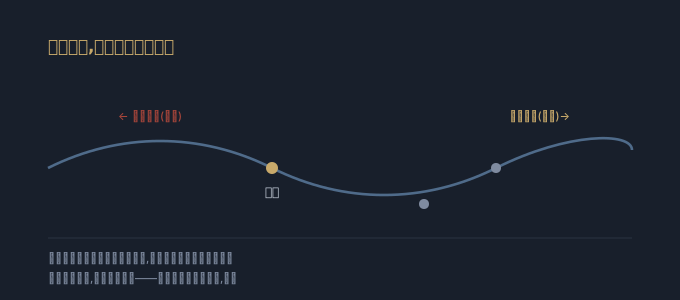
Here’s the common sense that needs turning over: price is not a thermometer of demand; price is part of credit. Almost no one buys a home outright in cash. Every transaction stands on a stack of credit — the down payment on a family’s years of saved-up creditworthiness, the mortgage on twenty or thirty years of bank lending, the developer’s land and construction on an even longer chain of debt. A home price isn’t “how much a willing buyer offers”; it’s “how much credit this entire chain is willing to create for it.” When credit expands, the tide rises, and the same home commands more financing, so the price lifts. When credit contracts, the tide goes out, and that same home commands less, so the price falls. The home-price dot doesn’t float above the supply-demand water level; it sits on the surface of the credit tide.
So explaining those four months of gains through “supply and demand” is really the language of micro-level buying and selling, borrowed to describe a macro-level process of credit. It gets the causation backwards. It isn’t that a few people changed their minds and the price steadied; it’s that the credit tide stopped receding — even began to turn — and only then did buyers and sellers at the margin regain the ability and the nerve to close. The willingness of supply and demand is never the cause of the turn; it is the result of the credit tide. Whether a family “wants to buy” is, at bottom, whether it “dares to shoulder another twenty-year debt.” Whether a developer “will cut prices to move inventory” is, at bottom, whether it “can still borrow the next loan to survive.” These things that look like willingness are, underneath, all water level. When the tide goes out, the strongest desire to buy still can’t become a sale; when it comes in, even the sidelined step back in. You think you’re watching supply and demand. You’re watching credit.
In that light, what actually decides whether home prices hold isn’t whether more people want to buy — it’s whether that credit network can expand again. And a credit network is exactly the thing hardest to move with a single lever. It’s the collective water level formed when countless households, banks, and firms each render their own judgment about the future. Any single tool is only the one valve at the very top of the network: it can change the pressure in the pipe, but not each node’s decision to take the water, to dare to use it. Pressure can prop the level up for a while — but as long as those countless scattered actors at the far end still don’t dare turn today’s liquidity into a fresh twenty-year debt, the tide is still going out, only more slowly. You can hold up the pressure without holding up the tide; you can steady the volume of transactions without steadying the direction of credit.
And it is that very same half-year report that says this most plainly. Lying right beside the four months of price gains are two other numbers: first-half property development investment down 18% year-over-year, and new-home sales area down 11.6%. On one side, prices steadying; on the other, investment and volume collapsing in double digits. These numbers don’t contradict each other — they are two layers of the same thing. Price is the dot on the surface; it can sit still for a while because inventory has fallen four months running and nobody at the margin is rushing to dump. But investment and sales area measure whether this credit chain still wants to create new credit for housing at all — whether developers dare to borrow again for land and construction, whether families dare to sign another twenty-year mortgage. The former is the water’s surface; the latter is the water. The surface went flat for a moment — but investment down 18% is telling you the water is still walking out.
At bottom, “stabilizing after the fall” is a phrase too reassuring for its own good — reassuring enough that people forget to ask what, exactly, has steadied. If what steadied is the credit tide — households daring to borrow again, banks daring to lend again, marginal debt beginning to expand again — then the “steady” has roots. If what steadied is only a moment’s transaction volume, a moment’s pressure, a moment’s expectation, while the credit underneath is quietly still ebbing, then the “steady” is just a brief lull as the tide pauses at some level. The price dot tells you the water level; it will not tell you whether the water is rising, or has merely, for now, stopped falling.
Don’t celebrate the word “steady” too quickly. Look down first: is what’s holding this home the tide come back in — or just a stretch of water that hasn’t yet fallen?
A home price never rests on the scale of supply and demand; it floats on the tide of credit — what steadies it was never people, it was the water.
SECURE PAYMENT VIA STRIPE
Subscribe: $50 annual pass unlocks every paid article on this site for one year
Go deeper: Ko-fi members get a weekly members-only deep dive, from $3/month Become a member →