Netflix Was Not Punished for Its Earnings — It Was Punished for a Second Derivative!
A growth stock’s valuation has never priced growth. It prices the acceleration of growth.
Netflix fell more than 10% on Friday July 17. Every screen explained it as “earnings missed.” But open the document the company filed with the SEC and the numbers read like this: second-quarter revenue of $12.6 billion, up 13% year over year (12% on an FX-neutral basis), a 33.4% operating margin, $3.401 billion of net income, $0.80 of diluted earnings per share. Full-year revenue guidance of $51.0 to $51.4 billion, representing 13% to 14% growth.
Not one line is shrinking. Revenue is climbing, the operating margin is above a third, net income is north of three billion dollars.
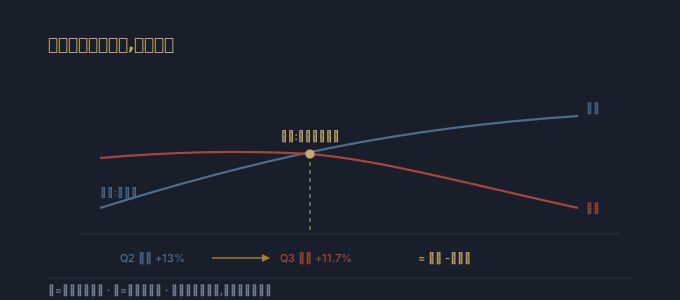
So what got punished? One line: third-quarter revenue guidance of $12.860 billion. That figure is higher than the second quarter’s $12.6 billion — sequential growth is intact — but it implies year-over-year growth of 11.7%, against 13% in the second quarter.
A point and change of deceleration bought a double-digit decline.
If you believe the market buys growth, this is incoherent: a company with rising revenue, a 33.4% margin, and three billion dollars of quarterly profit falls a tenth on what, exactly? But if you accept that the market buys acceleration, it is not merely coherent — it is inevitable. Growth is the first derivative. Acceleration is the second. Price tracks the second.
This is not madness. This is discounting arithmetic doing honest work.
A growth valuation folds many years of future cash flow back to today. Those cash flows are not laid out at current scale; they are extrapolated at the current rate. Thirteen percent and 11.7% differ by barely a point in year one — but they compound for ten. 1.13 to the tenth is about 3.40; 1.117 to the tenth is about 3.02. Same starting point, one point of difference, and ten years out the gap is more than a tenth — and the valuation is discounting precisely that ten-years-out world. So a small downward revision to guidance does not cut one quarter’s money. It cuts the slope of a decade-long compounding path. The market has never been selling this quarter. It sells the curve this quarter implies.
Which shows you exactly where a growth stock’s fragility lives. Its price does not rest on how big it is. It rests on it still getting faster. Let “getting faster” show one hairline of deceleration and the fulcrum shifts, even with scale, margin, and cash flow entirely undamaged.
That is the line between convexity and concavity — and the best ruler there is for locating a growth story on its arc. Do not look at whether it went up. Look at whether the growth rate is accelerating or decelerating.
The convex phase: the growth rate itself is climbing, each period growing faster than the last. Every fresh extrapolation makes the future worth more than the last one did, so the multiple keeps getting marked up. Upside is wide open — the numerator is expanding while the multiple people will pay is also expanding. Two variables multiplying in the same direction.
The concave phase: the growth rate turns down. The company is still growing, just a little slower each year. Every fresh extrapolation makes the future worth less than the last one did, so the multiple begins to compress. Upside is sealed off — the numerator still expands, but the multiple people will pay contracts. Two variables pulling against each other, cancelling. What makes it crueler is that a concave-phase company usually looks superb on the financials: record revenue, record profit, everything growing. Its bad news is not written on the income statement. It is written only in the difference between two growth rates.
So the thing to watch was never “how much did it grow” but “faster or slower than last time.” The statement tells you how big it is. Only the second derivative tells you which way it is bending. This is also why the market always reacts far more violently to guidance than to reported results: results are a first derivative about the past, guidance is a second derivative about the future. One is a fact already banked. The other is the first signal of the slope.
And precisely because of this, growth pricing contains a structural predicament with almost no escape: acceleration cannot continue forever, and the valuation is built on the assumption that it will. Every company’s growth rate must eventually turn from accelerating to decelerating. That requires no mistake, no competitor, no deterioration in the industry — it requires only that the base gets bigger. The base is the most honest enemy growth has: another ten billion of revenue is 20% on a fifty-billion base and 2% on a five-hundred-billion one. Success itself is how growth rates end. A company can become unworthy of its valuation by doing well enough to get large enough.
In that sense, Friday’s decline was not the market’s verdict on Netflix. It was the market completing a change of coordinates: moving the company out of the column marked “still getting faster” and into the column marked “large, growing steadily.” Those two columns are valued by entirely different methods, and at the instant of transfer the price must jump violently. What fell was not the company. It was the column the company sits in.
Ultimately this cuts harder at people than at positions. We appraise a company the way we appraise ourselves, with the same bad habit: we stare at scale and forget slope, we count what we already have and never ask whether we are still getting faster. But the market is a judge honest to the point of rudeness. It does not grade your transcript. It grades your direction.
What sets value has never been how far you have come. It is whether you are still accelerating.
Growth tells you how big the thing is. Acceleration is what tells you what it is worth.
SECURE PAYMENT VIA STRIPE
Subscribe: $50 annual pass unlocks every paid article on this site for one year
Go deeper: Ko-fi members get a weekly members-only deep dive, from $3/month Become a member →