Retail Sales Missed Badly, the S&P Barely Blinked — Cheaper Isn't Safer!
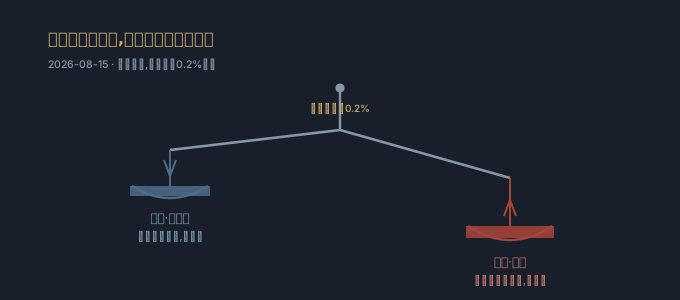
What is strange about retail sales day is not that the S&P fell — it is that it only fell just over 0.2%. What should make you pause about the weakest retail print in more than a year is not how bad it was — it is what the market chose to read into it. And what is actually worth working through is not whether “bad news is good news” is true — it is whether the same data release can be good news and bad news at the same time.
Cheap was never the margin of safety. Growth is — and today, growth is the thing actually trading at a discount.
Lay out what happened first. U.S. markets that closed in the small hours here today were Friday, August 14, in New York, and stocks were sitting near record highs going in. Friday morning, July’s retail sales report landed and put a chill on that record run.
Retail sales fell 0.6% month over month — the weakest month in more than a year — against a market that had priced in a 0.1% gain. Not just a miss: a reversal running more than six times the size of what was expected.
Strip out autos, gas stations, building materials and restaurants, and what is left is the control group — the slice that sits closest to how the government actually measures economic growth. That fell 0.4%, against an expected gain of 0.3%. Consumption, the biggest engine in the U.S. economy, quietly stalled on its own this month.
On that report, the S&P 500 closed down just over 0.2% — smaller than the normal daily swing on plenty of ordinary trading days — and still closed out its third straight winning week. The Nasdaq did the same; only the Dow finished the week in the red. The story everywhere: weak consumption is not bad news, it is good news, because it makes the Fed more likely to cut, and the market had already priced that in — hence the restraint. That is a clean case of survivorship bias dressed up as insight: two entirely different ledgers, folded into one and swallowed whole.
Here is the actual mechanics. The price of any asset is the gap between two ledgers: the numerator is what it earns in the future — growth. The denominator is the rate used to discount that future money back to today. A rate-cut expectation genuinely is good news — it lowers the denominator, and the same future cash flow, discounted at a lower rate, is worth more today. But weak retail sales — especially a control group that just turned negative, the reading sitting closest to GDP — moves the numerator. It says Americans loosened their grip on their wallets this month, on their own. A cheaper denominator and a shrinking numerator point in opposite directions, and nobody can say in advance which one wins by how much. The only thing that is certain is that they are not the same event, and they do not cancel out just because both arrived under the same headline. Growth is the real margin of safety. Cheap never was.
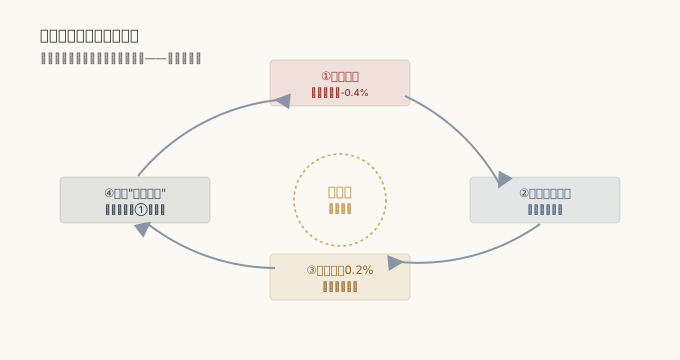
At bottom, that restrained 0.2% move is itself a loop validating its own premise: weak retail data gets read as a higher probability of a cut; a higher probability of a cut lowers the discount rate and props up valuations; propped-up valuations keep the index from falling much; the index not falling much then gets waved through as proof that “the economy is not that bad” — and the loop closes without anyone going back to check the control group that actually turned negative. ① weak data supports rate-cut odds, ② rate-cut odds support valuation, ③ valuation supports the index holding up, ④ the index holding up feeds back into ①’s optimism. That is a loop using the outcome to prove the cause — not an honest repricing.
The early/late mirror is where this report’s real weight sits. Early: a one-off soft print gets its bill paid up front by the good news of a lower discount rate; cheap covers up the question growth was supposed to answer, and everyone can still say it is a seasonal quirk, a one-time distortion, nothing to take seriously. Late: if retail sales, and especially that control-group gauge, keep sliding over the following months, a one-off becomes a trend, and the gap in the numerator grows too wide for any amount of rate-cutting to fill. At that point, the exact same sentence — “the Fed is going to cut” — stops being a gift that settles the bill and turns into a diagnosis: a cut no longer proves the economy is fine, it proves the economy has gotten bad enough to need saving. Same signal, read in opposite directions depending on which half of the story you are standing in.
People would always rather compress a complicated ledger into a single verdict — bullish or bearish, up or down — so they do not have to do the arithmetic twice. But price was never the output of a single sentence. It is the net of countless ledgers clearing at once, numerator and denominator each settling their own account, neither one covering for the other. Whoever actually bothers to pull the two ledgers apart and check them separately gets to see what is really going on. Whoever settles for the folded-together headline mistakes cheap for growth, and mistakes a gift for a diagnosis they never actually opened.
Margin of safety was never bought at a discount. It is calculated — and the ledger only balances when both halves get counted.
SECURE PAYMENT VIA STRIPE
Subscribe: $50 annual pass unlocks every paid article on this site for one year
Go deeper: Ko-fi members get a weekly members-only deep dive, from $3/month Become a member →