What Rose Wasn't Palantir — It Was Your Belief in It!
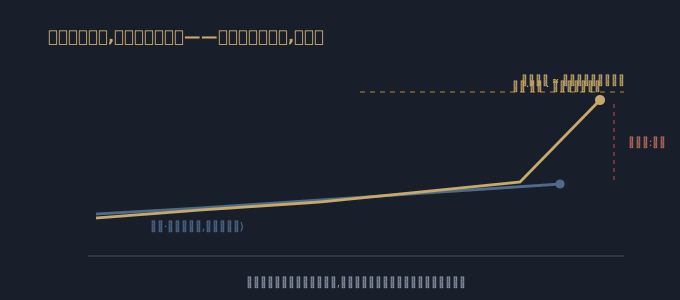
Palantir jumped nearly 30% in a day, and what jumped was not its business but the market’s belief in it; the most expensive thing in that jump was not how much software it sold last quarter but how much of the story it got people to believe; and its real risk lies not in whether next quarter’s numbers turn, but in whether that belief exhales.
Pull the day apart. The quarter was already closed. The money was booked last quarter; in twenty-four hours the company signed no new deal, wrote no new line of code, and its product, its customers, its team look today exactly as they looked yesterday. The only thing that changed was the price — up nearly a third in a session, its sharpest leap in two years. The business did not move a step, and the sticker jumped 30%.
So what, exactly, rose by a third?
Not the company. Your belief in the company.
That headline number — revenue up nearly double from a year ago — is a receipt. It records what already happened. The market never reads the receipt; it reads the sentence behind it: enterprises are really dragging AI out of the pilot deck and into the production line. Once that sentence is believed, no one recomputes what the company sold last year — they recompute what it can sell for the next ten. The whole price snaps into a new coordinate system overnight. The number hands belief an excuse to move; the thing actually moving is belief itself.
And belief, in the end, gets stamped onto the price. Buy it today and the market is willing to pay something like forty dollars for every dollar the company sells in a year — sells, mind you, not earns. Put crudely: at its current revenue, the price you pay today only squares up after it sells, year after year, for forty years. No one plans to wait forty years. Whoever pays that is not buying forty years of receipts — they are buying the story that it will sell more each year, faster each year, without end. Past this point, price no longer takes the company’s temperature. It starts pricing the story.
A story believed into a winner acquires its own weight, and then it turns around and feeds itself. For a stock crowned as the winner, the higher the price, the cheaper its capital, the more lavishly it hires with its own shares, the brighter the “best-in-AI” halo, the more willing customers are to bet their operations on it — so it really does sell more, and the results come back to stamp the belief as proven. Belief lifts the price, the price grows the results, the results reinforce the belief — one foot stepping on the other, link locked into link, no one able to say who is pushing whom up the stairs. This is not Palantir’s private miracle. It is the plainest face of reflexivity, worn by every asset that trades on belief.
But a machine that turns this smoothly forward turns just as dangerously in reverse. When belief is rising: price up, capital cheap, talent gathering, customers crowding in, growth accelerating, the belief confirmed at every step. Let belief so much as exhale, and the same machine runs backward, part for part: price down, capital dear, talent scattering, the halo dimming, growth slowing — and now “they believed wrong” gets confirmed from the other side. On the way up it amplifies confidence for the numbers; on the way down it amplifies doubt. Forty times sales is not a foundation holding the thing up. It is a machine that can reverse at any moment. The more a stock rises on belief, the less reason it needs to fall.
They say the margin of safety in a growth stock is growth — grow fast enough and even an expensive price gets clawed back. True enough, but it hides a condition: that the growth is not already in the price. Once the market marks a decade of high growth into today’s forty times, all at once, the margin of safety has been spent by the buyer himself. To go up, the story must be believed a little more deeply each year; to go down, it takes a single quarter that makes belief hesitate. The upside is open — open to a story not yet delivered. The downside is open too — open to the hesitation that always, eventually, arrives. Growth is a margin of safety. But once growth is marked into the price ahead of time, that margin belongs to someone else.
In the end, the market did not get smarter about AI that day. It fell more in love with its own forecast. It wants to nail a visible number onto a future it cannot compute; but the future was never something you can price — only something you can believe. Palantir’s near-30% leap was not the market suddenly discovering how much it is worth. It was the market taking one more long look at the rising curve it had drawn itself, and then pushing its chips up another notch. People keep hunting for a number to carry the weight of their uncertainty about the future; and whoever pays forty times has simply given that uncertainty a prettier name, and called it confidence.
You think you are pricing Palantir. You are putting a sticker on your own belief.
SECURE PAYMENT VIA STRIPE
Subscribe: $50 annual pass unlocks every paid article on this site for one year
Go deeper: Ko-fi members get a weekly members-only deep dive, from $3/month Become a member →