Profit Can Be Born From Price. Cash Cannot!
Profit can be born from price. Cash cannot.
After the close on Wednesday, July 22, Alphabet delivered a quarter that looks magnificent on paper: double-digit revenue growth, a sharp acceleration in cloud, an operating margin that expanded on top of it. The stock fell after hours.
The popular reading formed almost immediately: the quarter itself was strong, capex simply spooked investors. That sentence turns capital expenditure into a dial — as if you could turn it down a notch and the report would be flawless. But in this cycle, capex is not profit’s adversary. It is revenue’s source. Cloud revenue grew 82% year over year precisely because other companies are throwing money at the same thing; and the money Alphabet itself put into property and equipment this quarter was $44.9 billion, double what it was a year earlier. You cannot applaud the 82% and demand a smaller $44.9 billion. They are two ends of the same pipe.
The page worth reading is not the income statement. It is the cash flow statement.
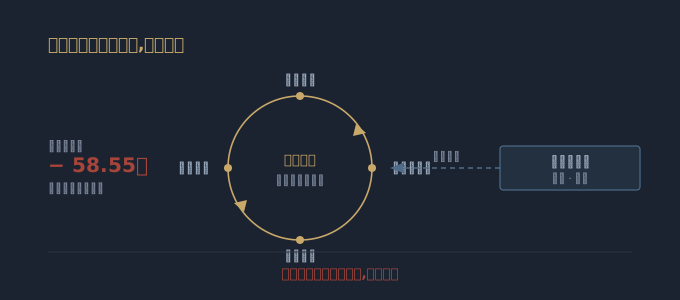
This quarter, Alphabet’s free cash flow was negative $5.855 billion. The cash the business earned was not enough to pay for the land, the buildings, and the chips. That has never happened since the company went public. And the minus sign matters less than the shape of the descent — this was not a single blow that punched through the floor, it was a staircase walked down one step at a time: a bit over $10 billion the prior quarter, and in each of the two quarters before that, a steady twenty-four-plus billion. In a trend, the level is never the dangerous part. The rate at which the level is falling is.
Then the profit. Earnings per share this quarter were $9.11, close to four times last year’s. Break the number open: $6.26 of it came from price changes on equity stakes the company holds — those companies’ shares went up, and accounting rules put the move through the current period’s income. Which is to say, of $9.11 per share, more than two-thirds was not earned by operating anything. It was re-marked by the market. This is not that Alphabet made more. It is that what Alphabet owns went up.
And here the loop closes.
It spends money on compute; that money lands as revenue at other companies up the chain; those companies’ revenue and valuations rise together; the equity stakes it holds gain on paper; the paper gain runs through the income statement; the income statement holds up its valuation and its credit; with valuation and credit intact, it can return to the market and raise another round to buy more compute. Around the circle, every link is fed by the link before it. The one thing this loop does not produce is cash.
Which is why the most telling fact in this report is that the direction of the money reversed. In the same quarter a year ago, the company was buying back its own stock in size. This quarter, buybacks were zero, and it issued $49.6 billion of new shares instead. A machine that used to only pay money out has begun pulling money in. This is not the mild statement that “investment went up.” It changed identity: from a company that pays the market to a company that asks the market.
Look at it forward and backward and you get a mirror.
On the way up: capex becomes someone else’s revenue, that revenue lifts their valuation, their valuation lifts my paper gain, the paper gain lifts my profit, the profit lifts my share price, the share price lets me issue new equity, the equity brings in cash, and the cash becomes the next round of capex. Every step supplies the reason for the next one, which is why nothing on the way up ever needs explaining. Now reverse it: paper gains become paper losses, the income statement collapses, valuation and credit contract together, new equity cannot be sold or can only be sold very expensively, cash stops arriving, capex is forced to shrink — and that contraction directly cuts the revenue of those same companies up the chain, whose valuations fall further, which drags my paper gains down again. The loop is as smooth going up as it is violent going down, because both directions run on the same set of gears.
So the question was never whether capex is too large. The question is where this loop’s one opening is. The answer is plain: the opening is outside capital. Profit is generated inside the loop. Valuation is generated inside the loop. A meaningful share of revenue is generated inside the loop. Only cash has to walk in from outside, handed over one check at a time by people who are not part of the circle.
This is why free cash flow occupies a different position in this cycle than it did in earlier ones. It is no longer merely a financial metric. It is the only component of the whole machine still running negative feedback. Every other reading gets lifted by the rise itself — revenue does, profit does, valuation does, credit does, which is exactly why their agreement proves nothing. Free cash flow does not. It does not measure what you are worth. It measures what you have left.
A complex system never argues with a narrative. It simply sets a physical limit at some quiet point and waits. No expansion in history was ever talked to a stop by an argument; every one of them ran into the same wall, a wall that does not negotiate: the money ran out. People can redefine growth, redefine profitability, call a paper gain a profit, call an equity issuance an investment, call spending more than you take in a strategic investment phase. Every one of those redefinitions works, and works for a long time — right up until the day the bill has to be paid.
Loops do not grow cash. Cash can only come from outside the loop.
SECURE PAYMENT VIA STRIPE
Subscribe: $50 annual pass unlocks every paid article on this site for one year
Go deeper: Ko-fi members get a weekly members-only deep dive, from $3/month Become a member →