Rates Aren't a Cost — They're the Price of Waiting!
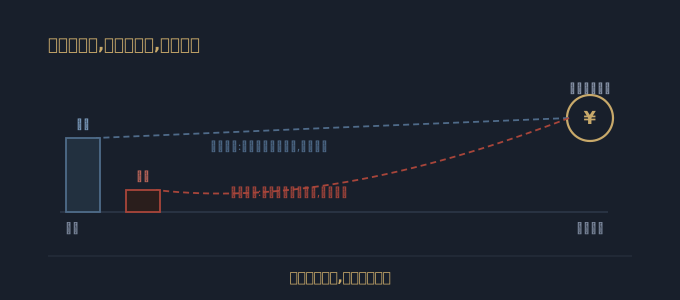
The hard part of this tech selloff isn’t seeing why it fell — it’s seeing why it waited this long to fall; the danger isn’t in the Nasdaq’s two-plus points on Thursday, but in the anchor quietly swapped out beneath those points; the root of it was never that the market suddenly found AI spending too reckless — it’s that the market just re-priced the act of waiting.
Rates aren’t the cost of borrowing. They’re the price of waiting.
On Thursday, July 23 (US session), the Nasdaq shed more than two percent in a single day, with chips the worst of it — several of the big names each down over 5%. The trigger was TSMC: it delivered a quarter that beat on both profit and revenue, and then, almost in the same breath, lifted its capex plan for next year by another large step. By Friday’s close the S&P had scratched its way back to flat while the Nasdaq kept bleeding — a whipsaw week. Open any recap and the verdict is nearly unanimous: the market has finally had it with AI spending, and capex is now the original sin.
That sentence treats rates as a backdrop with nothing to do with the fall, and treats the fall as a fit of emotion. Both have it backwards.
In fact, a rate isn’t the cost of borrowing — it’s the discount rate, the haircut that future money takes to come back to today. Make the haircut small and a dollar ten years out is still worth ninety cents today; make it large and that same dollar is worth fifty. In a low-rate world the haircut is nearly gentle, so the market will happily pay today’s price for cash flows that don’t land until many years from now. And AI, and chips, are the longest-duration bet in the whole market — the payoff they promise isn’t this quarter, isn’t next year, but some day a long way out. They are precisely the asset most afraid of a rising haircut.
Over the past half year, that discount rate underfoot has turned — quietly, one notch at a time. At the start of the year the crowd was still betting the cutting cycle would run on; step by step, the bet on cuts went to zero; and by this Thursday, with oil back above $100 and the shadow of inflation pressing down again, the crowd betting the Fed’s next move is a hike had grown to roughly one in three — a market that went from “all but certain to hold” to a coin toss. The policy rate itself sits where it sat, up in the mid-threes; what turned on its heel is the market’s guess about where it goes next.
And right at that moment, TSMC said it would spend more. When the haircut is gentle, “spend more, get paid later” is nerve — the story the market most loves to hear; when the haircut is rising, the same sentence becomes the very thing that kills you. Because the further out you push the payoff, the harder the growing haircut chews on it. The same earnings report, the same pile of spending, set in two rate regimes, is two opposite things. What the market read on Thursday wasn’t how much TSMC spent — it was how long the money has to wait. And waiting just got expensive.
Read it forward and read it backward, and it’s a mirror. In the years rates fell: every extra dollar of capex, every year the payoff got pushed further out, was cheered as good news — because the haircut was gentle, even a far-off future came back to today with little lost, and the longer the duration the harder it ran. Reverse it, let rates turn up: the same distance becomes a burden — the further out the payoff, the more the swelling haircut eats it, and the longer the duration the harder it falls. The bull rewards duration; the turn punishes it — on the very same set of gears. On the way up you thought the market was applauding AI’s future; half of what it was applauding was a cheap haircut. On the way down you think it’s doubting AI; it has only run the haircut again.
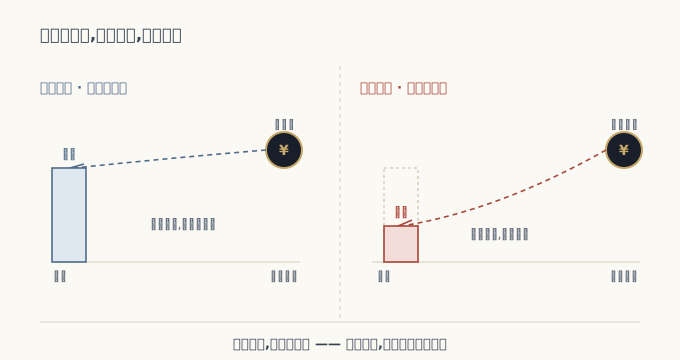
At bottom, cheap money did one thing: it pulled the future into the present. When the haircut is small enough to ignore, an earnings stream many years out can be priced today almost untouched — so a future that hasn’t arrived becomes the ground everyone stands on as though it were the present. But that ground was borrowed from the discount. Let the discount rate turn, and the future gets shoved back to where it always was — many years out — and the borrowed ground underfoot is pulled away with it. The market didn’t stop believing in AI; it simply remembered something that was always true: the AI payoff was always far off, and “far off” just got expensive.
Go one layer deeper, and the discount rate was never a button in the Fed’s hand. It’s the market’s price on patience — the pooled vote of oil, of inflation, of credit, of everyone’s appetite for the future. The Fed is more the thermometer that reads the pooled result than the thing that makes it; try to price against that pooled result and you’re the fox borrowing the tiger’s roar — let the tiger fall silent, and the beasts don’t heed the fox. So what truly values an asset was never any one meeting — it’s whether the market, right now, is willing to wait. When it’s willing, any far-off story holds, because the discount flattens the distance for it; when it isn’t, no story, however lovely, discounts back to today — because what people are really arguing over was never what some company is worth years from now, but what a single year of time is worth.
In the end, what people overestimate most is their gift for seeing a distant future clearly; what they underestimate most is that whether that future holds up isn’t decided by the future at all — it’s decided by the discount underfoot, the one that can swell at any time. You think you’re valuing the company. All along, you’ve been valuing your own patience.
On the way up, no one asks what a year is worth. On the way down, it's the only thing the market asks.
SECURE PAYMENT VIA STRIPE
Subscribe: $50 annual pass unlocks every paid article on this site for one year
Go deeper: Ko-fi members get a weekly members-only deep dive, from $3/month Become a member →