The Fed Holds the Rate; the Economy Pays Another!
Overnight — small hours here — the Fed pinned rates in place for the fifth meeting running. The recaps sing one note: the shoe dropped, the Fed stood pat, rates held.
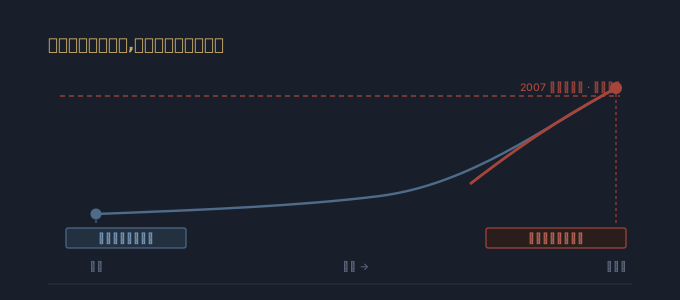
Yet on the very day rates held was being chanted, another rate leapt. The price the government pays to borrow for thirty years cleared 5.2% — the most expensive long money since 2007. The last time long money cost this much, the financial crisis had not yet broken.
The Fed stood pat, and the price of long money jumped to 2007. The two look like a contradiction. They are not — because the rate the Fed holds was never the rate the economy actually pays.
Pry open the everyday assumption first: a rate is not a number, it is a curve. From borrowing overnight, to borrowing for a year, ten years, thirty years — each maturity has its own price, and only strung together do they make “the rate.” The Fed’s hand can pin only the rung of that curve nearest to today: the price of overnight cash, set now in a narrow 3.50%–3.75% band, fixed since late last year and carried unmoved through five straight meetings. But the rung you and I actually pay sits at the other end of the curve. The mortgage takes its cue from it; the corporate long bond takes its cue from it; the government borrowing for thirty years takes its cue from it. And that end is not gaveled by the Fed. It is computed by the bond market.
The Fed holds a button. What it faces is a network.
The button wires to a single node of that network — the overnight rate. Press it, and the nearest rung obediently stays put. But the farther out you go, the farther each node sits from that hand, and the less it heeds it. The thirty-year end is a running computation by millions on inflation, on credit, on growth across three decades — no one conducting it, aggregating itself into one price. Pin the nearest node dead, and the far end, well beyond arm’s reach, marches on by its own arithmetic.
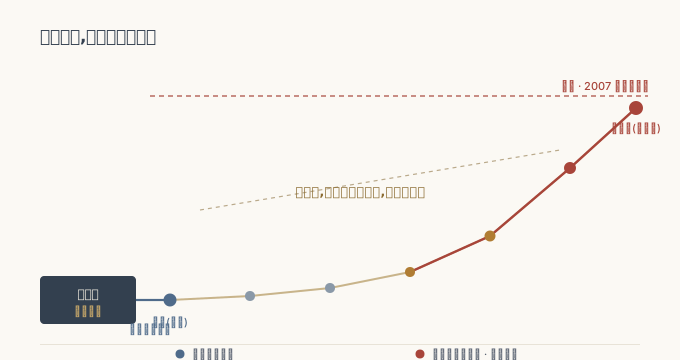
Stranger still is the direction it jumped. The ordinary script runs the other way: the Fed tightens, and the long end takes comfort — someone is leaning hard on inflation, the future needs less compensation, the long end can sit still or ease. Today it ran backwards. Nine hands on the committee held the rate; three rose to hike; the Fed did not hike. The short end exhaled — and the long end grew more anxious, not less.
Anxious about what? Because what the long end wants is never the Fed’s single motion this afternoon; it is the answer to will they pin inflation all the way to the floor. Today it read the answer as: not hard enough — with oil creeping up again and the inflation fire not out. So the long end reached in and repriced the future itself, demanding a fatter cushion. The long end rose not because the Fed did something, but precisely because it did not do enough.
In that sense the thirty-year yield simply is the price of long-term credit. The Fed can nail down the overnight rung; it cannot nail down the whole web of credit. The harder it leans on one button to move the entire curve, the sooner the far end — the end beyond its reach — turns and works against it. One meeting adjourns, and the two ends of the curve reach opposite verdicts: the near end says no hike, exhale; the far end says no hike, be more afraid. The gap between them widens — a bear steepener — and that gap was not opened by the Fed. It is the disagreement between the market and the Fed, forced into the open by a single sheet of paper.
In the end, people always long for a center, a single hand, that can fix the rate with one press and set the price of the future for everyone. But a rate was never a number that could be held down. It is a curve recomputed daily by millions. What the Fed grips is the shortest rung, the one nearest today; the farther out, the more it is everyone computing at once, and the less it belongs to the Fed at all. To move an entire network with one button is the oldest arrogance, and complex systems have only ever used the end beyond reach to press that hand until it aches.
Real humility is not admitting you cannot see the future. It is admitting that the rate you thought you had pinned is only the shortest rung of the whole curve — and the rung the economy actually pays has been out beyond your reach the whole time, quietly pricing itself.
The Fed can hold tonight's rate; it cannot hold the price of thirty years.
SECURE PAYMENT VIA STRIPE
Subscribe: $50 annual pass unlocks every paid article on this site for one year
Go deeper: Ko-fi members get a weekly members-only deep dive, from $3/month Become a member →