The Bounce Was Never Risk Appetite — It Was Money Crowding One Story!
The recaps sing one note: AI optimism is back, risk appetite has rebooted, risk assets rallied together. It sounds airtight — as if the market held a single master switch, and someone flipped it, and everything with “risk” in it — stocks, chips, bitcoin — rose as one. That framing takes countless doors, each opening on its own, and calls them one switch.
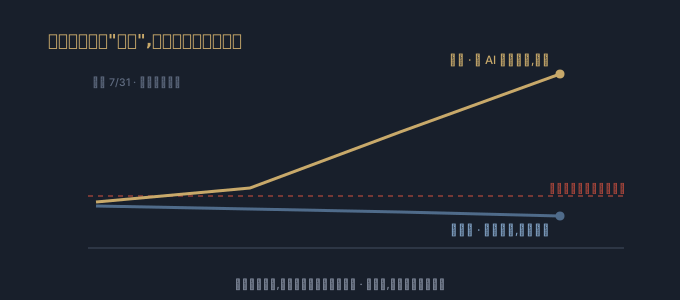
Yet on the very day the switch was supposedly flipped on — overnight here, the July 31 session in New York — the truth showed its hand on the spot. The Nasdaq blew out to the upside, Amazon dragged a pack of tech names higher, even Seoul’s chip stocks jumped along. By the script of “risk appetite is back,” the most volatile thing of all, the one that most is risk — bitcoin — should have led the charge. It didn’t. It closed lower that day, sitting in the low sixty-thousands, pinned beneath its own buyers’ average cost of the last half-year, not a step higher.
On one side, the flagship of risk assets cheers the rebound. On the other, the highest-risk asset of all falls the same day. These two things should not happen together — unless that “master switch” does not exist at all.
What rises is never “risk.” It is one story that some pool of money is crowding.
Pry the word “correlation” apart. People say stocks and bitcoin are “correlated,” as if they shared a bloodline, as if one moving meant the other must follow. But correlation is not a property of the assets; it is the shadow of the same money. When one leveraged pool stands in stocks and bitcoin at once, of course they rise and fall together — not because they are alike, but because behind them is one wallet. Let that money crowd a single door, answer to a single story, and the other side empties in an instant; the so-called correlation snaps on the spot.
The sharpest proof is to pull the lens back one notch. The same two things, the same pair of assets — across the whole month of July, stocks had their worst month in more than a year, tech bleeding lower session after session; while bitcoin quietly logged its best month in a year. One down, one up. Then on the month’s final session, it reversed: stocks blew out, bitcoin fell.
Same pair. All month, stocks-down-coin-up; the last day, stocks-up-coin-down. Change the timescale, and you change the sign. That thing called “correlation” flipped its face twice inside a single month. If it were the nature of the assets, how could it turn on a dime? It is not a nature. It is the shadow of where the money is; the money shifts a foot, and the shadow swings the other way.
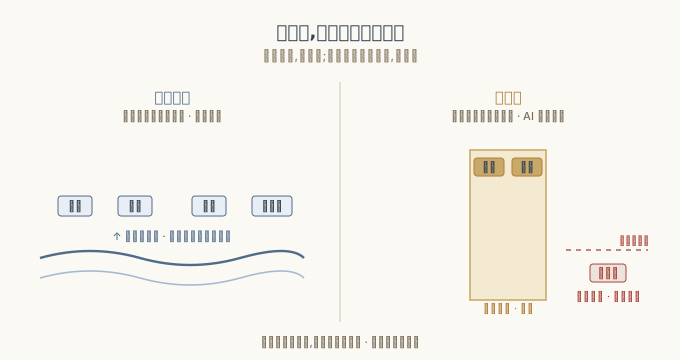
Once you see this layer, Friday’s bounce is not hard to read. It was not the master switch of risk appetite being thrown; it was money stampeding into one story — AI is going to keep spending. Microsoft and Amazon printed strong earnings back to back; Microsoft’s report alone sent the stock up some fifteen percent in a single day, Amazon surging right behind it, chips rising in a pack. This was not the whole category of “risk” being repriced; it was one specific narrative being snapped up. When money is spread wide, it is countless people each betting their own future — a tide laid flat, lifting every boat at once. When money narrows, the tide squeezes into a thin channel, and only the boats moored inside it rise; the ones moored elsewhere stay put.
Bitcoin, on Friday, was moored elsewhere. The buyer it needed did not show — every dollar willing to take a risk that day was busy chasing the one AI story, and none was left over to bid for it.
There is a layer of reflexivity hiding here too. On the way down, leveraged holders are forced by their losses to sell, the selling drops the price, and the lower price forces still more to sell — the fall itself manufactures more fall. In mid-July, bitcoin had the pedal held down by exactly that machine. But by month-end, most of those who had to be flushed out were already out, and the fuel of forced selling had mostly burned off; so it steadied and held its gain for the month. The same machine had floored the down-pedal, then simply lifted its foot — not because anyone suddenly turned bullish on it, but because the force pushing it down had spent itself. At bottom, that machine never once computed what bitcoin is worth. It computed only one thing: how many leveraged hands have yet to finish selling.
So do not take “risk appetite is back” for a true sentence. There is no master switch in the market called risk appetite — there never was. There are only pools of money, crowding this door today and that door tomorrow. When they crowd together, you see “correlation” and take the assets for one thing; when they scatter, you finally see that what bound them was never a shared nature — only the same money, happening to stand in the same place.
Price never tells you whether two assets are alike. It tells you only which door the money is crowded behind right now. You think you are reading the market’s appetite; you are reading a crowd’s footing. You think the bounce is risk appetite returning; it is one herd that turned and ran the other way. The easiest mistake a person makes is to take a crowd’s aggregate force for an invisible hand on a switch — to take the shadow the money throws for the assets’ native bone.
To rise and fall together is only the same money, happening to stand in one place; scatter the crowd and the shadow scatters with it.
SECURE PAYMENT VIA STRIPE
Subscribe: $50 annual pass unlocks every paid article on this site for one year
Go deeper: Ko-fi members get a weekly members-only deep dive, from $3/month Become a member →