The Catch-Up Rally Is an Ending, Not a Beginning!
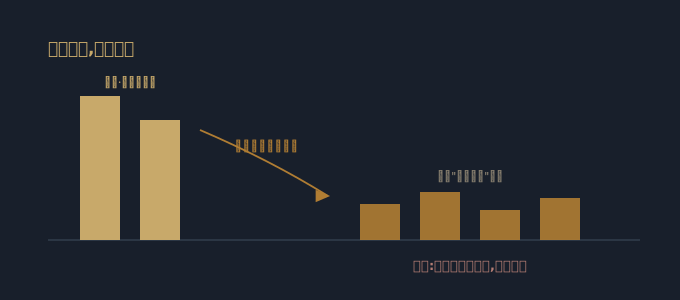
A catch-up rally is not the start of a new trend. It is the end of an old one.
A popular line is making the rounds: “Hard tech has finished leading; capital will now rotate into AI applications for a catch-up leg.” Rotation gets framed as a relay race with a guaranteed next runner — the strong finish their lap, hand the baton to whatever hasn’t run yet, everyone gets rained on, the rally rolls forward. People call it rotation. They call it price discovery. They imagine capital performing a fair redistribution across the market.
But a catch-up rally is not price discovery. It is the same pool of liquidity making its final handoff at the end of the chain.
To tell the difference, watch whether the reason money flows in has changed. Early in a trend, capital buys a sector because it sees real growth, real orders, real expectations being met — it is computing the future. By the catch-up stage, the only reason left is: “everything else has already gone up, this one hasn’t.” That is no longer computing the future. It is computing a queue. A catch-up rally never fills a value trough — it fills a sentiment trough. It isn’t buying “this is worth the price.” It is buying “this hasn’t had its turn.”
This is the dimensional collapse of a late-stage trend. A healthy trend is a distributed computer: thousands of independent judgments about the future flow into price, and the machine runs at full power. In the catch-up stage that computer has degenerated, its entire computation compressed into one lowest-dimension signal — has it gone up yet? When a market starts collectively buying “whatever hasn’t risen,” it has stopped computing value and started computing the order of the line. From computing the future to computing “whose turn is next” is a genuine collapse in dimensionality — and the most honest signal that a trend is running dry.
Doesn’t a catch-up rally contradict “the strong get stronger”? Isn’t that a sign of renewal? Precisely the opposite — the exception is the rule here: the catch-up leg isn’t a refutation of the trend, it is part of how trends end. The strongest names get bought to exhaustion first; their upside gets fully borrowed against; and the marginal dollar, finding no new high ground, is forced downhill to fill whatever corners were never filled. This is not more water arriving. It is old water finding the last unfilled crack. Which is why the more festive the catch-up rally — the broader the participation, the more every laggard “finally moves” — the closer the ending is. It is the fox parading in the tiger’s absence: by the final stretch, the tiger has already left.
Hold the two halves side by side and it sharpens. Mid-trend, the leaders climb on fundamentals and laggards drift up in their wake — catch-up as overflow. Late-trend, the leaders stall and capital is forced downhill — catch-up as the only thing still moving. Same word, opposite meanings: one is the spillover of a healthy trend, the other the dead-cat glow of an exhausted one. The distinction is never whether things are rising. It is whether new computing power is arriving to discover new value, or the existing stock of liquidity is hunting for the last unfilled trough. The first is a beginning. The second is an ending.
So when the research notes start writing “catch-up rally” as the next major theme, the thing to fear is not which sector gets the baton. It is that this market’s remaining computation has been reduced to sequence. A market is most alive when it computes the future — and least alive when all it can compute is “who hasn’t gone up yet.” The catch-up leg fills in the last piece of the puzzle. And when the puzzle is complete, the picture is finished.
The catch-up rally fills the final sentiment trough; when all a market can compute is "who hasn't risen," it has nothing left to compute.
SECURE PAYMENT VIA STRIPE
Subscribe: $50 annual pass unlocks every paid article on this site for one year