Supercycles Are Most Dangerous When Most Certain!
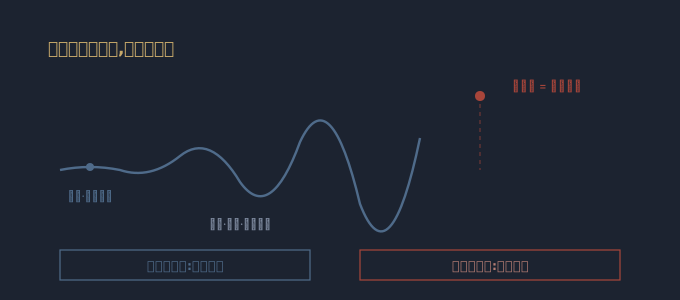
The most dangerous moment for a cyclical stock is not when nobody believes in it. It is when everyone can compute its next two years to the decimal.
Morgan Stanley has raised its targets on the memory leaders, projecting AI-related storage demand to grow from 20.5 billion gigabytes in 2025 to 40 billion in 2026 and 60.9 billion in 2027 — better than 50% a year. The market cheers the “NAND supercycle”: visibility, growth, price targets, everything converging on one word — certainty. And it is precisely inside that certainty that the worst risk-reward hides.
The moment demand is most certain is the moment the margin of safety is thinnest.
Start with where this “certainty” comes from. Memory is a textbook bullwhip chain: a small wobble in end demand travels through module makers, fabs, and equipment vendors, and every link over-orders a little for fear of shortage, amplifying the signal stage by stage. So the handsome “50%+ growth” in the institutional models is not a reading of true end demand — it is a reading taken at the far end of the whip. The certainty you see is certainty amplified by the supply chain; the louder the far end of the chain shouts, the closer the whip is to full extension. And the law of the bullwhip is simple: it snaps back hardest exactly where it was flung farthest.
Now run it through the risk-reward lattice. The value of any position lives in the ratio of upside to downside. Early in the cycle, demand is real, inventories are scraped clean, prices and capacity both point up — but nobody dares believe it, disagreement is maximal: open upside, limited downside, superb odds. Late in the cycle the picture inverts: the growth rate is written into every research note, order visibility stretches two years, targets ratchet upward, every last piece of good news is priced in — the upside has been borrowed and spent in advance, while the downside has just swung open. Whoever buys here believes they are buying “certain growth.” What they are actually buying is certainty flung to the very tip of the whip, one twitch from the snapback.
Reflexivity then pushes it to the limit. High growth expectations → industry-wide capacity expansion → new supply lands → supply crushes price. The peak of a supercycle is precisely the moment when everyone is expanding, everyone is stockpiling, and inventory is being stacked layer upon layer. Where demand is most certain, supply’s revenge is buried deepest. This is the fate of every cycle: it never tops because demand disappears; it tops because everyone is so sure demand cannot disappear that they build and hoard against it — turning certainty itself into the seed of the next glut. The moment of maddest expansion is the moment nearest the turn.
So what decides profit and loss is not how clearly you see — it is where you are standing when you finally see clearly. At the point of maximum visibility, growth has already degenerated from a margin of safety into common knowledge. Growth is the true margin of safety — but once growth becomes consensus, written into everyone’s price target, it stops providing any margin at all and becomes the most crowded, most fragile exposure in the market. What you are picking up is not a cheap cigar butt; it is certainty held aloft over everyone’s head, gleaming — upside sealed, downside open, the worst odds on offer.
In this sense, cycles never reward the people who see most clearly. They reward the people who board when no one can see, and leave when everyone can. Every cent of premium you pay for certainty equals, exactly, the drop you will absorb when it collapses. Certainty is the most expensive thing in any market — and the most expensive thing reliably pays the thinnest return.
The seduction of the word “supercycle” is exactly its danger: it makes the next two years look legible at a glance. But markets never settle on “looks legible.” They settle on where supply and demand actually meet in time. When something is so clear that even the most cautious institutions are raising their targets, the clarity itself is no longer worth anything.
Cycles do not reward those who see most clearly; the moment of maximum visibility was never a buy signal — it is the sell signal.
SECURE PAYMENT VIA STRIPE
Subscribe: $50 annual pass unlocks every paid article on this site for one year