Selling Your Compute Is the First Crack in the Compute Faith!
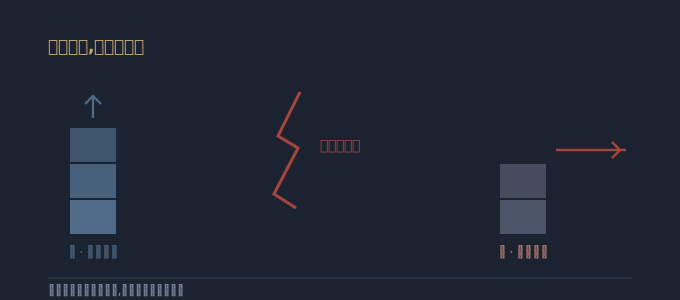
There is a fashionable reading going around: Meta beginning to rent out its own AI compute is a “rational monetization of idle capacity,” the sign of a business model graduating from a “pure cash-burning buildout” into a “billable platform asset.” It sounds like maturity, an upgrade, good news — the infrastructure that burned cash for years is finally learning to feed itself.
But this reading takes a directional signal and files it away as a financial optimization.
A frantic hoarder of compute who suddenly agrees to rent it out is not doing so because he has surplus on his hands. He is doing it because his own calculator gave him the answer: holding it beats selling it no longer.
For two years, compute has been the most devout faith in this market. Every giant moved in one direction only — buy the chips, build the clusters, grab the power, lock the capacity, terrified of falling a step behind. The logic: compute is scarce, compute appreciates, compute is the ticket to superintelligence, and the return it can generate in my own hands towers over any rent I could collect. In that faith, compute flows in and never out; you hoard it like gold, and only a fool sells. The car has an accelerator and no brake.
So when a top player taps the brake for the first time and lists its compute for rent, the thing worth reading is not “it has a little idle capacity.” It is that the calculator inside the company returned an answer contradicting the faith: the marginal return this compute can create in my own hands has already fallen below the market rent. Otherwise there would be no reason to sell — a true believer in ever-rising compute does not rent out his gold halfway up the mountain.
This is the most honest vote in the spontaneous order. The market never listens to what the keynote says; it watches where capital votes with its feet. A thousand words of “platform narrative” cannot outweigh a single act: the water-maker has started selling water. When the man who dug the well is willing to sell water to his neighbors at the going rate, it means the water in that well is no longer scarce enough to be worth hoarding. Pricing power, scarcity, “worth more in my own hands” — the premises holding up the valuation are quietly chipped away by the seller’s own behavior.
Set hoarding and selling side by side and the signal sharpens. In the frenzy of hoarding, every chip reinforces the consensus that “compute is priceless”: the more you buy the scarcer it gets, the scarcer it gets the pricier, the pricier it gets the more you must buy — a left-foot-on-right-foot feedback loop where price and faith feed each other. Reverse it: the moment a top player starts selling, the chain changes direction. Someone selling means someone has computed the opportunity cost of holding; once that cost is computed, the scarcity narrative loosens; once the narrative loosens, everyone else’s resolve to hoard wobbles too. Hoarding manufactures scarcity; selling consumes it. The same batch of compute is the fuel of the faith when held and the crack in the faith when listed.
Someone will say renting is the smarter use — collecting rent beats letting it sit idle, and this proves the ecosystem is maturing. Half true. Renting does beat idling — but that sentence itself concedes something: the return on using this compute yourself has sunk low enough that “might as well rent it out.” A thing that moves from “only worth it if I keep it all to myself” to “renting it out doesn’t hurt either” has, in that gap, seen the general sinking of its marginal return. Maturity, fine — except the market forever misreads the “rationality” at a cycle’s top as the opening of a new phase.
Run it through the risk-reward lattice and it turns colder. The faith in compute is fullest when everyone only buys and never sells, when the upside narrative blots out the sky — downside looks sealed, upside looks open, and the valuation is bid to the heavens. And the first act of “giving some back” means the marginal holder has shifted from grabbing to offering; the upside imagination begins to be priced against real rent, while the downside has just been pried open by one of its own. The danger was never that someone is bearish — it is that the most committed bull begins to short his own faith with actions.
In this sense, whether one company rents its compute is a small thing. A market that treats compute as a faith seeing, for the first time, the water-maker sell water — that is the large thing. The reversal at a trend’s end is never punched through by an external shock. It is the most committed insider, with one “rational” gesture, quietly loosening the first screw.
The gold is the same gold. What changed is not the compute — it is the man holding it, who has finally begun to doubt whether it is worth holding at all.
Hoarding compute manufactures scarcity; selling it consumes scarcity. When the water-maker starts selling water, the crack in the faith opens from his own hands.
SECURE PAYMENT VIA STRIPE
Subscribe: $50 annual pass unlocks every paid article on this site for one year
Go deeper: Ko-fi members get a weekly members-only deep dive, from $3/month Become a member →