Nvidia Didn't Fall on Demand — It Fell Because the Credit Pipe Finally Showed!
What stung about Nvidia’s drop was never the couple of points on the tape — it was what those points were actually pricing. What should unsettle you about the $500 billion rescue isn’t whether the money shows up — it’s why it had to show up now. And what deserves real scrutiny isn’t the four syllables of “concentration risk” — it’s that for the first time, the question of where this compute boom’s money actually comes from got laid out in the open, in full view.
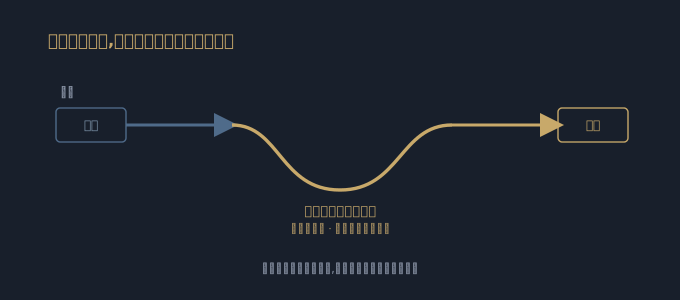
Nvidia didn’t fall on weakening demand. It fell because the credit pipe that has been running quietly underneath this whole buildout finally got seen.
Lay out what happened. On Monday, August 10, Nvidia announced it was partnering with Apollo, BlackRock, Blackstone, Brookfield, Goldman Sachs and KKR to mobilize more than $500 billion in third-party capital for AI infrastructure worldwide — using compute itself as collateral, raised through special-purpose entities issuing bonds, tens of billions of dollars at a time. By any ordinary reading this is enormous good news: half a trillion dollars lining up to pour into this industry. Instead, from the open, Nvidia’s stock slid roughly 2 to 3 percent, market value down tens of billions on the day. An announcement that read “the money is coming” bought a sell-off. A contradiction? Not really, once you look closer.
Here is the hinge: this isn’t equity. It’s debt — debt Nvidia itself organized, collateralized by its own customers’ future compute.
Unpack “concentration risk” and it translates plainly: Nvidia has long been helping its customers borrow money to buy the chips Nvidia sells them. The more they borrow, the more they buy, the better Nvidia’s revenue line looks — but whether that debt ever gets repaid depends on whether the compute those chips get built into actually earns the money back. Revenue and risk turn out to be two entries on the same ledger; nobody had ever been forced to read them side by side. This time, at half-a-trillion-dollar scale, that ledger got opened for everyone to see.
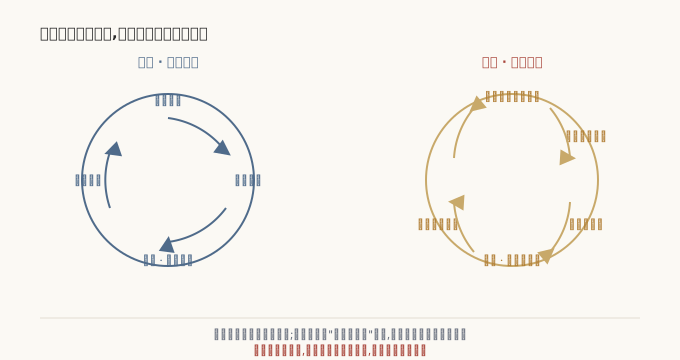
Follow the chain and a reflexive loop appears. Chips sell, revenue lands, customers expand capex, orders grow — that’s the familiar first half everyone already understands. But now there’s an extra link: Nvidia helps manufacture its customers’ borrowing capacity too. Customers borrow more, buy more chips, Nvidia’s revenue and the value of the collateral — the compute itself — rise together, which supports an even bigger round of borrowing next time. Once this loop is spinning, every link amplifies the next. It isn’t Nvidia building chips anymore. It’s the credit pipe inflating itself.
On the way up, every link in this pipe makes the next one richer. The day compute stops being scarce, the same pipe drags every link down at the same speed.
Run it backward and the fragility shows. The whole chain depends on one thing holding: that the collateral — compute — keeps appreciating. But compute depreciates. A new chip generation lands and yesterday’s data center is worth less overnight; if model efficiency ever proves it can do more with less compute, the collateral pledged today gets marked down tomorrow. Once collateral shrinks, borrowing costs jump, new customers can’t get cheap credit, orders cool, and Nvidia’s own credit standing slips a notch too. What’s borrowed has to be repaid — debt signed is water spilled, impossible to take back. The virtuous loop and the vicious one are the same loop; only the direction flips. That is exactly the part of this mechanism most likely to be forgotten, and most worth remembering.
Early-stage compute growth ran on cash customers already had: cloud providers spending real capex budgets, each making an independent bet — a distributed computer of judgment. What’s happening now is different: growth needs Nvidia itself stepping in to manufacture customers’ borrowing capacity, just to keep pace. That is not a sign demand is cooling — if anything it’s the opposite: demand has outrun what pure cash can fund, so credit has to take the baton. Credit taking the baton isn’t bad news by itself. But it is a reminder that this curve isn’t being grown on cash anymore. It’s being grown on credit.
TSMC, reporting the same day, offered a cross-check. Its July revenue rose almost 45 percent year over year, a fresh monthly high, driven by AI-chip demand. If this boom were actually cooling, that print should not exist. So what the market repriced on Monday was never “will these chips keep selling” — TSMC already answered that. It repriced whose money is buying the chips that do sell, and who eats the first loss if that pipe ever runs thin.
This $500 billion rescue is less an investment than a confession: this industry was never going to expand purely on its own cash flow — it needs the whole of Wall Street’s credit standing behind it. That isn’t automatically bad news, and it isn’t proof a crash is coming. Most real industrial buildouts, past a certain scale, end up running on credit relay — that’s the ordinary case, not the exception. The real risk was never whether to take this money. It’s whether everyone taking it understands what exactly they’re borrowing, and what exactly they’ve pledged. Miss that distinction, and on the way up you think you’re pocketing cash; on the way down you discover you’re the one holding the debt.
You thought Nvidia fell on demand. It fell because the credit pipe nobody had bothered to look at closely finally got dragged into daylight.
SECURE PAYMENT VIA STRIPE
Subscribe: $50 annual pass unlocks every paid article on this site for one year
Go deeper: Ko-fi members get a weekly members-only deep dive, from $3/month Become a member →