Nvidia Says Demand Is Higher Than Seventy Percent — That's Not a Verdict, It's the Defendant's Own Confession!
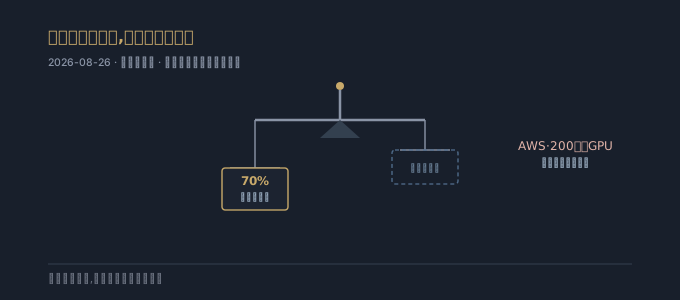
A claim has been making the rounds: Nvidia’s earnings — specifically that line about “next year’s revenue growing another seventy percent” — has finally put the AI-bubble argument to rest. Demand is this strong, so the skeptics should stand down. This is a familiar category error: mistaking what the defendant says on the stand for the verdict the judge hands down.
Beijing time’s pre-dawn close today tracks Wall Street’s Wednesday session — August 26. Nvidia reported after the bell, and for the first time in its history issued guidance reaching into the next fiscal year: roughly 70% revenue growth for fiscal 2028. But the very line every headline is quoting as proof, Jensen Huang spelled out plainly on the call: seventy percent is not an answer computed from demand — it is a ceiling admitted to by supply. Real demand, he said, runs higher than that number. This is not a verdict on demand. It is a confession about supply — and the mouth reading the confession and the mouth being cross-examined belong to the same person. Testimony can never establish its own innocence. What actually settles a case is whether someone else is willing to sign their name to it.
Real, trustworthy demand signals never look like this. The same day, Amazon Web Services announced an incremental order for 2 million more Nvidia GPUs, for delivery through 2027 and 2028 — a party with no stake in Nvidia’s story, doing its own arithmetic, clearing its own budget, and putting real capital behind the number. That is distributed computing in its proper sense: thousands of buyers who have never met each other, each independently computing the future, and the tally of their independent verdicts is what demand actually is. “Seventy percent,” by contrast, only ever passed through one computation, and the one doing the computing and the one being measured are the same company. A supplier declaring that its own factories can only support seventy percent growth proves nothing about how many outsiders want to buy — it proves only how much that one factory can build in a year.
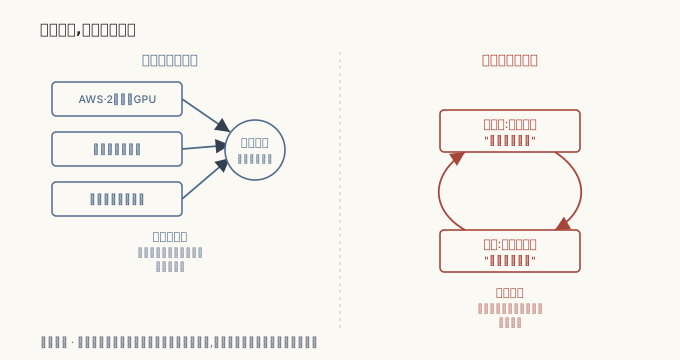
This kind of self-testimony works beautifully on the way up. Quarterly revenue came in at $96.2 billion, up 106% year over year — a genuinely strong headline number, and once it’s layered under a “supply-constrained, demand overflowing” narrative, the market automatically fills in the rest of the story in the most optimistic direction: if you can’t sell enough no matter what, then the multiple deserves to go higher. Next quarter’s guidance opened at $108 billion — again a near-term promise the supplier is making to itself, and again treated by the market as hard proof that demand is certain. Early in a cycle, this kind of self-testimony and real third-party orders reinforce each other so closely that you can’t tell them apart. But the day real orders start slowing, and outside buyers stop being willing to put their names on the line, that same sentence — “supply-constrained, demand even stronger” — flips from a confident admission into an uncorroborated plea. Building the credibility took several quarters. One missed guide is enough to tear it down.
At bottom, the weight of a claim was never about how confident the speaker sounds or how loudly it’s repeated — it’s about whether a third party is willing to co-sign it. Answering your own question, talking to your own mirror: repeat it a thousand times and it is still just one party’s testimony, even when that party happens to be the person who understands chips better than anyone alive. In substance, this is the same blind spot behind Nvidia’s own circular-financing deals: people are forever tempted to shortcut a complex system’s actual arithmetic, to route around the one outside verifier who has no stake in the story, and simply stamp their own paperwork and issue their own passport. In practice, the system never accepts a proof that only asks and answers itself. It only recognizes one thing: whether anyone is willing to put their own money behind the claim.
Supply can be promised in advance. Credibility cannot be self-issued.
A confession written by the defendant never settles the defendant's own case — what actually counts is whose name is willing to go on it besides theirs.
SECURE PAYMENT VIA STRIPE
Subscribe: $50 annual pass unlocks every paid article on this site for one year
Go deeper: Ko-fi members get a weekly members-only deep dive, from $3/month Become a member →