Apple's Cost Is Amazon's Revenue!
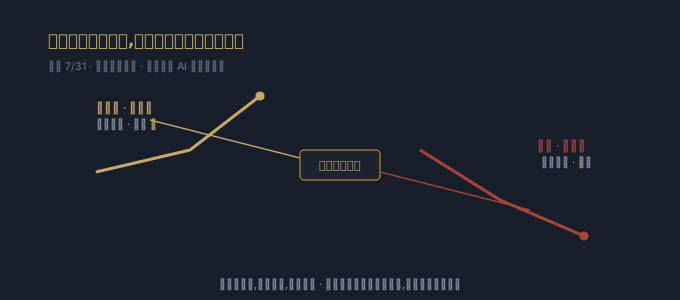
On the July 31 session that closed early this morning Beijing time, the market wore two faces. Apple cratered more than seven percent after earnings — its worst post-report day in over a decade. On the very same day, Amazon exploded higher, leaping roughly fifteen percent in a single session. The tape settled on one reading: Apple has fallen behind, its growth has peaked, it missed this round of AI; Amazon caught the cloud-and-compute updraft and soared. One loser, one winner, two stories running in opposite directions.
That reading mistakes the two ends of a single thing for two things.
Start with why Apple fell. Not because it is weak — the opposite. It just posted the highest quarterly revenue in its history. It fell because Cook, on the call, said the quiet part out loud: memory is living through a “100-year flood” on pricing, the company will “reluctantly” raise prices, and for the next several quarters the iPhone, the Mac, and the iPad will all be throttled by chip supply. The market read it instantly: Apple minted a record this quarter, but next quarter it owes an ever-larger bill for chips. What sold off was not the money already earned — it was the money about to be paid out.
Now why Amazon rose. Its cloud business clocked its fastest growth in about four and a half years, AI pushing demand for raw compute through the roof, capital lining up to pour into the end that sells compute.
Hold the two faces side by side. That “100-year flood” in memory Apple keeps describing — where did the water rise from? From Amazon’s end, the AI cloud swallowing chips and memory around the clock. The very same chips, bought out from under everyone, land as revenue on Amazon’s ledger and as cost on Apple’s.
The cost Apple pays out is the revenue Amazon takes in.
This is not two stories. It is one number, read from both ends. Scarcity is a single account, and revenue and cost are its two sides.
Stand at the end that sells compute — the cloud providers, the chipmakers — and scarcity is the best possible news: the tighter the supply, the higher the price, the thicker the revenue, the giddier the stock. Stand at the end that consumes compute — the ones who treat chips as raw material and build finished devices — and the same scarcity is the worst possible news: the tighter the supply, the higher the cost, the thinner the margin, the uglier the stock. One event, carried to the two ends of the chain, flips a sign: a plus at one end, a minus at the other.
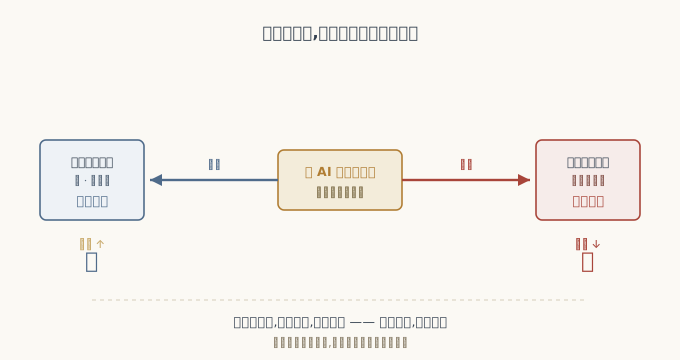
So those two faces on Friday: the rise was not “Amazon is stronger than Apple,” it was the same shortage happening to stand at Amazon’s end; the fall was not “Apple is weaker than Amazon,” it was the same shortage happening to press down on Apple’s. Scarcity does not detour around you because you are Apple. It knows one thing only: who is nearest the chip — who sells it, who is scrambling for it.
Here lies the most counterintuitive layer of all. Cook was explicit: Apple is short of chips not because it cannot sell, but because it is selling too well — the iPhone and Mac are moving faster than the company itself expected. Its “cost disease” is the byproduct of its own runaway demand. A company sells out, gets throttled by its own popularity, and its stock takes a blade for it. The winner’s affliction looks exactly like the loser’s.
In that sense, the market’s whole “winner/loser” partition picked the wrong subject from the start. It thinks it is scoring the strength of two companies. What it is actually recording is how one finite pool of compute gets split between two ends.
No one sits above the machine deciding that Apple should lose and Amazon should win. The finite supply of chips flows, on its own, toward the highest bidder, the hungriest use — AI’s demand for compute. As it flows, it writes one word at each end, and they are opposites: at the end it rushes toward, “revenue”; at the end it deserts, “cost.” This is an allocation with no judge — a complex system computing, by itself, whose scarcity this is. No boardroom, no analyst, ruled the outcome.
The mistake people make most easily is this: they see one thing rise and another fall and rush to find “who is stronger,” pinning a winner’s title on one and a loser’s label on the other. But the system hands out no such medals. In the end it is running the plainest arithmetic there is: this scarcity — who collects it, who pays it. You think you are ranking companies. You are reading the debit and credit of a single account.
Scarcity never vanishes into thin air. It only changes whose name pays. Today Amazon collects it as revenue and Apple pays it as cost; let the wind shift, and the collecting and the paying merely trade names. Between the ebb and the flow, the plus and the minus stay balanced to the last.
A rise and a fall are never victory and defeat — they are one ledger, entered on both the debit and the credit side.
SECURE PAYMENT VIA STRIPE
Subscribe: $50 annual pass unlocks every paid article on this site for one year
Go deeper: Ko-fi members get a weekly members-only deep dive, from $3/month Become a member →