Chip Stocks Fall for Seven Days Straight — Not on Fading Confidence, But on Nvidia's Own Check Coming Due!
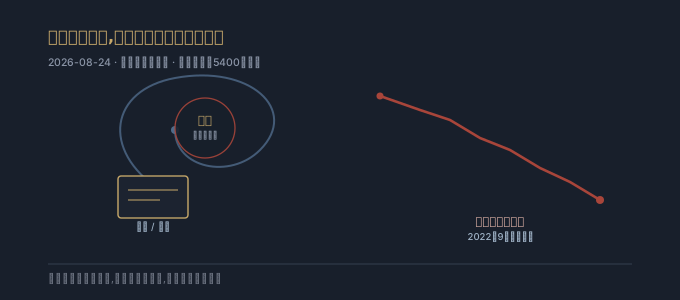
Chip stocks have not fallen for seven straight sessions because confidence in the earnings is fading. They have fallen because a check Nvidia wrote to itself is about to come due.
By the close on Monday, August 24 (US Eastern), Nvidia had dropped for a seventh consecutive session — the last time it fell this long was during the rate-panic of September 2022. Over that stretch it has shed 7.5% cumulatively, handing back most of a good month’s worth of gains in a week, and the rest of the chip complex has been sliding right along with it. The popular explanation is simple: everyone is waiting for Wednesday’s earnings (August 26 US Eastern, Thursday morning in Beijing) to settle the matter, and caution ahead of a print is only sensible — the selling is just sentiment killing time until the answer arrives. The trouble with that sentence is that it reads a reflexive system as if it were a person waiting on a letter. Waiting is passive; you just sit there. What actually happened over these seven sessions was active: the market was pricing something that has not yet shown up on any earnings report.
The thing being priced is “circular financing.” Strip away the jargon and the mechanism is plain: Nvidia puts up money — an equity stake, a loan guarantee — for a downstream customer, and that customer turns around and spends it on Nvidia chips. Money out the left hand, an order in the right; by the time it completes the loop, it has become a line of revenue on Nvidia’s own income statement. Since November 2025 these deals have piled up one after another — CoreWeave, OpenAI, Nebius, SK Hynix, the names keep rotating — with announced totals now topping $540 billion, more than double everything Nvidia earned in its entire prior fiscal year. That sum, at bottom, is not evidence of demand. It is Nvidia’s own credit, sent around a loop, coming back dressed as its own revenue.
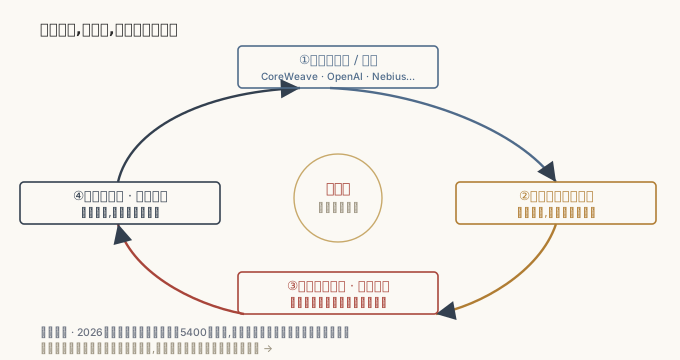
This is reflexivity in its purest form: Nvidia funds a purchase; the purchase becomes Nvidia’s revenue; the revenue lifts the stock; the higher stock lets Nvidia write an even bigger check next time, and dare to write it. Every step manufactures certainty for the next one, and once the loop closes, the system no longer needs an outside buyer — someone with no stake in Nvidia at all — to verify that the demand is real. It only needs to keep agreeing with itself. This is not distributed computing, in which many buyers who have never met each other independently decide whether to buy. It is a closed loop, one wallet paying itself with one hand and collecting with the other. Early on, these deals were scattered across different company names and looked like real orders landing all over the industry at once — several independent forces pointing the same way. By now the announced sums have grown larger with each round, and the names signing the checks and the names cashing them have started to rhyme with each other. What began as several independent inputs has degenerated into a single self-referential loop.
Nvidia’s own guidance for the quarter reporting after Wednesday’s close (Thursday morning in Beijing) is $91.0 billion, plus or minus 2%. Wall Street is not short on confidence here — most analysts have penciled in a number above that. But what is actually being watched is not whether $91 billion is high enough. It is how much of that $91 billion traces back to the $540 billion of self-dealing described above — and when a buyer is also its own seller’s creditor, no earnings table on earth will tell you whether that order counts as real demand. This is not an exam where an answer gets revealed. It is the first time this loop has had to hand a publicly audited ledger over to the one external check it had, until now, managed to skip.
The two directions of this trade are mirror images of the same mechanism. On the way up, every check Nvidia writes becomes proof that demand is real; more proof makes the next, larger check easier to justify — the loop is manufacturing its own growth. Once it turns, the sequence runs in reverse, in the same order: seven days of falling share price cheapens the hard currency — Nvidia’s own stock and cash — that funds these checks in the first place; a cheaper currency makes the next check harder to write comfortably; the next round of downstream purchasing gets delayed or trimmed; a thinner circular contribution shows up in the next quarter’s revenue; a weaker quarter presses the stock down further. On the way up, the loop manufactures its own credit. On the way down, the same loop destroys it. Demand did not go quiet first and drag the stock down after it. The stock turning is what cut the line feeding the loop in the first place.
At bottom, seven days of selling did not happen because someone found proof that demand is disappearing. It happened because the market did the more basic arithmetic first: however many times a check gets written, the signature line and the deposit line eventually have to match a name that is not the same on both sides — and where they do not, the check trades at a discount. Circular financing, in that sense, is not fraud. It simply moves the leverage from the buyer’s side of the table to the seller’s own side — the risk has not vanished, it has just changed which ledger it is hiding in. People trust their own arithmetic about complex systems far more than they should, telling themselves that money they put up and orders they collect can quietly skip the step of finding a real, unrelated buyer on the other end. A system built this cleverly still refuses to accept a self-issued receipt as proof. It recognizes exactly one thing: whether the money that made the full circuit ever actually landed in the pocket of somebody who has nothing to do with you. That is the iron law of spontaneous order in a complex system — it does its own accounting, and whatever verification step a person tries to skip on its behalf gets repaid somewhere else, with interest.
A check can be written in advance. Demand cannot be borrowed in advance.
Credit you issue to yourself still has to go to the post office, in the end, for a stranger's stamp.
SECURE PAYMENT VIA STRIPE
Subscribe: $50 annual pass unlocks every paid article on this site for one year
Go deeper: Ko-fi members get a weekly members-only deep dive, from $3/month Become a member →