"The Market Hasn't Priced It In" Is a Pseudo-Concept!
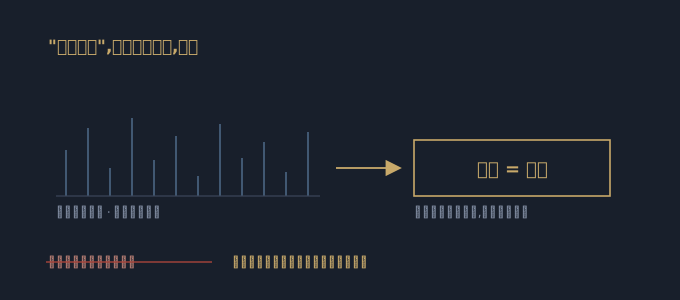
The market never prices an event. It prices the weighted sum of all events.
Nearly every strategy note published today carries the same sentence: at current valuations, the market may not have fully priced in the possibility of at least one more rate hike this half. Dressed in rigor, it reads like a responsible risk warning. Ask one more question and it falls apart. Who, exactly, failed to price it? Which piece is missing from the number? And how do you know it is missing?
“Not priced in” is never a statement about the market. It is a statement about the person saying it. Price is the net sum of votes cast with real money. Some are long the hike, some are long the pause, some are long the cut, some never look at rates at all and only trade earnings. Their positions, their leverage, their stops, their options — all of it is compressed into that single number. That number is not anyone’s view of the future. It is everyone’s view, weighted by capital. It is the output of a distributed computation, not the opinion of one machine. When you say the market has not priced something, what you are really saying is: my probability is larger than the one the market weighted out, and the market has had the nerve not to agree with me.
So the phrase is not an observation. It is a position. It is a more respectable way of saying I am short. The honest version would be: I put the odds of another hike at 60%; back out the implied odds from rate futures and option volatility and the market says 30%; therefore I am selling. That sentence can be falsified, settled, and made to cost you money. “Not fully priced in” cannot. It disguises a settleable bet as an unfalsifiable observation.
Turn it around and it gets clearer. If something truly were not priced, it would be a free lottery ticket, and anyone who saw it should buy it. And the moment anyone buys it, they are pricing it. A “mispriced risk” printed in every strategy note and read by every desk stops being unpriced at the instant it is read — unless you believe you are the only literate person on earth. Pricing takes no intermission. It does not happen when the event lands; it happens the moment each participant forms a view, and it happens continuously. Price is not a man waiting to be notified. It is the residue left after everyone has already notified it.
What actually happens is never “the market finally priced the event.” It is that the market redistributed the weights on a price it had already set. The hike arrives, and price need not fall — because someone had been long that 30% all along, and the 70% crowd merely trims. The hike does not arrive, and price need not rise. Events do not move price. What moves price is each participant’s adjustment relative to the position they already held. That is why “the bad news is out” and “the good news is realized” sound like mysticism. They are not mystical. They are simply telling you that the event you thought was coming was already inside somebody else’s cost basis.
In this sense, “not priced in” is a distinctly human arrogance. It assumes the market is a slow-witted opponent in need of education, and that you are the one who got the answer key early. But the market is not your opponent. It is the machine that aggregates the compute of everyone, you included. You may compute faster than it does — a very few genuinely can, that is called alpha, and it is paid for in drawdown and time. What you cannot do is stand outside it and point at it and say it got the sum wrong. Because in the second you spoke, you were already inside it. Your judgment, and the very act of voicing it, are its inputs for the next second.
The question worth asking was never has the market priced it in. It is how much has the market priced, and how large a bet am I willing to place on the difference. The first question makes you feel clever. The second makes you money or costs you money. Most analysis dies by only ever asking the first.
The market owes you no pricing. Whoever says it hasn't priced something in has simply not yet dared to write his probability onto a ticket that can lose.
SECURE PAYMENT VIA STRIPE
Subscribe: $50 annual pass unlocks every paid article on this site for one year
Go deeper: Ko-fi members get a weekly members-only deep dive, from $3/month Become a member →