Software Stocks Popped 20% and Called It a Verdict — the Witness Who Saved SaaS Is AI Itself!
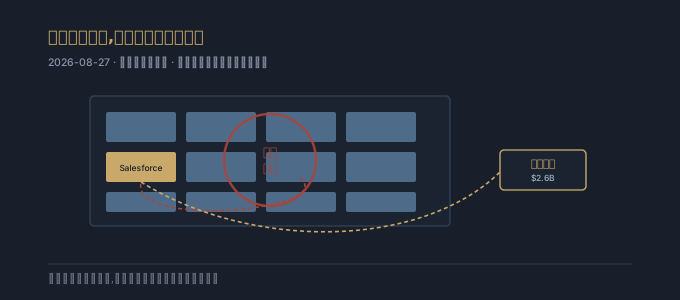
There’s a line making the rounds: software stocks just staged a broad, one-day rally, so the “SaaSpocalypse” — the fear that AI agents would gut per-seat software pricing — can be filed away. AI didn’t kill SaaS. SaaS proved itself, in cash. That reading is a tidy piece of overgeneralization: it takes a lot of tickers going green on the same day and reads it as an entire industry independently reaching the same conclusion — a vote.
The US trading day behind this morning’s Beijing close was Thursday, August 27: the Nasdaq gained 1.57%, its best single session in roughly three weeks. Software was the story. Salesforce closed up 22.6%, its second-best day ever as a public company. CrowdStrike, reporting the same day, jumped nearly 20%. Palo Alto Networks, ServiceNow — the whole basket rode the same wave. On the surface, it looks like the entire software industry raised its hand at once: we were not replaced.
But the testimony from the rally’s lead witness doesn’t hold up once you open it. Salesforce’s non-GAAP EPS for the quarter came in at $5.90. Of that, $2.6 was not earned by selling software subscriptions — it was a paper gain sitting on the balance sheet, from Salesforce’s own stake in the AI startup Anthropic, which happened to get marked up this quarter.
Strip that gain out, and GAAP EPS was $1.86 — lower than the $1.96 posted a year earlier. In other words: the scorecard the market waved around as proof that “AI didn’t kill the subscription business” shows the subscription business actually going backward. What lifted the earnings print, and sent the stock to its second-best day ever, wasn’t SaaS defending itself. It was a check AI wrote to itself.
Here is the irony sitting at the center of this “vote”: the market wanted an independent third party to confirm AI hadn’t gutted software companies. What it got instead was AI showing up as its own character witness. The defendant and the witness are the same name in a different suit. This isn’t a distributed vote — it’s one cause, booked twice: once under “threat,” once under “rescue.” Close the ledger and it looks like a wash. No outside party ever actually checked the math.
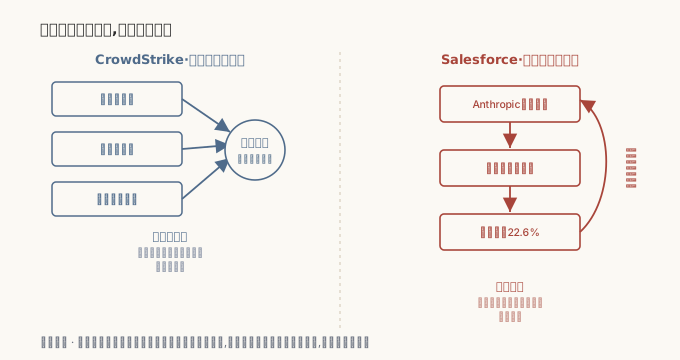
Real evidence did show up that day — it just wasn’t loud about it. CrowdStrike’s net new annual recurring revenue grew more than 50% year over year, the strongest quarterly comparison in the company’s history — not a number produced by marking an investment up, but by thousands of unrelated enterprise customers independently renewing and signing new contracts with real money. That’s what distributed computation actually looks like: each contract is a separate judgment made by a separate party. The market that day, though, couldn’t be bothered to separate the two kinds of evidence. It lumped the whole sector’s gain into one footnote for the same verdict — real growth and a paper gain, melted down into the same coin.
Growth in the sector used to be priced from many independent inputs at once — renewal rates, new contracts, pricing power — each one an outside check on the story. What’s happening now is the opposite: one investment gets marked up, EPS gets flattered, the stock jumps, and the jump itself is read back as confirmation that the AI stake was smart and the “AI didn’t kill SaaS” story was right all along. Close that loop and the system no longer needs an outside buyer to validate demand — it only needs to nod at itself. It’s the same reflex behind the $540-billion circular-financing web in AI chip spending from a few weeks back, just addressed to a different name this time — the check made out to itself.
There was a second, quieter force adding fuel that day. Since the SaaSpocalypse scare kicked off in February, hedge funds shorting software stocks had booked roughly $24 billion in paper profit — money that had been sitting there, unrealized, for months. Some of Thursday’s pop wasn’t a new verdict being computed at all; it was those shorts getting forced out, buying back into the rally they’d bet against, and stampeding the price higher on their own way out the door. A short squeeze is not a vote. It’s an exit under duress. But a candle on a chart can’t tell the difference between the two — it just draws the same steep green bar either way.
At bottom, people are impatient with distributed computation. Waiting for thousands of independent judgments to each run their own course takes time nobody wants to spend, so the market keeps reaching for one loud, tidy signal it can use to buy off the uncertainty in a single transaction. It’s the same impulse behind a Treasury buyback operation a few weeks ago, and behind Nvidia’s own circular checks: always looking for a shortcut that lets a complex system rubber-stamp a conclusion in one move. Complex systems don’t ship in bulk. They compute node by node, with no single verdict that closes the case — only daily, independent reconciliation. Fundamentally, a market willing to applaud a story is not the same as a market that has verified it. The louder and more synchronized the applause, the more worth checking whose hands are actually clapping.
Supply can promise itself forward. Profit can flatter itself for a quarter. Credit is the one thing that can never sign its own name.
When the witness and the defendant share a name, no matter how loud the applause, it never adds up to a real vote.
SECURE PAYMENT VIA STRIPE
Subscribe: $50 annual pass unlocks every paid article on this site for one year
Go deeper: Ko-fi members get a weekly members-only deep dive, from $3/month Become a member →