Wall Street Hit a Record This Day — the PPI Didn't Cool, the Thermometer Got Netted Flat!
What’s hard to parse about this record isn’t that the S&P 500 closed above 7,800 — it’s which data print it climbed on to get there. What should make you pause about July’s PPI isn’t how flat the headline came in — it’s which part of the report is actually doing the canceling. And what’s worth working through isn’t whether “inflation is cooling, so the Fed can ease off” is true — it’s whether a flat net number ever really means nothing happened.
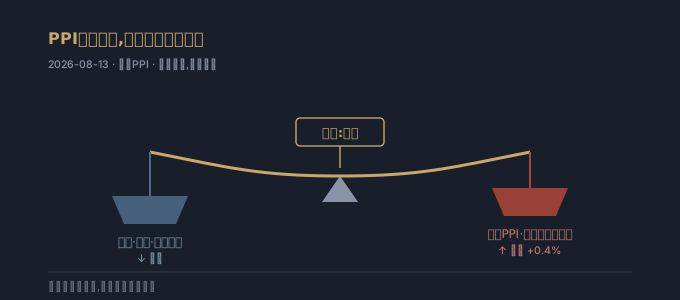
A flat index isn’t a quiet flat. It’s a netted flat — one thermometer cooling, another running a fever, and together they read calm.
Lay out what happened. U.S. markets that closed in the small hours here today were Thursday, August 13, in New York. On an inflation print that came in cooler than the market had priced, the S&P 500 closed above 7,800 for the first time in its history, and all three major indexes finished the session at record highs. The read was everywhere: inflation is cooling, the Fed doesn’t need to tighten further, keep buying risk.
Look at the actual numbers. The market had priced in a 0.2% monthly rise in PPI; it came in flat instead. The year-over-year print was expected at 4.9%; it landed at 4.7%. The numbers themselves didn’t lie. What lied was the habit of stopping at that one layer and calling it a conclusion.
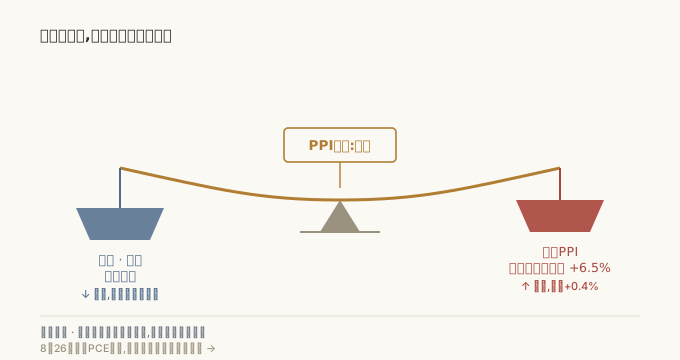
Here’s the hinge: pull the report apart and the story runs the other way. Energy, food, and a batch of trade-services categories like freight and warehousing genuinely cooled this month — those are the thermometers dragging the headline number down. But core PPI — stripped of food, energy and trade services, the slice sitting closest to the gauge the Fed actually watches — rose 0.4% for the month, more than four times June’s 0.1% pace. Leading the fever was an unglamorous line item: portfolio-management fees, up 6.5% in a single month.
At bottom, “inflation is cooling” was never a statement about the body’s actual temperature. It’s that some parts are cooling and some parts are running hot, and the thermometer only reports the number left over after they cancel out. A flat index isn’t a quiet flat. It’s a netted flat. Stopping at that net number and calling it a conclusion is a clean case of reading the average and missing the patient — a net of zero doesn’t mean every probe went quiet.
The moment that net number hit the tape, a reflexive loop started spinning on its own: traders saw “PPI flat” and read it as one notch less to worry about on further tightening, so rate-sensitive positions got sized up. Sizing up pushed the index through a record. The record itself then got waved through as one more piece of evidence that “the economy’s fine, inflation’s under control” — which fed back into more people piling on. ① the net number licenses an optimistic price, ② that price licenses bigger positions, ③ bigger positions push the index to a record, ④ the record itself validates ①’s optimism — and nobody, anywhere in that loop, went back to check on the core probe still running hot underneath it.
The early/late mirror is where this report’s real weight sits. Early: today, the data gets compressed into one net number and the crowd chases it higher, with nobody pausing to pull the thermometer apart. Late: August 26, when the core PCE reading the Fed actually bases decisions on lands — precisely where this fevered core-PPI probe, after a month working its way through the supply chain, is due to show up again. If core inflation keeps running that line on that day, today’s early applause doesn’t automatically get to continue. A netted-out headline is easy to dodge. A core reading that has to stand on its own isn’t.
People would rather have one number they can read at a glance — up or down, warmer or cooler — and let it do all their thinking for them. But a complex system never hands you one reading. It hands you thousands of prices, each clearing on its own ledger, and the net total you see is just the shortcut. Oil falling, food falling, portfolio-management fees rising — these were never the same story. They just happened to land in the same month and cancel into the same number. Whoever bothers to lift the lid gets to see the offsetting pieces underneath. Whoever settles for memorizing the number that’s already been netted out is looking at one tree and mistaking it for the whole forest.
Every calm reading is a netted calm. No weather ever really did nothing — it just happened to cancel itself out that day.
SECURE PAYMENT VIA STRIPE
Subscribe: $50 annual pass unlocks every paid article on this site for one year
Go deeper: Ko-fi members get a weekly members-only deep dive, from $3/month Become a member →