Same Signal, Two Lives: Bonds Took It Back in Two Days, Bitcoin Rode It to a Three-Year Best Week — Price Isn't Chasing the Signal, It's Chasing the Echo!
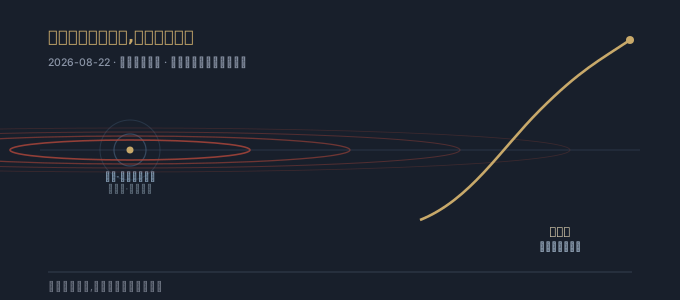
The line making the rounds this week is: “Wall Street liquidity is finally back — this Bitcoin rally is the market casting an early vote for easing.” The problem with that sentence isn’t the conclusion. It’s the direction of causality. It takes a signal that lived for barely two days in the market it was born in, and dresses it up as a fact the whole week supposedly confirmed.
The signal’s origin is not in dispute. The US Treasury announced it would at least double the size of its liquidity-support buyback operations for 10-to-20-year and 20-to-30-year bonds, effective September 9. The first reaction was orderly enough — the 30-year yield dropped the day of the announcement, though not by much, roughly 9 basis points. But the place a headline actually lives isn’t the headline itself — it’s how the market that gave birth to it keeps pricing it in the days after. By Friday, that same yield had climbed back to around 5.25%, almost erasing what the announcement had bought. Whatever room the buyback opened up two days earlier, the bond market closed right back over it. The same week, the S&P 500, Nasdaq, and Dow all closed lower for the week, with the Dow posting its worst weekly decline since March. That is the full extent of what this signal delivered in the two markets standing closest to where it was issued — which is to say, not much.
The same headline, in the market furthest from where it was actually issued, lived an entirely different life. Bitcoin posted its best weekly gain in more than three years, climbing nearly a quarter over four trading days, briefly touching the edge of $80,000, and closing near $77,000 on Friday — holding on to most of the move. The same signal that the bond market gave back inside two days got stretched, in Bitcoin’s price, into a full week of trend.
This isn’t Bitcoin believing in liquidity more than bonds do. It’s that price was never chasing the signal itself — it was chasing the signal’s echo. A signal has to be verified: the bond market re-prices it every single day, checking whether it’s actually being delivered on. An echo needs none of that — it only needs to be repeated, and the farther it travels from its source, the cheaper repeating it gets. Nobody rallies a position by pulling up the Treasury’s operational fine print. At bottom, that’s the real story of this week: the same piece of news, passed along far enough, gets louder with every retelling and drifts further from the account its birthplace would give of it.
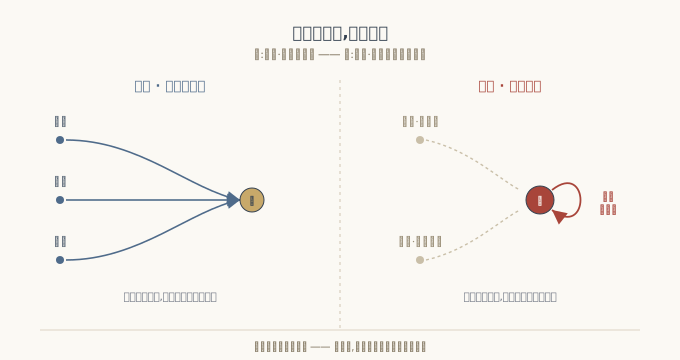
Split the week into two frames and you get a clean early/late mirror. Early is Wednesday, the day the news broke: bonds, stocks, and Bitcoin all reacted within hours of each other, three independent pricing networks running the same input through their own math — distributed computing, grounded in what had actually happened. Late is Friday’s close: the market standing closest to the signal’s source had already computed it to exhaustion, with yields nearly back where they started; all three major indexes were down for the week; and only one node — Bitcoin — was still repeating the same headline to itself. Price rises, drawing in fresh buying and squeezing shorts; the squeeze itself becomes the new reason to keep buying; a fresh high gets read as “the signal confirmed,” pulling in still more buyers. That is no longer distributed computing. It’s a closed loop — and the input feeding it is no longer the headline. It’s the price.
This is as clean a sample of reflexivity as markets produce. Rising price supported the belief that “liquidity is back”; that belief, in turn, supported more buying — the loop closes, and once it does, it no longer needs the original Treasury headline to be true or false. One line from the Treasury Secretary gave the rally a shove downhill it was already leaning toward, but that isn’t a measure of how accurate the signal was — it’s a measure of what an echo is for in the first place. An echo was never built to be checked. It was built to travel. A rumor doesn’t need a liar behind it; it just needs each retelling to carry a little less patience for fact-checking than the one before, and it will grow on its own.
The real risk here was never whether the signal was genuine — it was. The Treasury really did at least double its buyback size. The risk is that the farther a market sits from the source, the fewer people left in it still remember to check back against that source; taking the shortcut of believing is always lighter work than actually pulling the receipts. Bonds get checked daily, which is exactly why they closed the account within two days. Bitcoin has no operational fine-print table sitting on anyone’s desk forcing a reconciliation — so the echo simply keeps traveling. You cannot move an entire pricing network by pulling one local lever; what the Treasury actually moved, from start to finish, was one ring at the outer edge of that network — and the farther a ring travels from the drop point, the louder it gets, and the less it resembles the sentence that started it. Whatever verification cost got skipped along the way doesn’t disappear. It just waits for someone downstream to pay it back, at a price with nothing left to show for it.
A signal can be overturned. An echo can’t — an echo can only get louder.
Price was never chasing that headline. It's chasing whatever is still left of it by the time it reaches you.
SECURE PAYMENT VIA STRIPE
Subscribe: $50 annual pass unlocks every paid article on this site for one year
Go deeper: Ko-fi members get a weekly members-only deep dive, from $3/month Become a member →