What Got Pressed Down Was Not the Yield — It Was One Borrowed Day!
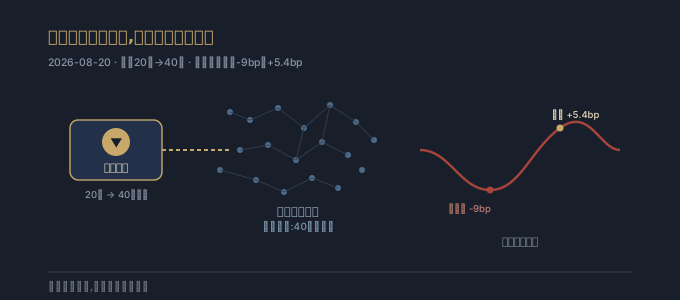
A line went around trading desks this week: the Treasury doubled its buyback operations, so the runaway long end is finally under control. It sounds like relief. It is the same mental error people keep making about complex systems — mistaking a lever for the machine it’s attached to.
What got pressed down was never the yield. It was one borrowed day. As long as trust holds, an operation can make a rate go quiet for an afternoon. The moment the network finishes recalculating what it’s actually owed, the rate returns to exactly where it was — not a basis point more forgiving, not a basis point less.
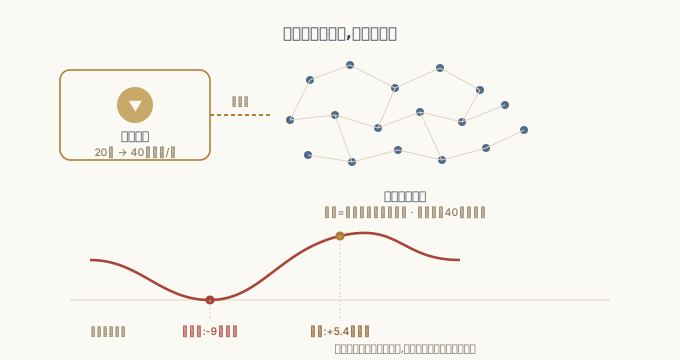
Start with the ledger. The day the Treasury announced it — doubling the maximum size of buyback operations for the 10-to-20-year and 20-to-30-year sectors from $2 billion to at least $4 billion per operation, effective September 9 through November 4 — the 30-year yield fell 9 basis points. A basis point is just the smallest notch on the interest-rate dial; nine of them is roughly a tenth of a percentage point, shaved off a yield that had been marking a 19-year high days earlier. That relief lasted exactly one session. The next day, the same 30-year yield climbed back 5.4 basis points, handing back almost everything it had just given up. What got bought back was debt. What did not get bought back was the one thing sitting in every lender’s ledger: that same week, total US federal debt crossed $40 trillion. A buyback moves the flow. It does nothing to the stock still owed. Turn the tap as hard as you like — the tank’s capacity hasn’t changed, and the water finds its level regardless.
This is not an isolated malfunction. It is the same law proving itself again: you cannot move an entire credit network by leaning on one local price. Trying to pin down the pricing of a whole network with a single lever ends the way every “one action fixes a systemic problem” attempt always ends — the network turns out to have more patience than the lever, and more honesty too.
Lay the announcement day next to the day after and the mechanism gets easier to see. Early: the market hasn’t yet had time to re-run every variable, so a fresh piece of news — the buyback itself — can move price on its own, like a stone dropped in still water, ripples clearly visible. Late: every lender has folded the buyback size, the pace of new issuance, and that new $40 trillion threshold back into their own model and run the numbers again — and landed almost exactly back where they started. The ripples settle, the surface returns to flat. The one thing that didn’t return to where it started is the stone sitting on the bottom, and it’s gotten bigger.
Equities answered the same question a different way that same day: the S&P 500 slipped 0.87% — not a rout, but a plain, matter-of-fact reply. The network had finished repricing the operation, and its conclusion barely differed from where it stood before the announcement. In the end, the long end was never a price the Treasury alone got to set. It is the output of everyone who holds and prices that debt, computing it, unwinding it, and computing it again.
People keep assuming there’s a button somewhere, and that pressing it turns the whole network obediently in one direction. But the network was never driven by a button. It is computed, in real time, by countless independent ledgers — each one continuously checking how much trust is left, and how much debt still isn’t. Manipulate a local price and you can buy the appearance of control for a day. You cannot buy the number the system arrives at once it finishes the recalculation. That new $40 trillion threshold doesn’t get erased from anyone’s ledger by one buyback operation. The bill comes due, one way or another, in everyone’s books eventually.
A yield was never a switch that stays wherever you flip it. It is the credit network’s running vote on how much trust it still extends. What a buyback operation can change is only the mood in the room at the moment of the vote — never what’s still owed in the mind of the person casting it.
What got pressed down was never the yield. It was one borrowed day — and when the day runs out, the network hands you back its own arithmetic.
SECURE PAYMENT VIA STRIPE
Subscribe: $50 annual pass unlocks every paid article on this site for one year
Go deeper: Ko-fi members get a weekly members-only deep dive, from $3/month Become a member →