Seasonality Is Not a Law, It Is the Coincidence That Survived!
There is a claim that has come back, right on schedule.
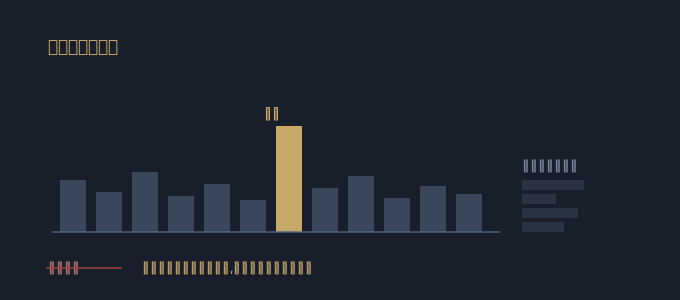
“July is historically one of the best months.” “The first half wins more than seven times in ten.” “Buy in July when the sun is high in the sky.” In nearly every strategy column today sits the same bar chart of monthly win rates, red and green, looking for all the world like a weather forecast. Give it its proper label: this is superstition that has been dressed up in data. It calls a coincidence that survived a law.
Look at how the argument is built. Take thirty years, count the Julys that rose, divide by thirty, and out comes a win rate somewhere north of seventy percent. Line it up against the other eleven months and July ranks near the top. Every number is true, and the arithmetic is fine. What is wrong is the act itself. You are not testing a hypothesis. You are picking, out of a heap of numbers that already happened, the one that most resembles a law. With twelve months, one of them must have the highest win rate. Even if the returns were drawn from a random number generator, the backtest would still deliver a “best month,” and someone would still produce a plausible story for it: mid-year earnings, summer inflows, the end of tax season, institutional rebalancing. Explanations are always plentiful, because explanations are only demanded after the fact.
Seasonality is not a law of the market. It is a survivor’s archive. The month effects that did not hold died long ago, and nobody wrote them up. Every “July effect” you read today was pulled from a vast, unvisited graveyard of failed statistics — the one corpse still on its feet. It stands not because it has bones, but because you only picked up the ones that were standing.
There is a clean line between a real law and a coincidence that survived: a law has a mechanism, a coincidence has only a correlation. The earth’s orbit has a mechanism, so the seasons extrapolate. Christmas retail has a mechanism, because people actually buy things then. So what is the mechanism by which July stocks rise? If it is a seasonal flow of capital, why does that capital not front-run itself into late June? If it is the rhythm of earnings, then earnings themselves are uncertain — by what right does a calendar dictate their direction? A law that requires nobody to do anything in order to hold is not a law. It is a way of keeping the books.
Worse is reflexivity. Suppose the July effect was real to begin with, produced by some genuine rhythm of flows. What happens next? People find it, write it, trade it. Buying moves from July 1 to June 30, then to mid-June. The effect is front-run, thinned, arbitraged away, until it is gone. A seasonal law, once made public, destroys itself by being public. Whereas a seasonality that never existed at all — pure statistical noise — can live forever, precisely because there is nothing in it to arbitrage away. It only needs to be retold each year. Which means the seasonal effects you can reliably read about are, on the whole, more likely to be the fake ones. The real ones were traded to death. It is a cruel filter: the laws that live longest are usually the laws that are worth least.
Both faces are the same event. July rises, and people say look, the seasonality worked — the law gets another year of life. July falls, and people say macro overwhelmed the seasonality this year — the law gets another year of life. A claim that is right when it rises and right when it falls is not a law. It is a consolation. Its function was never to forecast the market. Its function is to give someone who must say something every day something to say on the days when nothing new has happened. And for the listener, its function is to outsource a judgment he should have made himself to a bar chart. The calendar will not be held responsible for your losses, which is precisely its selling point.
At bottom, price is the residue left when everyone’s weighted view of the future has been settled in capital — a distributed machine recomputing itself every second. It does not know what “July” is. It knows liquidity, credit, earnings, and what the people standing across from it are thinking right now. Calendars do not produce returns. People produce returns. To mistake the calendar for the cause is that ancient human impulse: faced with a complex system he cannot compute, a man would rather believe a simple mnemonic he can memorize than admit that he does not know. That impulse built calendars once, and astrology, and today it builds bar charts of monthly win rates. The instrument changed. The fear did not.
In this sense, the real value of seasonality research is not in telling you whether July will rise. It is in showing you why you wanted to believe it. What you wanted to believe in was never July. It was the existence of a law you could use without having to understand it. There is no such thing in this world. The compute of a system is never sold at a discount to those who recite mnemonics.
There are no returns hidden in the calendar. What stands on that chart of monthly win rates is not a law — it is the one coincidence, among all the ones you forgot, that has not yet fallen over.
SECURE PAYMENT VIA STRIPE
Subscribe: $50 annual pass unlocks every paid article on this site for one year
Go deeper: Ko-fi members get a weekly members-only deep dive, from $3/month Become a member →