Outflows Are Not the Same as Falling Prices!
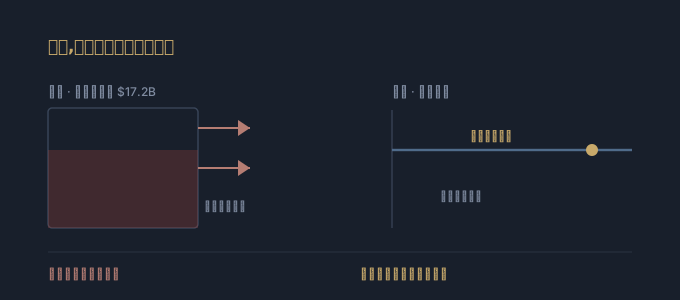
Price is never set by the total. It is set only by the margin.
The most eye-catching number this week is that U.S. equity funds logged the fastest outflow of the year: $17.2 billion in a single week, the second straight week in the red. Almost every reading points the same way — money is running, smart money is leaving, price cannot hold. And yet in that very same week the index sits one step from its record high. “Fastest outflow ever” and “a step from new highs” get printed side by side, and almost nobody asks the simplest question: if money is genuinely leaving, why has price not fallen?
Because “net outflow of $17.2 billion” is a ledger entry, not a sell order. It says only that redemptions exceeded subscriptions by $17.2 billion over the week — a stock-of-money accounting result. But that $17.2 billion did not land as a market order on the tape. When an investor redeems, the fund manager need not sell stock at once; he can draw down cash, wait for the next subscription to offset, or simply nudge the book down a notch. The vast majority of it is a transfer of fund shares settled off-exchange, water moving from one pool to another — and price does not live in the pool. Price lives only in that narrow slit of the order book, set here and now by the last person willing to trade, at the number he is willing to accept.
That is the difference between the total and the margin, and it is where nearly all “flow analysis” breaks its neck. The market is not a tank whose water line rises and falls with how much pours in or out. It is a continuous auction: a thousand would-be sellers and a thousand would-be buyers, with price resting where their willingness meets. You can send nine hundred of them for the exit, and as long as the hundred who remain — sellers who refuse to cut, buyers who still bid — hold their ground, price does not move a hair. What carries a week of positions out the door is money; what holds this second’s price is the unwillingness of those who will not sell cheap. The two are simply not the same thing.
Turn it around and the up moves work the same way. On inflows, people say money pushed price higher; but the true sequence is often reversed — price rose first, the profit effect coaxed the subscriptions out, and money followed. On outflows, likewise: price usually softens first, and that triggers the redemptions, rather than redemptions hammering out the fall. Flows and price are never a one-way chain of cause and effect. They are a loop feeding on each other: price pulls money, money turns back and reinforces price. Collapse that loop into a single “money → price” arrow and you have mistaken a reflexive chorus for one man’s solo.
So what “fastest outflow” really tells you is not how heavy the selling is, but how many people are trying to leave and finding that price will not step aside for them. That is evidence of a firm bid, not a fragile one. The truly dangerous signal is never “a lot of money is leaving.” It is “a little volume opens a deep hole” — that says there is no bid underneath, no one at the margin to take the other side. The former is bookkeeping; the latter is selling pressure. Reading bookkeeping as selling pressure is holding a bank statement and using it to forecast tomorrow’s price of vegetables at the market.
At bottom, price is not a container filled or drained by the aggregate of money. It is the net of everyone’s marginal willingness at a single instant, a distributed machine settling continuously. It does not ask how much money came and went this week. It asks only: the next print — who will trade, and at what price. Trying to infer direction from a week of net outflow is like using a year’s rainfall to predict whether it is raining outside your window right now. Wrong unit, and the conclusion is wrong before you start.
Money can leave all week; price lives only in the last print. What moves positions cannot move the man who will not sell cheap.
SECURE PAYMENT VIA STRIPE
Subscribe: $50 annual pass unlocks every paid article on this site for one year
Go deeper: Ko-fi members get a weekly members-only deep dive, from $3/month Become a member →