The Robot Valuation Buys 2035, Not Today!
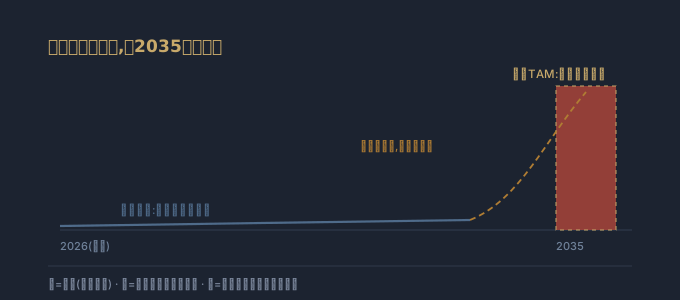
There is a line very popular in the market right now: humanoid robots have “huge imagination space,” a market of hundreds of billions by 2030 and several hundred billion by 2035 lies just ahead, and a star company’s tens of billions in valuation is merely “staking a claim early.” The subtext is this — no revenue now does not matter; what matters is that number ten years out.
This is a classic far-dated stimulant. Its charm is that it takes a distant number no one can falsify and turns it into a certain reason to pay today.
A far-term TAM is never demand; it is imagination, discounted. This is the one line that cracks the whole narrative open. A several-hundred-billion market for 2035 is not an order, not an IOU, not even a forecast — it is the whole of humanity’s optimism about a technology, cashed out in one stroke into a specific number, then stamped with the objective-sounding label “market.” The larger the TAM, the further the story sits from today’s revenue; it measures not how real the demand is, but how full the imagination is. Yet the market reads it backward: the bigger the number, the more it feels like something already in the pocket.
Just lay out the two ends of the time axis and you see which end the valuation hangs on. The near end is a thin line hugging the ground: for the vast majority of these companies, real humanoid revenue is still a rounding error against the valuation, mass-production timelines keep sliding back, and autonomous walking itself remains brutally hard. The far end is a tower hung ten years out: hundreds of billions of TAM, stacked from “penetration assumption × price assumption × adoption-speed assumption” multiplied layer on layer — each assumption reasonable, the product of them all a pure article of faith. What the market does is tie the rope of valuation firmly to that tower ten years out, then tell itself: I am buying a robot. No — you are buying the year 2035.
What narrative does best is translate “far” into “big,” then translate “big” into “safe.” The further off a thing is, the blurrier its details, and the easier it is to tell grandly; and grand enough, people mistake it for reliable. Here hides a reflexive self-loop: valuation rises → read as “smart money betting on the future” → draws in more capital → drives valuation higher → and the rise itself is taken as evidence the story is “coming true.” Through all of it, the thin ground-hugging line of real revenue can sit perfectly still, while the valuation tied to the far tower has hoisted itself into the sky. What holds it up is not cash flow but the fact that “others believe too” — which is precisely where all narrative pricing is most fragile.
The real danger is not that the story is false, but that it is too far. A far-term TAM cannot be falsified — 2035 has not arrived, so no one can call it wrong — but for that very reason it can never be realized today either. So it becomes a strange asset: on the upside, propped by faith, valuation rising as high as imagination is large; on the downside, falsified by time, every missed production milestone, every “actually, it’s hard” admission, every startup shakeout shaving a slice off that far tower. What each “reset” cuts is never demand — it is the discount rate on imagination. When people begin to demand that the story hand over a little something real at the near end, the valuation hung ten years out has to fall back down along that line that hugged the ground all along.
So stop asking how high the ceiling of humanoid robots is; that number is drawn, and drawing it higher costs nothing. Ask instead a plainer thing: before the story comes true, how much are you willing to prepay for a year that only time can prove and only faith can support? Imagination is the cheapest thing in the world — anyone can own a tower dated 2035; revenue is the most expensive, and it has to grow one day at a time. The market will relearn to tell the two apart soon enough — usually right after it has paid, in cash, the price of imagination.
You can buy the whole of 2035 if you like; just don't forget you are paying in the hard cash of 2026, and what they are selling you is a year that has not yet shown up.
SECURE PAYMENT VIA STRIPE
Subscribe: $50 annual pass unlocks every paid article on this site for one year
Go deeper: Ko-fi members get a weekly members-only deep dive, from $3/month Become a member →