A Hundred-Fold Surge Measures Last Year's Misery, Not This Year's Strength!
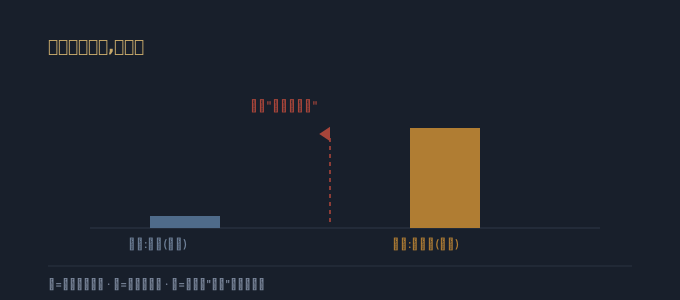
A year-on-year growth rate is a fraction, and the market reads only the numerator.
Guidance season, nine in ten firms report good news, growth of tens and hundreds of times over fills the page, read effortlessly as one sentence: fundamentals broadly improving, the sector staging a strong recovery. But a growth rate is a fraction — it has this year’s numerator and last year’s denominator both. When a rate grows so large it distorts — up hundreds of times, up a thousand — what is really speaking is almost never that numerator, but the denominator: last year’s base, the one everyone forgot at once, low enough to hug the ground.
A hundred-fold surge measures not how strong this year is, but how wretched last year was. This line flips the whole of guidance season over. A company whose profit is up seven hundred times year-on-year has, mathematically, only two possibilities: either it earned earth-shakingly this year, or it lost catastrophically last year, its base smashed near zero. And in reality, nearly all those terrifying multiples belong to the latter. The deeper last year’s trough, the more this year — merely climbing back to mid-slope — can compute an astronomical figure. What is staggering is not this year’s height; it is the fall from last year to this — and a fall like that is a thing only found at the very bottom of a cycle.
In that sense, a super-high year-on-year rate is not proof of strength but often the imprint of its opposite. A healthy, stable, genuinely growing business grows at a mild, sustainable rate, not tens of times over — because its own base last year was already not low. Only businesses just clawing out of a deep pit earn the word “surge.” So when the whole market cheers “nine in ten guiding up,” it is really cheering the mirror image of “nine in ten were wretched last year.” The higher the numerator is raised, the deeper the denominator once fell. This is not the trumpet of recovery; it is more like the echo of a cycle’s floor.
The real trap is that people are built to see change and blind to the baseline. Growth is change, the dance of the numerator — vivid, exciting, intoxicating; the base is the baseline, the silence of the denominator — dull, distant, and no one wants to flip back to check it. So the market systematically overrates the gold content of a growth rate: it reads “no longer so wretched” as “strong from here on,” and mistakes a one-off low-base rebound for a sustainable slope of growth. But a low base cannot be used twice — this year the trough of last year printed seven hundred times; next year this already-lifted number becomes the denominator, and the rate collapses back to earth. Then the market is surprised again: where did the high growth go? It never existed. It was only the denominator’s one-time illusion.
So to read a growth rate is always to do one more thing: dig out the denominator and see where in the cycle it stands. The same “year-on-year growth,” with the denominator at the trough, is a rebound; with the denominator high, it is growth. The two look identical in an earnings headline and are worlds apart in what the future pays out. The market pays the price of growth for the former because it read only the headline, not the folded-away last year.
A growth rate will shout a company's loudness this year while hiding its shame last year; and what truly decides its worth is exactly that hidden denominator.
SECURE PAYMENT VIA STRIPE
Subscribe: $50 annual pass unlocks every paid article on this site for one year
Go deeper: Ko-fi members get a weekly members-only deep dive, from $3/month Become a member →