The Bull-Bear Line Isn't the Market's Tipping Point — It Only Has One Because Everyone Watches It!
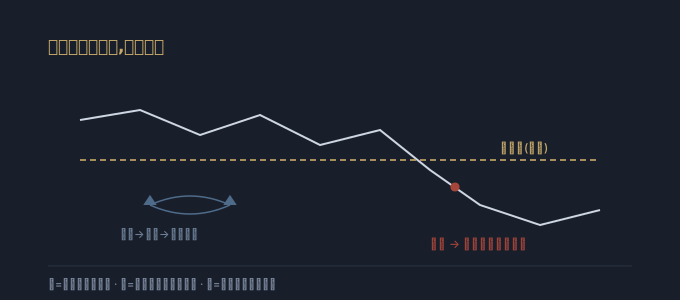
A broad selloff today, the Shenzhen Component down more than 2.6%, over 4,500 names falling, the tape limp. Yet more uniform than the drop is the reading of it — midday notes, group chats, news flashes, every screen carrying the same line: “broke the bull-bear line, can it fall in order to rise?” Chartists enshrine this 250-day moving average as a magical tipping point: stand above it and you’re in a bull, break below and you turn bear, as if this line drawn on a chart held the whole market’s life and death. The saying is so widespread that no one bothers to ask: how can an average of past prices decide the future?
The bull-bear line holds not one ounce of power of its own; it has power only because everyone stares at it and acts around it. The tipping point is never on the line — it is in the shared belief of the crowd watching it. The yearly line is nothing but the average of the last 250 closes, a result, an arithmetic mean of history, with no native power to foretell anything. It “works” through a self-fulfilling prophecy: because everyone believes “break the yearly line and the bear comes,” the moment price breaks it, the believers cut together, and cutting together really does knock the market down. The line’s power is watered into it, ladle by ladle, by that collective belief — it is not built in. You think you are reading an objective line; in truth you are taking part in a collective act of self-hypnosis.
Set the two directions side by side and the hypnosis shows its seams. Above the line, believers pile in, the bids really do push the index up, and everyone nods: “See, above the yearly line, the bull runs.” Below it, believers head for the exits, the offers really do drag the index down, and everyone nods again: “See, a break, the bear turns up.” The same line, two opposite directions, both fed into “a rule” by its own followers with their own money. It is not the market’s thermometer — a thermometer reads the body’s real temperature, 38 degrees whether you believe it or not; the bull-bear line is more a mirror, and only when the people in it raise a hand together does a hand rise in the glass. The market moves first, the line follows, and once the line moves it turns around and makes the people in the market move together. That is reflexivity: expectation manufactures action, action delivers the expectation, and the expectation thereby looks flawlessly right.
So when does it “fail”? When false breakouts and false breakdowns come one after another, when people are slapped in the face enough times that the belief scatters — then the line suddenly stops working. But the failure is not the line breaking; it is the shared conviction watering it evaporating. Which proves, in reverse, that the power lived in the belief all along, never in the line. Likewise “fall to rise,” that neat phrase, is itself a confession of reflexivity — it says the market must first manufacture the panic of a “fall,” wash out the loose chips and the confidence together, before any “rise” can be spoken of. Fall and rise are the same crowd’s emotion, completing its self-fulfillment in two directions, one after the other. Who does the falling, who does the rising? The same people looking in the mirror.
In the end, people forever want, in a market of chaos and no order, to find one certain line, so they can hand their fate to a visible mark and sleep soundly. But the market has no native marks; every line is one people drew themselves, then knelt down to worship. The bull-bear line measures not the market but whether the crowd watching it still believes, right now. How well it works only tells you how many are still willing to kneel before it.
The line never decides the human heart; the human heart decides the line — it works only because enough people are still kneeling in front of it.
SECURE PAYMENT VIA STRIPE
Subscribe: $50 annual pass unlocks every paid article on this site for one year
Go deeper: Ko-fi members get a weekly members-only deep dive, from $3/month Become a member →