Pork Turns Up Not on Demand, But on Capacity Cleared to the Very End!
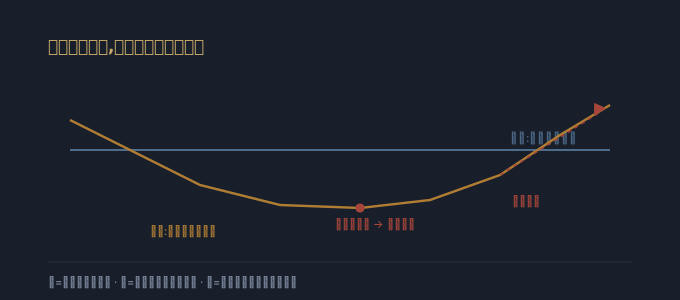
After grinding a long bottom, pork’s retail action finally shows a flicker of change this summer: on July 10 the national wholesale average for pork was 15.67 yuan per kilo, up 6.7% from 14.68 a week earlier. The reading came out almost in unison, all pointing one way — demand is recovering, consumption is reviving, summer peak season is here. As if it were the extra appetite at the dinner table that pushed the price up.
But look back over even a few hog cycles and you know: the turning point in pork prices is almost never decided by demand. Pork turns up not on demand, but on capacity cleared to the very end. Demand is a line that hugs the horizontal all year: people don’t eat twice the pork because it’s cheap, don’t switch to vegetables because it’s a touch dear; how much pork a country eats in a year is stable to the point of dull. What truly heaves, what truly sets the price’s turn, is the violently undulating supply curve — the breeding-sow herd, the expansions and liquidations of the farms. Grinding the bottom grinds capacity out, batch by batch, as long losses force it to quit; the turn comes when the last of the glut is finally cleared and the supply gap yawns open. The price is not pushed up by demand; it is left exposed by the ebbing tide of supply.
In that sense the hog cycle is a self-organizing machine no one can steer. Losses force smallholders and small farms out, supply contracts, price recovers; the moment price recovers, it tempts everyone to restock and expand, supply gluts again, price falls once more. Rise and fall alike are the emergent result of millions of scattered breeding decisions. Any effort to move it with a single button — reserve buying, reserve selling, restocking incentives — is in the end bitten back by the machine: the harder you push restocking today, the fiercer the next glut you bury. The signal of a rising price is itself a summons to the next batch of capacity, and thus the hand that plants the seed of the next decline. The price is both the result of this round’s clearing and the starting point of the next round’s glut.
The real misreading is that people are built to see demand and blind to supply. Demand is one’s own affair — whether I buy today, whether I eat — near at hand, vivid, tangible. Supply is a distant affair — a batch of sows culled in some county, a farm emptied hundreds of kilometers away — dull, remote, and no one wants to count it. So the market each time reads the story of supply as the story of demand: at the bottom everyone eyes “weak demand, prices that won’t lift,” when supply is quietly clearing; at the turn everyone cheers “demand is back,” when from start to finish it is the yawning supply gap that speaks. The cycle never asks demand for the answer; it delivers itself inch by inch, only at the margin of supply.
So to read pork, don’t rush to count the extra mouths at the table — first go count how many hogs are left in the pens un-culled. The former barely changes all year; the latter holds where this round’s price truly comes from and truly goes. To credit every cyclical turn to demand is the laziest reading, and the one most likely to lose money — because it stares at a line that scarcely moves, and turns a blind eye to the one that heaves the sea.
A rising price is not demand's love letter to you; it is the next invoice the cycle quietly hands over, once capacity has cleared.
SECURE PAYMENT VIA STRIPE
Subscribe: $50 annual pass unlocks every paid article on this site for one year
Go deeper: Ko-fi members get a weekly members-only deep dive, from $3/month Become a member →