A Sector Rotation Doesn't Move Risk Out — It Just Moves the Same Crowd!
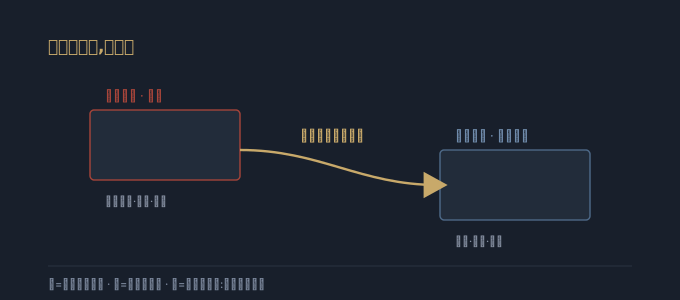
A-shares printed another spike-and-fade today. The Shanghai index touched higher and then lost 3,900; the STAR 50 fell 3.45%; AI-server names shook lower and semiconductor-material stocks sold off as a block, a screen of green. On the other side, oil-and-gas, coal and pharma retail turned red against the tide, with names locking limit-up one after another. This “one side collapses, the other lifts” tape got a very dignified name from the top ten brokerages, in one voice — “local rebalancing,” “high-to-low rotation.” It sounds mature and measured: money is moving smartly from crowded, expensive sectors into cheap, undervalued ones, risk is being actively worked off, structure is being quietly optimized.
But a so-called rotation moves out not risk, but the same crowd — it changes direction, not nature. The word “rotation” presumes a single, bargain-hunting, risk-avoiding agent in the market, a shrewd trader deliberately shifting weight from dear to cheap. No such agent exists. There are only countless people, each fleeing, each chasing, summing into one resultant force. When the high sectors start to fall, the money crowded inside them has not seen the light and grown wise — it is stampeding for the exit. What it flees is the red on its own screen, not some abstract “risk”; what it buys is “hasn’t fallen yet,” not “undervalued.” Panic and greed change their clothes, and we call it rebalancing.
Set the two directions side by side and the “optimization” shows its seams. When a high sector falls, ① the winners rush to book gains, ② the trapped chasers cut and run, ③ the chart readers stop out on the break — three forces slam it down, and the falling itself, in real time, manufactures the consensus that “the highs really were risky.” When a low sector rises, ① the bottom-fishers get in first, ② the rotation money floods in, ③ the rotation-watchers pile on — three forces heave it up, and the rising itself, in real time, weaves the story that “the lows really are safe.” The same money, in two opposite directions, one after the other, defines “risk” and “safety” for itself. It is not avoiding risk; it is voting with its feet, carrying risk from under one label to under another.
This is reflexivity in its quietest form. The moment a low sector is lifted by that fleeing money, the rise itself instantly becomes the new reason to buy, and a fresh crowd re-gathers and ferments there. Today’s low was hoisted up by yesterday’s high; and today’s chased-into low is growing into tomorrow’s high, the one that will get “rotated” out. Crowding never disappears. Like a tide, it drains from this pool and floods into that one — the water moves, the total never falls. If you treat every rotation as a clearing of risk, you will forever chase the hot sector half a beat late, believing you are selling high and buying low, when in truth you are just the last one into the crowd’s migration route, and the first to be buried.
In the end, risk never hides in the height of any one sector; it hides in the total crowding of the money itself. Sectors rotate, valuations run high and low, but as long as it is the same pool of equally frightened, equally greedy money that recognizes only “hasn’t fallen yet,” the system’s total risk has not dropped a fraction. The market’s greatest illusion is mistaking movement for disappearance, mistaking relocation for subtraction. You think the rotation carried the risk away; in fact you just handed it, with your own hands, to the next corner that hasn’t been exposed yet.
Crowding doesn't vanish because it changed sectors — it just moved house, waiting for the next batch of people to finish saying the word "safe" over it.
SECURE PAYMENT VIA STRIPE
Subscribe: $50 annual pass unlocks every paid article on this site for one year
Go deeper: Ko-fi members get a weekly members-only deep dive, from $3/month Become a member →