A Supercycle Isn't a Longer Cycle — It's the Epitaph a Cycle Writes at the Top!
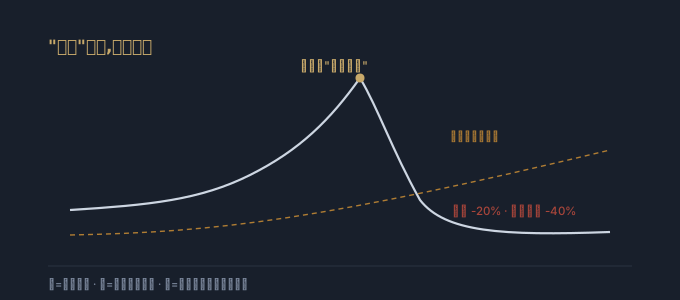
Overnight into today, the memory chain caved in. SK Hynix has round-tripped nearly 40% off its June high, more than 20% in two sessions, and yesterday it printed its largest single-day drop on record in Seoul — over one hundred and fifty billion dollars of market value gone in a day; Micron, Western Digital and SanDisk followed into a pre-market bloodbath. What crushed it wasn't a demand print. It was one offhand line from Morgan Stanley — "memory is, fundamentally, a cyclical commodity." That line went in like a needle and popped the word hanging over all of AI hardware. Even Michael Burry piled on, filing this round of giant-led, frenzied capacity expansion as one of the markers that "the AI investment cycle is beginning to turn."
But the harder it fell, the harder that word got summoned back to hold the line: supercycle. In the notes, on the roadshows, in the reassurance blasts, the same comfort on repeat — "this round is different from the old memory cycles; it's an AI-driven supercycle, the demand is structural, it won't swing wildly like before." As if those two syllables put a policy of insurance on the cycle, promoting it from a mean-reverting mortal commodity into a new species that only climbs. But a supercycle is never a cycle grown longer or stronger; it is what a cycle writes for itself once it has topped and begun to need defending. A genuinely healthy cycle needs no adjective.
— PAID CONTENT BELOW —
Access stays active in this browser after payment. Bookmark the payment success link to restore access on another device.
SECURE PAYMENT VIA STRIPE
Subscribe: $50 annual pass unlocks every paid article on this site for one year
Go deeper: Ko-fi members get a weekly members-only deep dive, from $3/month Become a member →