August Core PCE Came in 0.3 Points Below Forecast, Yet the 10-Year Treasury Yield Closed Near 5.3%, a Record Above Even 2007 — Everyone Says Cooling Inflation Will Drag Yields Down. But What's Rising in the 10-Year Was Never the Inflation Cushion; It's the Rent on Time Itself!
The 10-year Treasury yield is not a shadow of inflation. It is the rent on time.
On Wednesday, September 30, the U.S. released August core PCE, the inflation yardstick the Fed likes best: 3.0% year over year, against 3.3% expected. A full 0.3 points light. By the textbook script, cooler inflation means bonds rally and yields fall. Instead the 10-year closed near 5.3% that day, a record higher than anything in 2007. On Thursday, October 1, it eased about 5 basis points to 5.24%, and the popular line came on cue: inflation is retreating, yields have peaked, the worst is behind us.
That line rests on one premise: yields rise because people fear inflation. And that premise is the error.
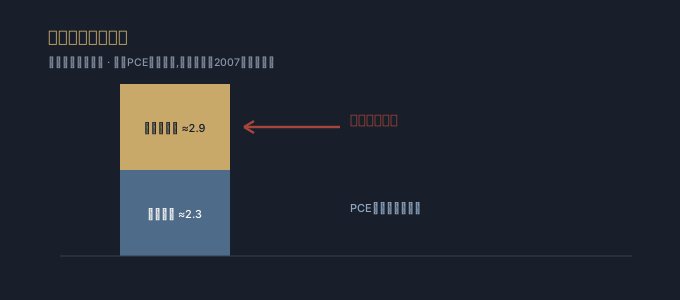
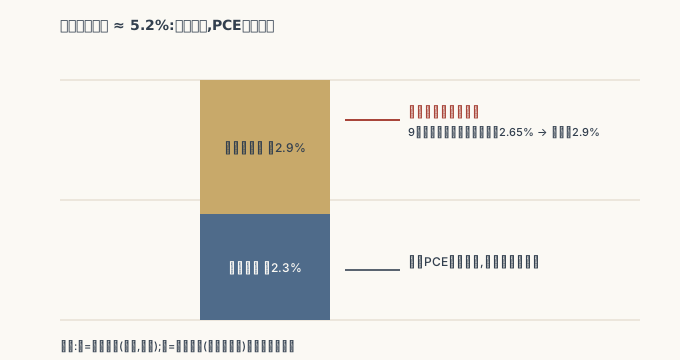
Take the 10-year apart. Lending to the government for ten years is renting out a house for ten years. The rent has two parts. First, a cushion for what rising prices eat away over the decade; the rent has to climb with prices or you lose. Second, the net rent left after prices are taken out, the pure payment you earn for letting go of the house: the real rate. Cooling inflation presses on the first part. What has been pushing up these past few weeks is the second. Backing out from market quotes, the inflation cushion inside the 10-year is only about 2.3%, while the pure rent has reached roughly 2.9%. At Treasury’s mid-September auction of inflation-protected bonds, that same block was still about 2.65%. In under two weeks it moved up again.
So no PCE print, however soft, can do more than press down the blue block. It cannot touch the gold one, because the rent isn’t set by this month’s prices. It is set by something else: how much does it cost, today, to ask someone to hand over ten years of money?
This is why “inflation cools, so yields must fall” is linear thinking. A yield is not a thermometer, reading out today’s prices. It is the tide itself, the combined verdict of everyone on what ten years of money is worth and how much they must be paid to lend it.
Now run it as a mirror. When inflation is the driver: ① the price reading falls, ② the cushion falls, ③ the yield falls with it, a one-way street where a data print moves the price. When rent is the driver: ①′ even a good price reading is only the small part of the whole, ②′ a higher rent means every future cash flow is discounted harder on its way back to today, ③′ discounted assets are less able to hold their prices, and weaker prices make borrowers more cautious while bond buyers ask for still more rent. That is a reflexive loop: higher rates widen the discount, the discount weighs on assets, weakened assets push up the rate demanded. Fundamentally, a good inflation print decides where the loop starts, not whether it turns.
Two more numbers are worth setting side by side. On September 16 the Fed lifted its policy rate to 3.75%–4.00%, and the 10-year now sits more than a full point above that. Meanwhile the odds of another hike in October fell within a week from over seventy percent to under forty. The short end is the committee’s vote; the long end is the market’s. A committee can decide whether to hike at the next meeting. Only the market decides what ten years of money is worth. The short end’s expectations are easing while the long end’s rent is rising — two pricing systems walking away from each other.
None of this says yields must keep climbing. Rent can fall back or keep rising, and a few days of data cannot tell which; nor does it tell you what to buy or sell. What can be said is narrower: using “PCE below forecast” to bet that “yields have peaked” is using a number that governs only the blue block to wager on the gold one.
In the end, the most expensive thing in any price is never inflation. It is time. Whoever wants time to get cheaper must first persuade everyone that ten years from now, the money will still be there.
Inflation can cool; the rent on time is priced only by trust.
SECURE PAYMENT VIA STRIPE
Subscribe: $50 annual pass unlocks every paid article on this site for one year
Go deeper: Ko-fi members get a weekly members-only deep dive, from $3/month Become a member →