The 10-Year Yield Slid Back Toward 4.9% From a 19-Year High and Oil Fell for a Third Day — Everyone Called the All-Clear, Yet Bitcoin ETFs Took In $160 Million While Ethereum ETFs Bled $39 Million the Same Day. What Recedes Is Never Risk — It Is Each Asset's Own Bill for Leverage!
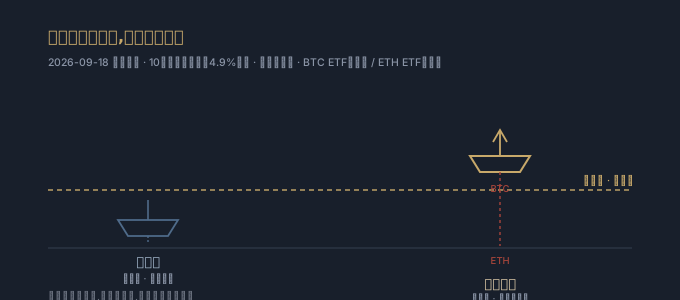
The line that traveled furthest in finance coverage this weekend was simple: the risk alarm has been called off. The evidence looked plain enough — the 10-year Treasury yield, which had touched a 19-year high just days earlier, slid back down, and crude, after two straight weeks of gains, fell for three sessions running. The claim is comforting because it is cheap: pick one or two macro readings that moved toward “easier,” and assume every risk asset owes the same sigh of relief. It treats risk appetite as a single master valve — open it, and the water is supposed to reach every corner, in different amounts perhaps, but never in different directions.
Friday, September 18 (US Eastern) — early Saturday in Beijing — poured cold water on that valve. The 10-year yield really did ease back toward 4.9% from Monday’s 19-year high, and crude really did fall for a third straight session, hovering near the $100 mark. By the textbook script, that should have let stocks exhale. Instead, the broad market barely moved: the Nasdaq added less than half a percent, the Dow and S&P were mixed, and taken over the full week, both the Dow and the S&P had logged a loss. What actually jumped that day was somewhere else entirely — bitcoin and ether, both of which rose noticeably.
More worth sitting with is the split inside crypto itself. On the same day, spot bitcoin ETFs took in roughly $160 million while spot ether ETFs saw about $39 million leave — money moving in on one side, out on the other, and yet both coins’ prices closed higher. If inflows are what drive a price up, ether’s price that day should not have risen at all. If outflows are what drive a price down, it should have risen even less. Price and flow didn’t reconcile — and the mismatch is not a data error. It is a sign that “flow determines price” was the wrong question from the start.
What actually recedes is never risk. It is the price of leverage. When the discount rate — the toll charged for pulling tomorrow’s money back into today’s — eases by an inch, not every asset measures that inch with the same ruler. A blue chip’s value comes from how much it will earn a decade out; ease the discount rate by an inch and today’s price shifts by half a step, at most. Bitcoin and ether have no ten-year cash flow to discount in the first place — their price is, in essence, the price of leverage itself. Loosen the cost of borrowing, and they are the ones built to jump first. That isn’t bitcoin being “wilder.” It’s that bitcoin and a blue chip simply sit at very different distances from leverage to begin with.
The logic runs the same in both directions. When the discount rate gets pushed to a high, the first to buckle is never the company whose cash flows arrive a decade from now — it’s whatever asset was already leaning on leverage to hold up its price. When the discount rate eases, the first to jump is that same asset. ① It is the most sensitive to the cost of leverage, ② so it reacts first, ③ and that very reaction gets read by the press as proof that risk appetite is “coming back,” which pulls in still more money behind it — a self-reinforcing loop whose starting point was never the abstract word risk. It was the quoted price of leverage.
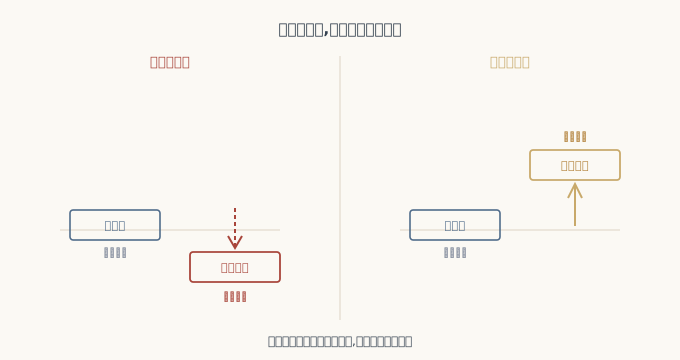
Ether’s price that day sharpens this point better than anything else could. Price is not a thermometer for fund flows. It is whatever number is left standing after inflows and selling pressure have finished fighting it out. The $39 million that left ether’s spot ETFs that day tells you a real cohort of holders was heading for the exit. What it doesn’t tell you is that this cohort won the fight — shorts may have been forced to cover, and buyers on the spot and futures side may have been absorbing the other end of the trade. Fundamentally, no market is one unified computer deciding whether ether deserves to be bought. It is countless independent machines running at once — some redeeming ETF shares, others adding futures or spot positions — handing back, in the same instant, two opposite and equally honest answers. The ETF outflow line is just one ledger among many. It was never the only one.
The mistake people make most easily is imagining risk appetite as a single dial that can be turned on its own — loosen one macro reading, and every asset is supposed to rally back in lockstep. But no market does its arithmetic as one entity. It is a thousand independent, equally honest ledgers, each handed the same easing in the discount rate at the same moment, each returning its own distinct answer. When those answers happen to converge on one direction, that is coincidence being mistaken for consensus. When they scatter instead, which is the more common outcome, that ordinary scattering gets misread as an anomaly. Fundamentally, what recedes is never risk — it is the price of leverage, and that sentence holds from blue chips to bitcoin, from this round to the next one. No single sea rises or falls as a whole. The tide only ever does one thing: lift the water level. How far each boat rises with it — how long its anchor line runs, how deep its hold sits in the water — is that boat’s own business.
The water always rises together. The tide going out is every boat's own affair.
SECURE PAYMENT VIA STRIPE
Subscribe: $50 annual pass unlocks every paid article on this site for one year
Go deeper: Ko-fi members get a weekly members-only deep dive, from $3/month Become a member →