"Deviating From Fundamentals" — What It Deviates From Was Never the Fundamentals!
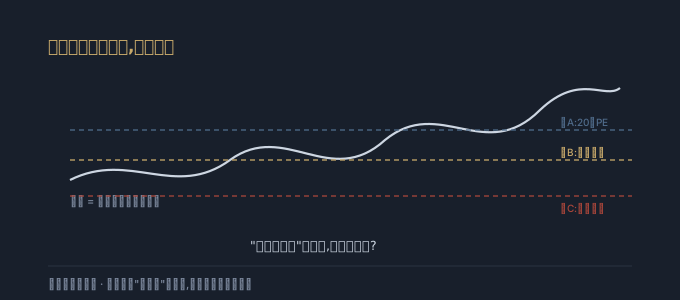
A phrase has been going around lately, and today a company said it about itself, out loud. Suqian Liansheng filed a risk notice warning that its own stock showed “overheated market sentiment and irrational speculation, with the price having severely deviated from the company’s fundamentals, carrying the risk of a rapid decline at any moment.” A company stepping up to say “I’ve been bid up too far” sounds humble, sounds responsible. And straight off that sentence, the market grows a popular verdict: since it has “deviated from fundamentals,” it must fall back.
The trouble with that sentence isn’t that it’s bearish. It’s that it quietly smuggles in an assumption almost everyone believes and almost no one can defend: that there exists some objective, static “true fundamental,” written into the financials like a drawn true-value line, and price has merely floated above it and must, sooner or later, sink back. But ask one question — where, exactly, is that line drawn? — and the whole thing falls apart. Is twenty times earnings the fundamental, or thirty? This year’s profit, or three years out? Liquidation value, or a growth discount? What you call “the fundamentals” was never an objective fact; it is the valuation anchor in your own head. Price doesn’t deviate from the fundamentals — it deviates from the fundamentals you imagine.
To really break it open, you have to switch frames on what price even is. Price is not an external thermometer, hung above the company, faithfully reading out a body temperature called “intrinsic value.” Price is generated inside the market network itself — by countless hands, countless judgments, countless real-money bets, voted and aggregated in real time. It is, in itself, the highest-compute computation everyone has run on this company’s future. “Severely deviated from fundamentals,” translated, simply means: the answer the market computed this moment doesn’t match the answer in my head. And on what grounds do you rule that your single anchor is right and the pooled vote of countless participants is wrong? Rather than “price has deviated from value,” say it straight: your valuation has deviated from the market.
There’s a more counterintuitive layer underneath. The very act of a company crying “overheated” feeds the fire it means to warn against. The market is a reflexive system — a notice reading “I’m being irrationally speculated on” is a brake to the cool-headed, but to the players it’s a fresh piece of narrative: it confirms this stock has emotion, has a crowd, is hot enough. So the risk warning gets inhaled as fuel by the self-referential machine; the speculation doesn’t cool on a piece of paper, it gains one more reason to run. The louder you call it hollow, the more people bet on how much longer it can stay hollow — which is exactly where spontaneous order is most merciless: it obeys no single node’s command, not even that of the company that issued the shares.
At bottom, “the price has deviated from fundamentals” reveals not how crazy the market is, but how badly the speaker wants to drive a stake into a system too complex to grasp, just to feel steady. Humans crave a static, knowable true value behind the world, something to grip in the chaos — the craving is deep, and very human, and it is an illusion. The market doesn’t oscillate around a fixed fundamental; countless judgments are rewriting the fundamental itself, in real time. Price has no place it “should” be. It is only where it was, this moment, voted to be. You can have a hundred reasons to be bearish on a stock, but “it has deviated from fundamentals” isn’t one of them — that only says you and the market computed different answers about the future.
The honest phrasing isn’t “the price has deviated from fundamentals.” It’s “the price I computed and the price the market computed are not the same.” As for who’s right — time will vote, and neither you nor I get to call it.
Price never deviates from the fundamentals; it only deviates from the stake in your own head — and that stake speaks for exactly one person's compute.
SECURE PAYMENT VIA STRIPE
Subscribe: $50 annual pass unlocks every paid article on this site for one year
Go deeper: Ko-fi members get a weekly members-only deep dive, from $3/month Become a member →