300 Global Debuts Launch Not Demand, but Capacity!
A trade show never measures demand. A trade show measures supply.
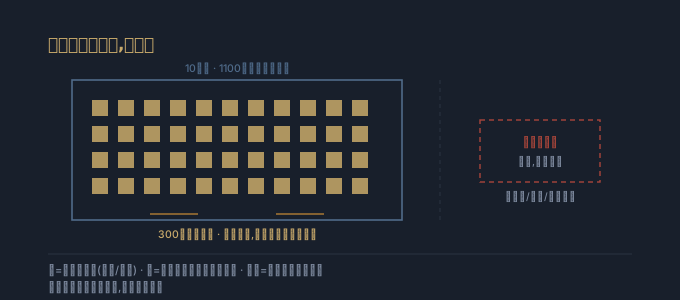
The 2026 World Artificial Intelligence Conference opened in Shanghai today. The numbers are handsome: exhibition space past 100,000 square meters for the first time, over 1,100 companies exhibiting, more than 3,000 exhibits, over 300 products making their global debut. Every write-up reaches for the same sentence — unprecedented scale, unprecedented debuts, proof of how ferocious demand in this industry has become.
Inside that sentence sits a quiet substitution. A debut is a supply-side act, not a demand-side one.
Who decides when a product makes its global debut? The vendor. Its R&D calendar decides. Its capacity ramp decides. The date it owes the board and the capital markets an answer decides. What its competitor is launching in the same hall decides. The customer decides none of it. Customers do not queue at the hall door waiting for a debut. Customers pay, when they need something that solves a problem — and paying is an act that never takes the stage.
So “over 300 products making their global debut” translates precisely as: 300 vendors concluded, in the same quarter, that it was time to push new things out. That is the resolve of 300 suppliers. It is not the order book of 300 buyers. It measures how many are ready to sell, not how many are ready to buy.
The 100,000 square meters is the same. Who pays for floor space? Exhibitors. A bigger booth means a vendor will pay more to be seen. And when is an industry most willing to pay to be seen? Not when orders are deepest, but when orders most need to be found. A company booked out through next year does not need an enormous booth; it needs production lines. The ones willing to build the biggest booth are precisely the ones holding capacity and looking for demand.
Run the early/late mirror on this industry and the split gets clear.
Early on: the show is small, the booths plain, few companies, fewer debuts. But nearly every object on display sits against a specific customer, a specific order, a specific problem. The product was pulled out by demand — someone wanted it, so someone built it. Nobody has spare money for 100,000 square meters, because every yuan has to go into delivery.
After a capex peak: the show breaks records, the booths outshine each other, over a thousand exhibitors, hundreds of global debuts. And you notice something — the differences between these products are visibly shrinking. Because they were not pulled out by their own distinct demands. They were pushed out by the same capacity curve. The same chips, the same models, the same frameworks; hundreds of companies arriving at the same position at the same moment, so what they launch is highly isomorphic. At that point the density in the hall is no longer the density of demand. It is the density of capacity: 1,100 companies packed into 100,000 square meters, seeing, face to face, each other — not customers.
In this sense a trade show is a group photo the industry takes of itself. More people in the photo does not mean more people outside queuing for tickets. It only means the industry has grown more people of its own. And how do those people grow? Out of the capex, the funding, and the boom narrative of the past few years. The scale of the show lags the scale of capex by roughly a year or two — it is the first time money-turned-capacity walks onstage together. The spectacle is not demand’s opening act. It is supply, fully assembled.
So here is the commonsense reading that has to be turned over: a trade show is not a thermometer for demand; it is a group photo of capacity. A thermometer measures how hot the world outside is. A group photo measures how many people are standing in the room. People look at 1,100 companies and 300 debuts and think they are seeing how large the market is. What they are actually seeing is how much supply has gotten ready. In the first half of a boom the two move together, which is what tricks everyone into thinking they are one thing. The moment they part ways is exactly the moment the industry goes from being found to having to go find — and they part ways, always, in the year the group photo is at its most crowded.
Real demand never needs a booth. It shows up as an order, is confirmed as a payment, continues as a repeat purchase — quiet, and in none of the photographs. Supply needs the booth, because supply has to be seen to have any chance of being chosen. The more eager an industry is to be seen, the more it says about the industry sliding from the position of being found into the position of going out to find.
Fundamentally, what this industry is actually computing was never how many companies showed up. It is whether anyone will pay for what those companies build. The first is on the press release today. The second gets settled one quarterly report at a time. People love inferring the second from the first, because the first is countable, photogenic, and available same-day. But the system does not read press releases. It records an entry only at the moment someone actually pays.
A hundred thousand square meters holds 1,100 companies. It does not hold a single order.
Spectacle is never evidence of demand. It is evidence that supply has finally all arrived.
SECURE PAYMENT VIA STRIPE
Subscribe: $50 annual pass unlocks every paid article on this site for one year
Go deeper: Ko-fi members get a weekly members-only deep dive, from $3/month Become a member →