Pessimism Is Not a Buy Signal — It Is a Readout of Credit Still Contracting!
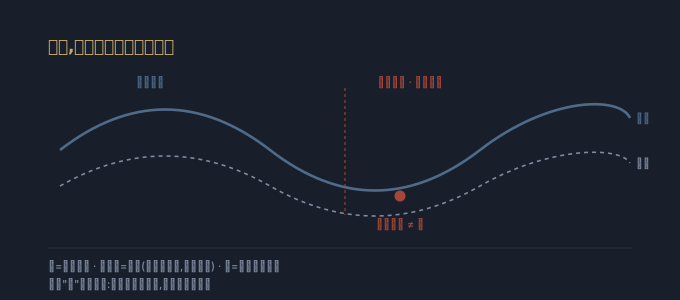
Pessimism is not a buy signal. Pessimism is a readout of credit still contracting.
Today the Shanghai Composite slid back toward 3800, with only about a thousand names finishing green. Around the close, one sell-side note went everywhere. The title was lovely: buy in pessimism, meet again at new highs. Five reasons, neatly stacked. Q2 GDP growth of 4.3% is the growth bottom. Q2 micro liquidity is the money bottom. Sentiment gauges near the lows are the sentiment bottom. A large cohort of assets sits at the start of an earnings recovery, still cheap. And several quality tech listings in H2 will bring incoming money. Five bottoms in a row. Tick them all, declare the bottom in.
This is checklist bottom-fishing: lay a few readings on the table, tick the boxes, draw the conclusion. It sounds rigorous, because each line taken alone is true. But not one of those five is a cause — all five are outputs. GDP is an output. Liquidity is an output. Sentiment is an output. Valuation is an output. Incoming money is an output too. Using five results to forecast a cause is not analysis; it is running causation backwards.
To see why, you first have to move the word “sentiment” off the shelf it has been placed on. The market’s default is that credit and sentiment are two separate things: credit is the objective water level, sentiment the subjective temperature; the level is hard to read, so read the temperature instead — once it is cold enough, the water should be due back. That default is wrong at the root. Sentiment is not the opposite of credit. It is credit’s shadow.
Run the mechanism. When credit expands: prices rise, collateral appreciates, appreciated collateral supports more borrowing, borrowed money pushes prices higher, so everyone dares to lever and everyone feels good about the future. Sentiment runs hot not because people suddenly grew brave, but because credit is being brave on their behalf. Reverse it. When credit contracts: prices fall, collateral shrinks, shrunken collateral triggers margin calls, forced liquidation drives prices lower, so everyone delevers and everyone feels worse about the future. Sentiment runs cold not because people suddenly turned timid, but because credit is being timid on their behalf.
So what does “sentiment gauges near the lows” actually say? Not “everyone has been bearish long enough, the turn is due.” It says: credit is still contracting, and contracting deep enough to have taken the nerve out of every last participant. Pessimism is not a buy signal; pessimism is a readout of credit still contracting. A cold thermometer does not mean the tide is coming back. It means the tide is still going out — the cold is what the outgoing tide left behind.
The other items on the checklist are the same error wearing different coats.
Cheap valuation — an output of what? Of price falling faster than earnings. And why does price fall faster than earnings? Because credit is contracting, and the money willing to pay for the same unit of earnings has shrunk. So “valuation at the lows” is not “time to buy.” It is another way of saying credit has not come back. Cheap is never a reason. Cheap is a readout.
Liquidity bottoming — an output of what? Of the sellers being mostly done. But between “done selling” and “starting to buy” lies not time, but credit. Without credit expansion, exhausted supply produces dead volume, not higher prices. That is a still pond, not a rally. Selling stopping is not buying standing up; somebody in between has to be willing to lend to the future again.
And “quality listings in H2 will bring incoming money” — that one deserves a pause. When a company lists, does it put money into the market or take money out? Every yuan raised in the primary market comes out of the secondary market’s pocket. It may bring heat, narrative, the appetite to trade. But in the arithmetic of money it is an outflow, not an inflow. Reading a withdrawal as a deposit is the most concrete inversion on the list.
Fundamentally, these five bottoms are one thing projected onto five dashboards. That they all read low together is not five independent pieces of evidence corroborating each other; it is one cause casting five shadows that lengthen at the same time. That cause is credit. What the five shadows point to is not “the bottom is in.” It is: the thing making all of this is still here.
So what is a bottom, really? A bottom is not a level a checklist can identify. A bottom is a process that grows, slowly, after credit stops contracting. It will never light up early on any dashboard, because every dashboard measures its consequences. The turn happens inside the network: somewhere, credit stops shrinking, and someone becomes willing to pay for the future once; that payment supports a price; that price makes the next person willing to pay a second time. The moment credit starts reinforcing itself again, the bottom is already behind you — and when it passes, the sentiment gauge is still at the lows, valuation is still at the lows, and every box on the checklist is still ticked.
That is the sly part of “buy in pessimism.” It takes a description written after the fact and hands it over as a rule to be used before the fact. In hindsight, yes, bottoms sit inside pessimism. But the overwhelming majority of positions inside pessimism are not bottoms — they are the middle of the decline. History left on the chart only the pessimism that happened to be a bottom, and erased all the days that were pessimistic and then got more pessimistic. Going from “bottoms live in pessimism” to “pessimism is the bottom” is reading a survivor’s coincidence as a causal necessity.
In this sense, what the checklist really exposes is not a miscalculated number. It is an attempt at something no person can do: to nail the bottom to a table while credit is still contracting. The market is not an instrument waiting to be read. It is a net that borrowing, pledging, liquidating, hesitating, and capitulating compute together. When that net stops contracting is not decided by any one person’s checklist — including the person with the prettiest checklist. Trying to pin an entire network with five boxes is not analysis. It is pride.
The question was never “are we pessimistic enough yet.” It is “has credit come back.” You can tick the first one today. The second one you can only wait for.
A bottom is never found. It is grown, by credit.
SECURE PAYMENT VIA STRIPE
Subscribe: $50 annual pass unlocks every paid article on this site for one year
Go deeper: Ko-fi members get a weekly members-only deep dive, from $3/month Become a member →