Chips Fell Into a "Bear Market" — What Fell Was June 22, Not the Chips!
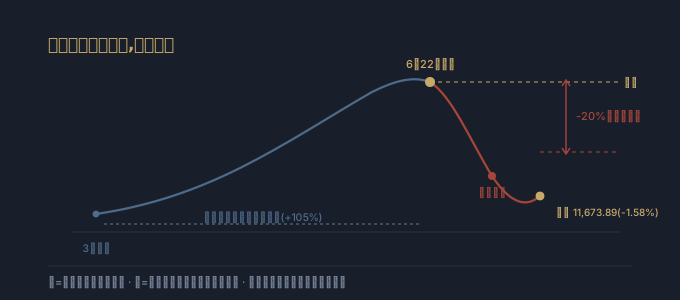
A drawdown does not measure the asset. It measures the peak.
On Friday July 17, “chips have entered a bear market” filled every screen. Here are the readings. The Philadelphia Semiconductor Index fell as much as 5.7% intraday, and its drawdown from the June 22 record briefly crossed the 20% line — that is where the label came from. But the index closed at 11,673.89, down 187.23 points, a loss of 1.58%. The same session, the Nasdaq Composite closed at 25,520.24 (−1.40%), the S&P 500 at 7,457.69 (−1.02%), the Dow at 52,146.42 (−0.77%).
Which is to say: the bear market that was declared existed for a few hours, and was gone by the closing bell.
And the index that got the label had run 105% from its March low to its June peak. Even after this rout, it is still up more than 60% year to date. Something up over 60% on the year, down 1.58% on the day, got named a state of the world because it touched a percentage intraday.
That naming tells you nothing about chips. It tells you the ruler is broken.
A drawdown is not a measurement of the asset. It is a measurement of the peak. “It fell 20%” contains two variables, and everyone stares at the numerator while treating the denominator — that high — as a constant beyond inspection. But the high is the least reliable object in the whole exercise. June 22 was not the day capacity, orders, and cash flow collectively topped out. It was the day the density of bids hit its limit. It is not a fundamental fact. It is a liquidity fact. It is the level positive feedback pushed itself to.
Which gives you a beautiful piece of circular reasoning: using an extreme produced by a self-reinforcing loop to judge whether that loop has ended. You are asking the bubble to certify its own ending.
Worse, the ruler only comes out in one direction.
On the way up, nobody judges risk by “it is already 105% off the low” — that 105% gets read as momentum, as secular trend, as the beginning of an era. On the way down, everybody judges state by “it is 20% off the high” — that 20% gets read as an inflection, as the end of a cycle, as a paradigm expiring. Same price series, same percentage ruler. Going up we measure the numerator; going down we measure the denominator. People are not using a ruler to measure the market. They are using the market’s direction to decide which end to anchor the ruler on.
So “bear market,” as the word is currently used, is backward-looking arithmetic, not forward-looking judgment. It does not tell you the future. It only tells you which day you drove your stake into.
The real question is not how far price is from the high. It is whether price is still computing the future.
A healthy market is a distributed computer. Millions of people each holding a fragment of local information — this one knows their own order book, that one knows equipment lead times, another knows power costs and depreciation, another knows the client’s next budget cycle — each does their own arithmetic, each places their own bet, and together they compress countless fragments into one number. Selling in that regime is disagreed selling: one sells because they saw inventory, another buys because they saw a new order. Both sides are pricing each other with different information. Price moves, information flows in, the system computes.
In a self-referential market, selling has exactly one reason: it is falling. One sells because a stop was hit, another because margin was called, a third because they saw others selling. No new information enters the machine — only positions triggering each other by mechanical rule. Price stops being the output of computation and becomes the only input.
Apply that test to Friday and the character is clear. The selling was globally synchronized — Asia broke first, the US session took the baton. It was cross-asset and same-signed: bitcoin was dragged toward $63,934 on the same day. And it was indiscriminate within the sector: it did not matter whose order book was fuller or whose cash flow was thicker, everything got sold together. Same-signed, disagreement-free, cross-market selling is not judgment forming. It is liquidity leaving.
But that is precisely what makes the label absurd. Liquidity leaving and an industry’s future ending are two entirely different events. The first is capital physically changing location. The second is trillions of dollars of capital expenditure changing direction. Friday was the first. The label announced the second.
Mirror it and it gets cleaner still.
Early in a trend, price rises on several real inputs at once: actual orders, credible expectations, expanding credit, a compelling story. That advance carries information — it rises because people computed different things and then agreed at a higher price.
Late in a trend, those inputs go dark one by one until only one remains: it is rising, so buy; buying, so it rises. That advance carries no information. The rise has degraded from the result of the computation into its only raw material.
Declines are perfectly symmetric. Early declines are information-driven — somebody genuinely saw what others had not. Late declines are position-driven — leverage liquidating under contract. The first is pricing the future. The second is merely returning money borrowed in the past.
In that sense, judging where a move stands has never been about counting percentage points from the top. It is about whether the selling still contains disagreement, whether new information is still arriving. Disagreement means the system is still computing. Universal same-signed selling means it is only settling debts. Twenty percent off the high is arithmetic. Still computing the future is a state. People substitute the first for the second because arithmetic requires no understanding — only subtraction.
That is exactly why thresholds like “down 20% is a bear market” are so popular. They convert a question that requires judgment into a question that requires only a glance. Confronted with uncertainty, the human reflex is not to admit ignorance but to find a number that can be announced. Having announced it, one feels one knows. But naming is not understanding, and a label is not a judgment. Christening a decline does not tell you one hour more about how long it will run.
Ultimately those few hours of “bear market” on Friday were a useful reminder: the system does not partition itself along human thresholds. There is no mechanism inside the number 20 — it is an integer that base ten happened to produce. The system does not know whether it is in a bear market. It simply recomputes, every second, what the future is worth. It is people who need a name, so they have something to say inside the noise.
The humble move is to take that record high down off the altar. It is not a measure of value. It was just the day the money was fullest.
How far it fell measures how full the money was that day. Whether it still computes the future is what measures the thing's worth.
SECURE PAYMENT VIA STRIPE
Subscribe: $50 annual pass unlocks every paid article on this site for one year
Go deeper: Ko-fi members get a weekly members-only deep dive, from $3/month Become a member →