This Week, the House Dealing the Cards Is the One Being Bet On!
Earnings season is not the season when the market audits companies. It is the season when companies hand the market a script.
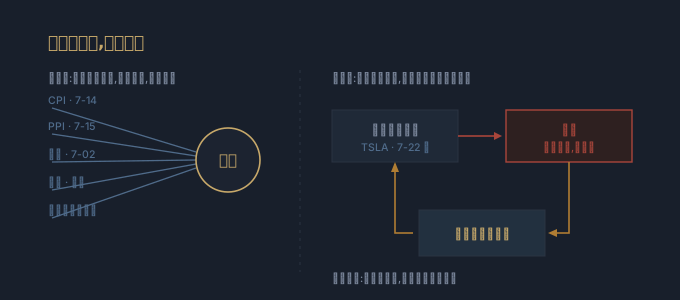
Start with the calendar. The Bureau of Labor Statistics set its schedule long ago: June CPI came out July 14, PPI July 15, the employment report earlier still, on July 2. Across July 20 through 24, all the BLS has on the board are a few state-level employment and earnings tabulations — nothing that will make an index flinch. On the macro side, this week is empty.
Earnings fill the vacancy. Tesla’s own investor relations page lists second-quarter results for July 22, with a long queue of giants lining up behind it. And so nearly every week-ahead note carries the same sentence: light on data, heavy on earnings, let the fundamentals speak.
That sentence sounds perfectly ordinary, and it leaves out the one thing that matters. The difference between a macro print and a company report is not size, and not importance. It is who publishes it.
CPI is a stranger measuring you. Statisticians carry a fixed basket, apply a fixed methodology, and on a fixed date they write the prices down. The person writing them down owns none of your stock, needs none of the numbers to look good, and cannot quietly change the methodology the night before. To the market that number is exogenous — it enters from outside the system, carrying information the system did not already contain.
An earnings report is not that. An earnings report is the object being priced, measuring itself. The part that has already happened is constrained, more or less, by accounting standards and auditors; there is only so much room to move. But what has already happened is never what moves the stock. Guidance is. Netflix last Friday was the live demonstration: nothing in the reported quarter was shrinking, and what took it down was the outlook it wrote for the next one. The market repriced a large slice of the company’s value on the basis of a number that has not happened, drafted by management, revisable at will.
Guidance is not information. It is an offer.
Not one figure in a guidance range is observed. Every one of them is chosen. The people choosing hold the stock, the options, the job, and the reputation, and they understand better than anyone how the market will price that piece of paper. They can of course be honest — but honesty here is a personal virtue, not a structural constraint, and that is nothing like the constraint binding the clerk who copies down prices at the statistical agency.
In that sense the market’s position this week is peculiar: its only source of new information is the set of people it is betting on.
Put the two kinds of week side by side and the difference surfaces.
In a data week, the market computes the world. A CPI print lands, and millions of people each run it through their own balance sheet, their own cost structure, their own borrowing plan, and each acts. Price is the resultant of those millions of independent judgments. Information enters from outside; judgment distributes itself inside. That is the market at its most like itself.
An earnings week runs the other way. New information no longer arrives from outside. It is generated inside the object being priced, filtered first through management’s selection, then through the communications team’s phrasing, and finally translated word by word into price. Five hundred companies are not five hundred independent sources; they are five hundred self-descriptions. What price is doing is not computing the world. It is repeating what someone says about themselves.
Worse, the loop closes. Companies know the market watches only guidance, so guidance becomes a dial: set it low and next quarter is easy to beat; set it high and today’s stock looks better. The market knows the dial is being turned, so it stops reading the absolute level and reads only the gap against “expectations” — and expectations were derived by analysts from the last round of guidance. Go all the way around and the celebrated “beat” is a beat against a line the beater helped lay. This is not the market auditing the company. It is the company and the market taking turns countersigning the same price.
None of which says earnings are useless, still less that management lies. Most guidance is honest, cautious, often deliberately conservative. The problem is not honesty. It is the direction the information travels. A complex system computes better than any individual inside it because its inputs come from every direction — unrelated, uncoordinated, drawn from different sources, so that errors cancel and biases correct one another. The moment the input narrows, for a stretch of days, to what the computed object says about itself, the system’s computing power is compressed. Not because it got dumber. Because it has nothing else to compute.
This, in the end, is what separates the early phase of a trend from the late one. Early on, price computes reality, expectation, credit, and narrative all at once, four inputs cross-checking each other, none able to fool the rest. Late on, reality fades out, expectation is published by the very parties being bet on, credit answers only one question — is the money still available — and eventually narrative is left talking to itself. The further along you go, the less price is computing the future, and the more it is computing what someone says about the future.
So the thing worth watching this week is not who beat and who missed. It is how the companies burning the most cash — the ones that most need the capital markets to keep feeding them — describe the money they intend to spend over the next year. Their capital expenditure is hard: it gets poured into concrete and silicon, and it runs on a physical clock. The revenue meant to justify it still lives mostly inside guidance, and runs on whatever the drafter decides. The gap between the hard side and the soft side will never appear in any quarterly table. It appears on the day the soft side changes its wording.
The market is not failing to think this week. It is thinking harder than usual. It has simply been handed a very narrow hand of cards with which to reason about the whole table — and that hand was dealt by the player sitting across from it.
The blindest moment is never the one without news. It is the one where all the news has a single author.
SECURE PAYMENT VIA STRIPE
Subscribe: $50 annual pass unlocks every paid article on this site for one year
Go deeper: Ko-fi members get a weekly members-only deep dive, from $3/month Become a member →