"Extreme Fear" Never Measures Fear — It Measures Price!
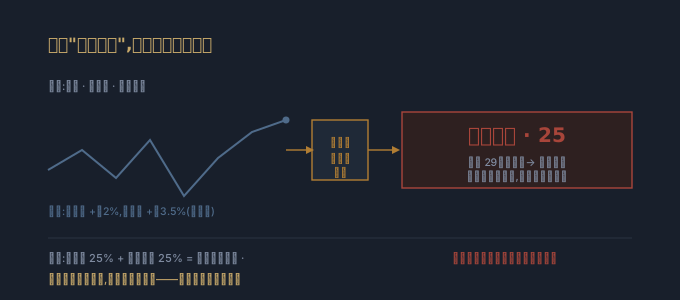
The Fear & Greed Index does not measure the market’s emotion. It measures the market’s price. That reading stamped “Extreme Fear” is not a crowd’s dread. It is price’s own shadow, wearing a new label, handed back to you.
On July 21, Beijing time, the crypto Fear & Greed Index fell to 25 — “Extreme Fear.” The day before it read 29, merely “Fear.” By the logic of the word, deepening fear should ride alongside falling prices. Yet open the same day’s tape: Bitcoin up about 2%, Ethereum up about 3.5%, the whole book climbing. A market supposedly more frightened by the hour, with prices lifting their head anyway. And so the timeline fills with the old Buffett line — be greedy when others are fearful — and “Extreme Fear” is read as the starting gun for buying the dip.
The contradiction is right there: the market is rising, the index says the market is afraid. Either the price is wrong, or that word “afraid” does not mean what it says.
The answer is in how the index is built. Take it apart: volatility, a quarter of the weight; trading momentum and volume, another quarter — over half the index grows straight out of price and turnover. What’s left — social-media buzz, Google search trends — is downstream of price too: the tape moves first, then people argue on Twitter and search on Google. And the one component in the whole formula answered by an actual human voice — the survey — was shut off long ago. So this instrument that calls itself a gauge of emotion is, more than half, price; most of the rest is price’s echo; and the only genuinely independent human input has been turned off.
So “Extreme Fear” is never the market being afraid this moment. It is saying: over the past days, price fell, the volatility hasn’t been digested, the momentum is still negative. The index is reading last week’s drop, not today’s mood. Prices rose today, and it is still bent over reciting yesterday’s ledger. It is not a signal that leads emotion. It is a lagging echo of price. You think you’re moving ahead of the crowd’s reaction; in fact you’re half a step behind the price.
That is why it can’t carry your weight. You think it’s a thermometer plugged into the market from outside, taking its temperature for you. In fact it’s a node inside the market — it copies the price down, renames it emotion, and hands it back to you unchanged. Price is not what it measures. Price is its raw material.
“Be greedy when others are fearful” only works if fear is something independent of price — only then can you stand across from it and bet. But if that “fear” is itself computed from price, your so-called going-against-the-crowd collapses into a tautology: fear means price fell; my greed means buying where it fell. That is not emotional arbitrage. It is a chase-the-drop rule wearing a costume. What Buffett’s line actually bets on is the gap between value and price — price panics, value hasn’t changed, and you pocket the gap. A sentiment reading computed out of price contains no variable called value at all. It can measure no divergence. It can only say the price over again.
Run it the other way and the mechanism is symmetric. Price falls — volatility rises, momentum drops, money flees back into Bitcoin and lifts its dominance — and the index prints “Fear.” Price rises — volatility settles, momentum turns positive — and it prints “Greed.” From end to end, emotion is the dependent variable of price, never the independent one. You can never pull from this dial anything price hasn’t already told you — because the dial is made of price.
In this sense, people who want an external emotion-gauge want an impossible thing: to feel nothing and yet know what the crowd feels; to watch no chart and yet know the chart. But the crowd holds no separate stock of feeling somewhere else, waiting to be measured. Price is the crowd’s feeling — the resultant of millions of trades settled on the spot, already computed. Asking a fear index whether the market is afraid is asking the market to take what it just said in price, change the font, and say it to you again.
Real contrarianism is never contrarian to a number. It is contrarian to a judgment — you worked out the value yourself, price has stepped away from it in panic, and you have the nerve to stand in that gap. That takes a ruler of your own. What the Fear & Greed Index hands you is not a ruler but a mirror: every degree of fear, every degree of greed it shows is a reflection of price. You shout “others are fearful” at your own reflection, then buy, still believing someone else is standing on the other side of the glass.
You think you're going against the crowd. You're following the price — it just changed its name, and you took it for someone else.
SECURE PAYMENT VIA STRIPE
Subscribe: $50 annual pass unlocks every paid article on this site for one year
Go deeper: Ko-fi members get a weekly members-only deep dive, from $3/month Become a member →