Capex Isn't a Cost — It's an IOU Waiting to Be Claimed!
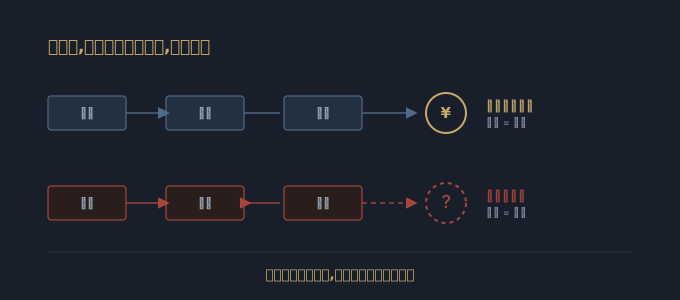
Capex isn’t a cost. It’s an IOU. And whether the IOU is worth anything has nothing to do with how big a number you signed — it turns on whether someone at the other end of the chain is willing to claim it.
This week the market looked like it flipped overnight. First Alphabet lifted its 2026 capex ceiling toward $205 billion — a number large enough to buy an entire industry — and took a hit despite a clean quarter. Then, on July 23, Tesla fell more than 14% in a single session, its worst day in about a year, and the Nasdaq slid 2.15% behind it. Open any recap and you get the same conclusion: the market has finally had it with AI spending, and capex is now the original sin.
As if capex were a knob you could dial down — spend the hardest, get punished the hardest.
But hours after that same July 23 close, Intel reported. It is spending no less than anyone — it is burying one fab after another in the ground — and its stock rose instead of fell. Same market, same day, two nearly identical piles of burning cash, and opposite verdicts.
So the market never punishes the spending itself. It punishes the spending no one has agreed to pay for.
The difference isn’t how much you spent. It’s whether, at the far end of the money, a real payer is standing. Tesla booked record revenue this quarter, near $28 billion, up about 26% from a year ago — and yet walk that revenue line all the way down and almost no profit is left: operating margin was squeezed to 1.4%. Put plainly: a full quarter of work, and out of every hundred dollars of business done, less than a dollar-fifty lands in the operating pocket. Where did the rest go? Into Optimus, into robotaxi, into compute not yet built. At the far end of all of it stands a promise — someday, someone will pay. Alphabet’s $205 billion is the same shape: it becomes rows of servers and halls of data centers, and at the far end stands a phrase, “AI demand” — a name not yet fully cashed.
At the far end of Intel’s money, by contrast, stands a specific person. What actually let the market exhale this quarter wasn’t a profit line — it was that Intel, for the first time, named an external customer for its 18A line: a cloud company writing a real order, not a “we’re in talks.” Both companies buried money in capacity. One buried it in an order; the other buried it in a promise. What the market claimed was the order.
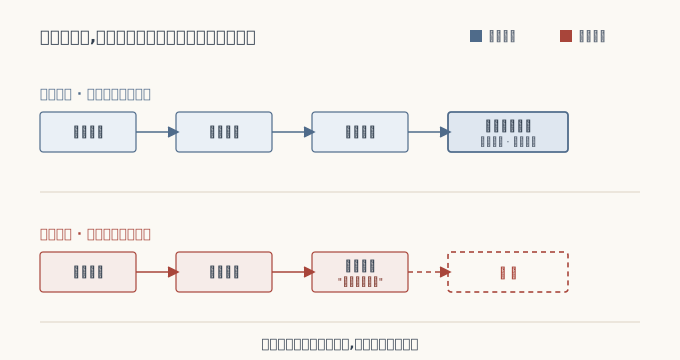
Zoom out and the whole AI capex chain is a string of IOUs linked end to end. My spending is your revenue; your revenue carries your profit; your profit fattens your valuation; your valuation gives you the nerve to keep ordering from me. As long as the loop stays closed, every dollar of spending is ratified by the next link as “growth,” and the more you spend the more it looks like expansion.
Reverse it. The moment a single link stops and asks, “why exactly am I paying for this?”, the spending along the whole chain flips — in the same instant — from asset back to liability. That is precisely what the market did on July 23. It didn’t stop believing in AI; it simply began calling names, one by one: this money — who claims it? Those with an answer rose. Those without watched their spending get re-priced back into mere spending, that same day.
At bottom, the market is a distributed computer, and what it computes is never the conviction behind your spending — it’s whether the capacity you built has real demand waiting to receive it. Conviction can be performed; a promise can be repeated as often as you like; the one thing that cannot be faked is a second person willing to pay. That is the least sentimental feature of a self-organizing order: it doesn’t listen to stories, it counts heads.
Early in a bull market, the market assumes every capex has a payer at the far end, so it only asks whether you dare to spend. Late in a bull market, it starts checking, link by link, who that payer is — so it only asks whether your money has anyone to claim it. The same spend is called nerve in the first phase and a black hole in the second. What changed isn’t the money. It’s whether the market is still willing to assume, on your behalf, that the payer exists.
In the end, capex was never a question about money. It’s a question about what is real. You can tell the market the grandest future you like; the one small thing it truly wants to know is whether anyone besides you will pay real money for that future, even once. Real demand can’t be manufactured, any more than a claimant can be conjured out of air. What people overestimate most is their gift for describing the future; what they underestimate most is how hard it is to get one other person to sign for it.
Whether a dollar counts as growth is never decided by the one who spends it — only by the one who claims it.
SECURE PAYMENT VIA STRIPE
Subscribe: $50 annual pass unlocks every paid article on this site for one year
Go deeper: Ko-fi members get a weekly members-only deep dive, from $3/month Become a member →