A Spot ETF Is Not a Floor, It Is a Two-Way Conveyor!
There is a claim that has hardened into consensus lately: spot ETFs have wired structural, institutional demand into bitcoin. This money comes from pensions, advisors, allocation books — not from retail chasing green candles. Once it arrives, the story goes, it holds for the long run and lays a solid floor under the price. Last week the story was told loudly. Bitcoin sat around sixty-four thousand dollars, spot ETFs logged seven straight days of net inflows totaling close to a billion, and the timeline filled with one line: the institutions are back, and the floor is thickening.
That claim treats the ETF as a reservoir that only fills — as if money, once poured into the channel, is locked inside, holding the price up for everyone.
Then came Thursday, July 23, US time. In a single day, the same funds shed more than 225 million dollars, and the seven-day streak snapped. What stung more: roughly ninety percent of that exit came from the one fund everyone had crowned the institutional anchor. The same channel that was a floor one week was a chute the next.
So the spot ETF never added a buyer to bitcoin. It did something else. It stripped out the friction of getting in and getting out — and friction was what the floor was made of.
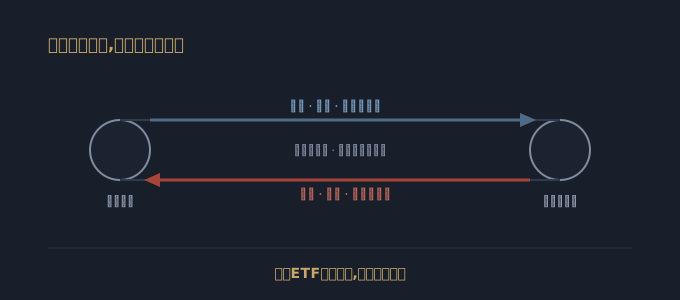
An ETF is not a reservoir; it is a conveyor. Buy a share and, behind the scenes, someone buys the matching bitcoin in the spot market. Redeem a share and, behind the scenes, someone sells it. The fund holds no opinion on direction. It simply carries whatever the share side does over to the spot side, unchanged. It is a pipe, not a cistern — and water in a pipe runs whichever way the open end decides.
Holding bitcoin used to carry friction: opening an exchange account, guarding private keys, worrying about custody. That friction was sandpaper — it slowed everyone trying to get in, and it slowed everyone trying to get out just as much. The ETF sanded it flat. No keys to touch; one click in, one click out. Everyone saw that entry got easier. Nobody did the other half of the arithmetic: exit got exactly as easy. Convenience never runs in only one direction.
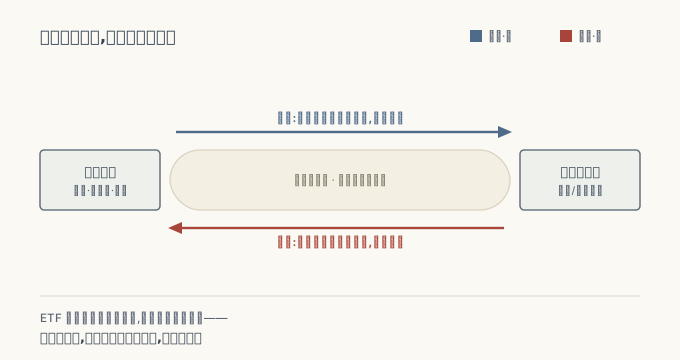
Read it forward and read it backward, and you see a mirror. When price rises, shares get bought, the conveyor feeds outside money into spot, the buying lifts price, and the higher price pulls in still more subscriptions — last week’s seven-day climb was the belt running one way. When price turns, shares get redeemed, the same conveyor runs in reverse at the same speed, hauling spot back out, the selling drags price down, and the lower price forces still more redemptions — Thursday’s 225 million was the belt running the other way. One motor, one belt: on the way up they call it structural demand, on the way down they call it structural supply. What changed was not the mechanism. It was the direction the belt turned.
The floor people longed for was never built out of money. It was built out of friction. What welds holders in place is not conviction; it is the hassle of leaving. That hassle is precisely what makes some people slow to run when panic comes — and that slowness is why the price does not shatter. Resent the friction, sand it away, and the floor goes with it. The ETF gave bitcoin a frictionless entrance no one had ever offered, and in the same stroke, it gave bitcoin a frictionless exit.
In that light, institutional money is no stickier than retail money. Stickiness is never decided by who the holder is; it is decided by how hard the exit is. An advisor’s allocation book and a retail chaser, facing the same silky redeem button, move their finger the same way. That ninety percent of Thursday’s outflow came from the largest, most “institutional” fund says it plainly: the steadiest money sits in the fastest lane out. It came in hardest, so it leaves quickest.
The deepest error a person makes is mistaking convenience for safety. You want a door you can walk through anytime, and you also want the people behind it locked in, holding the price up for you — but it is the same door. However easily you got in is however easily everyone else gets out; the smoothness you enjoyed is the smoothness they leave on. This is where a complex system shows no mercy: it will not hand the benefit to you alone. Every scrap of friction you removed applies to every direction and every holder, all at once.
However easily you got in is however easily everyone else gets out; a floor is never laid with money, it is laid with friction.
SECURE PAYMENT VIA STRIPE
Subscribe: $50 annual pass unlocks every paid article on this site for one year
Go deeper: Ko-fi members get a weekly members-only deep dive, from $3/month Become a member →