Rotation: the Side That Rallied Wasn't Chosen, It's the Crowded Trade's Shadow!
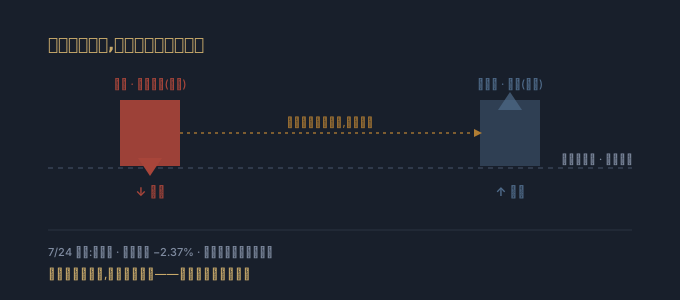
The most deceptive thing on a down day isn’t the drop. It’s the half of the tape that’s green.
At Friday’s close on July 24 (US Eastern), the Dow turned green, the S&P 500 sat almost exactly on the flat line, but the Nasdaq closed lower and technology led the entire tape down — while real estate and financials took over at the top. The numbers: the Dow up 0.46%, the Nasdaq down 0.64%, and the tech sector off 2.37% on the day. Intel beat earnings and its stock fell hard anyway. Wall Street had its line ready before the bell finished ringing: money is rotating out of the crowded AI trade into neglected value names, and breadth is finally broadening.
The most dangerous thing about the word “rotation” isn’t that it points the wrong way. It’s the word flow buried inside it — it makes you picture a pool of money with a thesis, one that weighed both sides and decided to sell tech and buy value. But behind Friday’s green, nobody was “bullish” on real estate, and nobody woke up in love with bank stocks. The side that rallied wasn’t chosen by anyone. It was bought as the mirror image of the side that was falling.
Money moving from A to B can be two entirely different events. First: A and B each have their own fundamentals, the market reprices them separately, and total exposure is rising — that is healthy broadening, the market distributing its computation across a longer list of winners. Second: only A, a single crowded trade, is coming apart; the money scrambles for the exit, total exposure is shrinking, and it lands on B for one reason only — B is the opposite of A. That isn’t broadening. That’s de-risking.
On a one-day heatmap the two look identical: A red, B green. The difference isn’t the color. It’s whether the pool of money got bigger or smaller, whether anyone actually cast a vote for B’s future. Thursday, the megacap techs were hammered, shedding hundreds of billions in a single session. Friday, no new money appeared out of thin air — it was the same money, spooked out of AI, looking for somewhere that isn’t called AI to sit.
Why did it land on real estate and financials specifically? Because those two are the most rate-sensitive groups on the board. Oil had pulled back, the inflation worry eased a notch, and the Fed’s rate decision was right around the corner — so going long them is a bet that money gets cheaper. What actually traded on Friday wasn’t “the real economy is recovering.” It was “rates are about to loosen” plus “I need to get away from AI.” It’s a rate bet wearing a recovery costume; it’s fleeing money holding up a “rotation” sign.
Not a single new fact about the real economy appeared in those 24 hours. Real estate didn’t improve between Thursday and Friday; bank loan books didn’t heal overnight. Only one thing changed: the most crowded trade started leaking air. Every tick the laggards gained wasn’t earned by them — it was reflected off tech’s fall. They’re the shadow, not the light source.
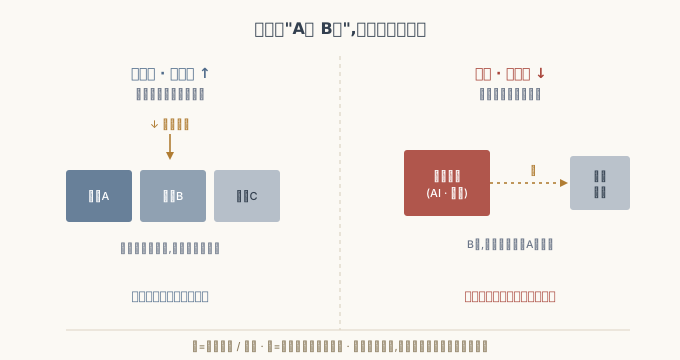
This is where the word “rotation” does its real damage: it translates a de-risking into a switch, and quietly rewrites fear as confidence. You hear “money is rotating” and you picture the market broadening healthily, the drop digested, the risk spread around. What’s actually happening beneath the tape is a crowded trade — one held up by its own self-reinforcement — beginning to unwind. On the way up, the more it rose the more people bought, and the more they bought the more it rose. On the way down, that loop just runs in reverse: the more it falls the more people sell, and the cash that comes out parks somewhere else first, so somewhere else turns green. That green is nothing but this red, reflected.
So to tell true breadth from fake rotation, the age of the trend is your ruler. When a trend is healthy, the broadening is real: money adds to the leaders and spills over into what hasn’t run yet, the total is expanding, the market is lengthening its list of winners. After a trend tops, the “broadening” is fake: the money isn’t growing, it’s just relocating inside a shrinking pool, from the hottest corner to the least-hot one — and calling that relocation “rotation.” Same A-down-B-up. The first is the market computing more future. The second is the market finding a place to park the same fear.
At bottom, telling these apart has nothing to do with which sector is green. It’s about whether the pool of money is expanding or contracting. The market is never short of a green corner. What it’s short of is a moment when someone is willing to bet one more unit on the future. Money that will genuinely take on risk grows the exposure. Money that only wants to survive the day just slides from one square to another inside the same-sized board — and lets itself be called rotation.
The tenderness of the word “rotation” is precisely that it pretends nothing was lost. But the market’s ledger is honest: the sectors that rose borrowed their color from the sectors that fell, and borrowed no new confidence from anywhere.
The rocks the ebbing tide uncovers first are the ones that look most like new land.
SECURE PAYMENT VIA STRIPE
Subscribe: $50 annual pass unlocks every paid article on this site for one year
Go deeper: Ko-fi members get a weekly members-only deep dive, from $3/month Become a member →