Memory Isn't AI's Thermometer, It's the Tip of the Whip!
There is a question all over the tape this week: if AI is so strong, why is memory crashing?
The trigger is real. On Monday, July 27 (ET), memory chips led the entire semiconductor complex lower; the flash leader lost a big chunk in a single session, and the three memory giants were dragged into a bear market together. Yet only days earlier they had posted record revenue and said the high-bandwidth memory that feeds AI accelerators — HBM, the fast memory bolted next to the compute — was sold out, booked well into future quarters. So everyone lands on the same puzzle: the hand is still raised high, so why did the tip hit the ground first?
That puzzle treats memory as a thermometer of AI demand — as if its fall measures AI cooling.
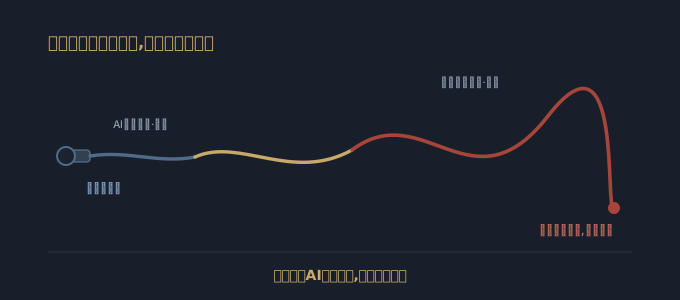
It was never a thermometer. Memory is a long whip the AI supply chain cracks, and what broke this week is the tip — the segment farthest from the hand.
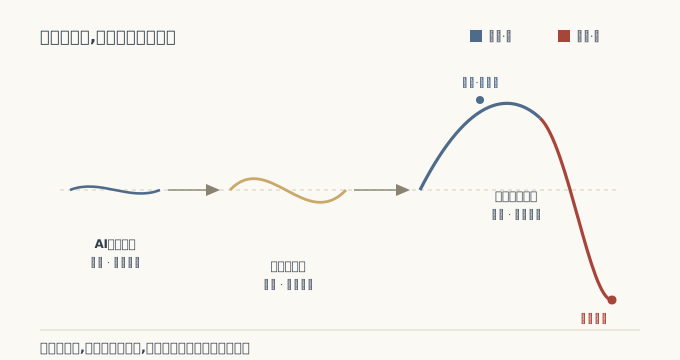
Supply chains have an old name for this: the bullwhip effect. A small wiggle in end demand travels up the chain, and the farther upstream it goes, the wider it swings. The hand moves an inch; the tip travels a yard. AI compute demand is the hand. Commodity memory — the plain DRAM and NAND anyone can fab — is the tip. Lift the hand and the tip shoots to the sky: rising prices, sold out, record revenue. Pause the hand, and the tip is what slams down hardest. What falls hardest is never where demand is weakest — it is where the amplification is greatest.
And the whip is not one uniform cord. The word “memory” hides two things. The high-bandwidth memory AI needs sits behind a steep technical moat, owned by a handful of makers, still sold out. The commodity bits are standardized, low-barrier, anyone-can-build — and cheap new capacity is breaking ground. What the market clubbed this week was not “memory” in the abstract; it was the half of the whip with no moat. What is cracking is not AI, but the part that has been commoditized.
Then what about that record revenue? Revenue is the rear-view mirror — it shows the road already traveled. The stock price is the windshield — it stares at the bend ahead. The harder a business pins prices to the ceiling and sells out, the louder it hands every rival an invitation: come in, the money is here. Every plant breaking ground today is a brick in the oversupply of the year after next. The price is not counting today’s profit — it is pricing a glut that has not arrived but is already being poured. In that sense, record revenue is not a margin of safety; it is the glut under construction.
This is the oldest reflexive loop in commodities: scarcity lifts price, high price summons capacity, capacity kills the scarcity with its own hands. On the way up — sold out, marked up, queued up, record after record — every line is fuel for the next glut. Once the tip swings to its peak, AI need not cool at all; the whip’s own momentum is enough to snap it back. A boom like this is not popped from outside; it is fattened by itself and crushed by itself.
So don’t rush to ask whether AI is done. The hand is still raised, steady. The tip’s collapse does not measure the strength of the hand — it measures how many times over the whip amplifies every small move the hand makes. The costliest human habit is to take an accelerating line and pencil it a little further into the sky: to assume sold out stays sold out, that record stays record. Complex systems never reward that straight-line extrapolation; the bullwhip is the backlash they keep on hand for linear minds. Memory is not AI’s thermometer. It is the whip — and the tip, farthest from the hand, always swings the highest and falls the hardest.
The segment that cracks hardest is always the one farthest from the hand that holds the whip.
SECURE PAYMENT VIA STRIPE
Subscribe: $50 annual pass unlocks every paid article on this site for one year
Go deeper: Ko-fi members get a weekly members-only deep dive, from $3/month Become a member →