Nvidia Isn't Backstopping OpenAI. It's Backstopping Its Own Order Book!
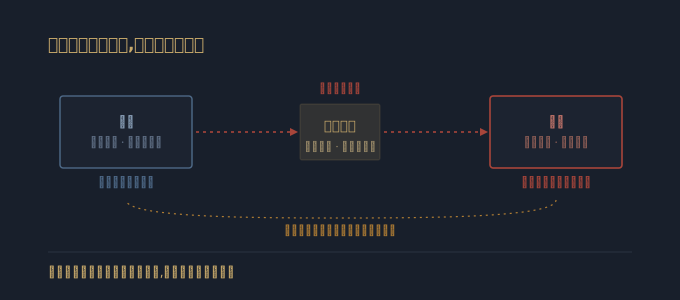
Nvidia fell nearly 5% on Monday, July 27. The trigger was a report that the company is in talks to provide up to $250 billion in guarantees so OpenAI can lease compute from a data center project in Ohio. The market value it shed that day was roughly the same size as the sum it is preparing to guarantee.
The reassurance arrived within hours: a guarantee is not an investment. It costs no cash, touches no income statement, and merely provides credit enhancement to a large customer. Trouble, if any, is years away. Today it is only a piece of paper. Every word of that is true, and it skips the only part that matters — it is useful precisely because it costs nothing today.
A piece of paper conjures no buyer out of thin air. It buys one specific risk — whether OpenAI can pay the rent — off the landlord’s book and onto Nvidia’s own. A guarantee does not create demand. It moves the credit risk of demand off the buyer’s side and onto the seller’s.
Look at the two ends of the trade. OpenAI wants the compute but cannot produce the credit the landlord requires. Nvidia signs, the lease exists, the order exists, the revenue lands on Nvidia’s statements. This is not charity. It is procurement — and what is being procured is not silicon or power. It is the buyer’s eligibility to be a buyer.
Capped Upside, Uncapped Downside
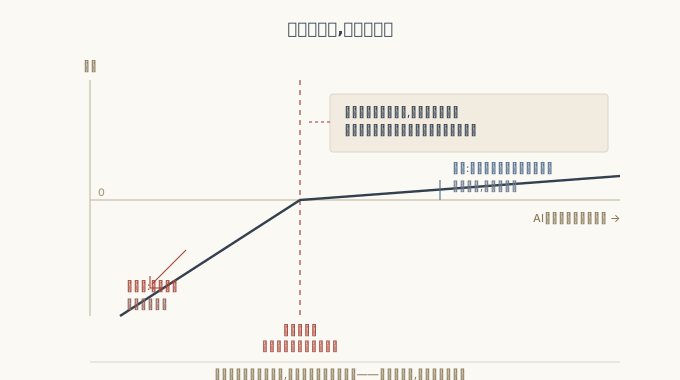
Price it as a business. What is the upside? The gross margin on that order — real, finite, and long since written into everyone’s expectations. What is the downside? Lease principal, paid in cash by Nvidia on the day OpenAI cannot pay it. The upside has a ceiling. The downside has no floor.
That is not the shape of a business. It is the shape of an option, written by the seller. Nvidia is not acting as an investor here; it is acting as an insurer — one whose premium happens to be its own revenue line.
Insurance works only when claims and premiums are uncorrelated: whether a house burns has nothing to do with how many policies the insurer sold. This guarantee inverts that. The day OpenAI cannot pay rent is the day AI capital spending has broken — and on that day Nvidia’s own order book is breaking, its stock is falling, its rating is under review, and its cost of debt is at its worst. The moment the claim triggers is the moment it can least afford to pay. It has not underwritten some outside risk. It has underwritten the ground it is standing on. This isn’t diversifying a risk; it’s buying the same risk twice.
One Piece of Paper, Two Faces
While demand runs hot, the paper is free: no cash out, no drag on earnings, and it pulls an order that hasn’t happened yet into today’s revenue. Reverse it. When demand breaks, the same paper becomes a liability payable in hard cash, coming due at the precise moment cash is scarcest and outside funding dearest. Not a word of the contract has changed. What changed is which end of the cycle it is standing on — an accelerator of revenue on the way up, an amplifier of loss on the way down.
Put it back into the whole chain and the loop closes. Nvidia’s credit lets OpenAI borrow; the borrowed money becomes an order placed with Nvidia; the order becomes revenue and profit; profit supports the stock and the rating; a firmer rating lets it write a larger guarantee. Every link is real. Together they admit not one dollar from outside. The loop turns wider and wider, and there is still only one financier in it.
Real demand is millions of unrelated buyers each casting a vote. It carries information precisely because whoever pays decides for themselves whether to pay. Once demand requires the seller’s signature to exist, the list of buyers grows shorter and the votes start coming from the same hand. Early in a trend, orders come from everywhere and the buyers do not know one another. Late in a trend, orders concentrate in a handful of buyers whose credit the seller itself is propping up. Demand has not disappeared. Demand has begun to be manufactured by the seller.
Equities Ask What It’s Worth; Credit Asks Whether It Can Pay
The signal worth watching wasn’t the share price. Another market moved the same day, and it moves far less often: the cost of insuring Nvidia’s bonds jumped about 20% in a session — protection on $100 million of Nvidia debt went from a bit over $600,000 a year to a bit over $800,000. According to ICE Data Services, that was the largest single-day jump since these contracts began trading actively last November.
The two markets are not asking the same question. That 5% in equities asks what the company is worth. This jump in credit asks whether it can pay. Equity markets will pay for a story; credit markets almost never do. When a company’s share price and its default protection move on the same day, believe the second one — equity owns the upside, credit watches the downside, and a guarantee only ever comes alive in the downside world.
There is a further arrangement still under evaluation: financing OpenAI’s purchases of Nvidia chips directly. Take that step and even the lease drops out of the middle. The seller supplies the money, the buyer uses it to buy the seller’s product, and revenue is recognized as cleanly as ever — except the money never once leaves the loop. At that point the word “demand” retains only an accounting meaning.
Ultimately, a market is a computer assembled out of millions of unrelated judgments, and demand is information only because the party paying made up its own mind. When the seller starts signing for the buyer’s ability to pay, the machine stops computing the future and starts certifying it. A signature can make an order exist today. It cannot make demand arrive. The harder anyone works to manufacture demand on the system’s behalf, the more plainly they are conceding there isn’t enough of it.
What a guarantee underwrites is never the buyer's credit. It is the seller's own order book.
SECURE PAYMENT VIA STRIPE
Subscribe: $50 annual pass unlocks every paid article on this site for one year
Go deeper: Ko-fi members get a weekly members-only deep dive, from $3/month Become a member →