The Rate Isn't Decided by the Fed — It's Computed by the Market!
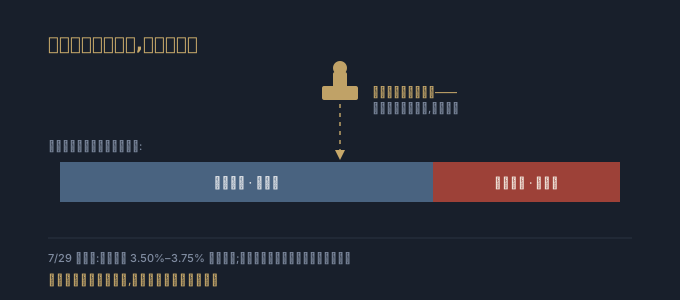
There is one sentence scrolling across every screen this morning: the world holds its breath, waiting to see what the Fed decides today. At 2:00 p.m. Eastern the statement lands; at 2:30 the new Chair takes questions. The sentence sounds self-evident — and it has the causation backwards. It assumes the rate is something the Fed settles this afternoon, with the market waiting outside the door for an answer.
The rate isn’t decided by the Fed this afternoon. It was computed by the market over the past two weeks. The paper released at two o’clock stamps a sum the market has already worked out.
Think of the rate market as a giant computer spread out across the floor. Millions of positions — every party willing to lend or borrow at some price — feed their read on the future into it, and it aggregates them into a single figure: the odds that the next move is hold, hike, or cut. No center runs it, no one conducts it; on its own it grinds everyone’s view of inflation, of growth, of oil into a probability. On an ordinary meeting, by the eve, the machine has already converged: ninety-five out of a hundred betting hold, the door shut. At that point the Fed walks into the room to face an answer already computed, and what it does is ratify it. A converged meeting, in the end, is a non-event — the market did the problem for it; the Fed only reads it aloud. The rate has sat above three percent, held for the fifth meeting running, and quarter after quarter most meetings have been exactly this kind of non-event.
But today the machine has not converged. Two weeks ago it leaned almost entirely to hold — fewer than one in ten betting a hike. Then oil punched into three digits, the inflation cloud rolled back in, and in nine days the machine repriced the hike bet from roughly one in ten to better than one in three — one of the fastest recomputations in recent memory. Note this: across those two weeks the Fed said nothing, published no dots, the Chair stayed silent. What changed was not the Fed’s mind — it was the machine recomputing in real time. It read a new oil price and changed its answer.
So what is genuinely undecided today is not what the Fed will do, but that the market itself hasn’t finished computing. The Fed reads the same oil screen, the same price sheet, as you and I; it has no extra pair of eyes. That one-in-three is not the Fed hesitating — it is the market splitting.
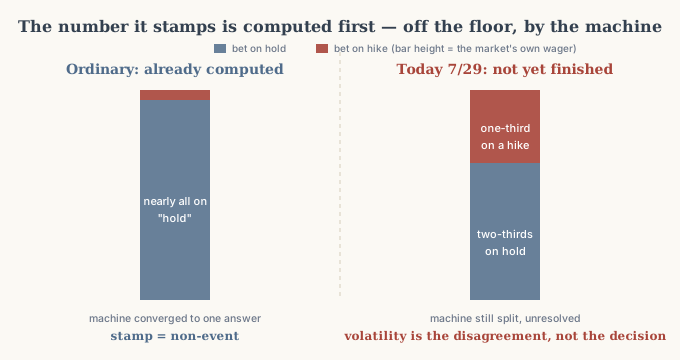
The danger in a meeting was never in the Fed’s hands; it is in the width of the disagreement. When the machine has converged — ninety-five on one side — it barely matters where the statement lands; almost no one is caught wrong, and the tape lies still. When the machine is split — two-thirds against one-third — the instant the statement drops, a whole crowd is on the wrong side at once and has to turn on a dime and re-position overnight. That volatility is not conjured by the Fed doing something dramatic; it is the unfinished disagreement, force-settled by a single sheet of paper. Put differently: the quieter the tape, the more the market has already done the Fed’s work; the more violent the tape, the less the market had managed to agree.
There is a reflexive loop coiled inside this. The Fed sets policy watching financial conditions and market expectations; the market bets watching the Fed’s every move; the two stare at each other, feed each other, and the loop normally converges to a consensus on its own. Yet this meeting, of all of them, carries no dot plot — no sheet of the Fed’s own forecasts. The loudest ritual on an ordinary decision day is the crowd gathered around the dots, interrogating the numbers in a few officials’ heads, as if the answer were locked in the Fed’s drawer. Today the drawer is empty, and the new Chair intends to say even less than the last. That, precisely, strips the illusion away: the answer was never inside the Fed. With the drawer empty, the only map on the field is the one the market drew itself — the odds. The Fed was never the cartographer. The market draws the map.
In the end, people crave an authority who “knows the answer” at a moment like this: a center that can rule, settle the matter, carry the weight for everyone. But this number, the rate, was never gaveled down by one person in one room. It is a probability that millions of unreconciled, contradictory judgments computed into being on their own. The Fed is, at most, the machine’s first reader — it leans in to the odds already formed, reads out the nearest rung, and presses its stamp. To wish for one button in place of a whole distributed computation is the oldest human arrogance, and complex systems have only ever punished the hand on the button. What the breath-holding was waiting on, it turns out, was never an answer. It was a computation that hasn’t converged.
The rate was never anyone's decision; it is a number everyone computes — the Fed is only the first to read it aloud.
SECURE PAYMENT VIA STRIPE
Subscribe: $50 annual pass unlocks every paid article on this site for one year
Go deeper: Ko-fi members get a weekly members-only deep dive, from $3/month Become a member →